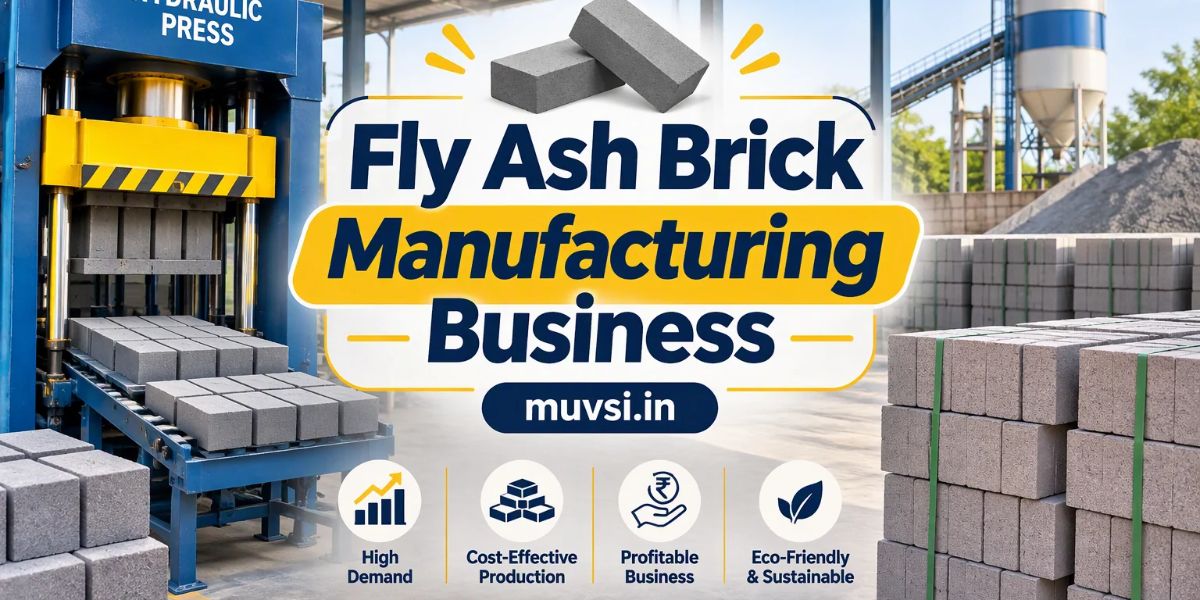
Starting a fly ash brick manufacturing business in India is a practical, high-demand construction-material venture—especially for founders located near thermal power plants, industrial corridors, and growing tier-2 and tier-3 towns. Because bricks are heavy and transport costs rise sharply over long distances, producing uniform, high-strength bricks close to active building sites gives local plants a strong delivered-cost advantage.
Unlike traditional red clay bricks that strip fertile topsoil and require kiln firing, fly ash bricks repurpose industrial fly ash generated by thermal power stations into dense, dimensionally uniform masonry bricks. Whether you are evaluating a compact hydraulic setup or comparing it with a medium-scale manufacturing business, profitability depends on raw-material freight, mix discipline, proper curing, and buyer trust.
This guide covers hydraulic plant costs (₹15 lakh to ₹35 lakh), proven mix ratios, curing and yard space planning, BIS standards, and PMEGP financing.
Why Fly Ash Brick Manufacturing Works Near Thermal Power Belts
- Local Raw Material & Freight Edge: Founders near coal-based thermal power stations can source fly ash directly or via authorised arrangements, keeping input costs competitive while supplying nearby builders, contractors, and housing plots.
- Superior Dimensional Uniformity & Lower Mortar Use: Machine-pressed bricks have sharper edges and more consistent dimensions than irregular hand-moulded clay bricks, helping masons achieve thinner mortar joints and smoother plastering.
- Growing Institutional & Contractor Adoption: Builders and public/private construction projects increasingly evaluate fly ash bricks based on strength, uniformity, and compliance with Indian standards.
Hydraulic Press Plant Cost (₹15 Lakh – ₹35 Lakh) & Scale Options
A fully automatic or semi-automatic fly ash brick manufacturing business using a hydraulic press typically requires a total project outlay of ₹15 lakh to ₹35 lakh depending on press tonnage, automation level, batching/mixing setup, pallet handling, and working capital. You can compare verified equipment vendors through our industrial machinery suppliers directory.
New ebook from MUVSI
Starting a factory? Read this before you buy a machine.
UDYOG SAATHI is a practical guide for first-time manufacturers in India: 46 chapters on checking demand, costing your factory, funding it and, above all, selling.
Get the ebook, ₹299Instant PDF download. Built for reading on your phone.
Plant Configuration | Indicative Output | Indicative Total Cost | Best Fit For |
|---|---|---|---|
Compact Hydraulic Press Unit | ~6,000 – 10,000 bricks/shift | ₹15 Lakh – ₹22 Lakh | First-time MSME founders serving local builders & plots |
Standard Automatic Hydraulic Line | ~12,000 – 18,000 bricks/shift | ₹23 Lakh – ₹35 Lakh | Steady regional contractor, housing & commercial supply |
Key Machinery in a Hydraulic Fly Ash Brick Plant
- Hydraulic Brick Press: Compresses the raw mix under high hydraulic pressure into uniform solid bricks (and can often take interchangeable moulds for blocks or pavers depending on press design).
- Pan Mixer / Counter-Current Mixer: Blends fly ash, aggregates/sand/stone dust, binder, and water into a consistent, workable mix.
- Conveyor Belts & Hopper / Batching Bins: Feed raw materials into the mixer and move pressed bricks or pallets smoothly without manual bottlenecks.
- Pallets, Stackers & Three-Phase Electrical Panel: Supports green bricks during transfer and curing while maintaining steady power and safety controls.
Fly Ash + Cement + Gypsum Mix Ratio & Formulation
There is no single rigid formula for every plant—exact proportions depend on the quality and reactivity of your fly ash, local aggregate availability, target brick strength class, and whether you use lime or cement as the primary binder. Formulations commonly blend fly ash (often around 50%–65% in typical commercial mixes), sand or stone dust/quarry fines, a cementitious/lime binder, and gypsum to regulate setting and strength development.
- Fly Ash: Forms the core pozzolanic base; check fineness, loss on ignition (LOI), and moisture consistency from your supply source.
- Sand / Stone Dust / Quarry Fines: Provides granular skeleton and packing density to reduce shrinkage and improve dimensional stability.
- Cement (and/or Lime): Supplies binding strength; optimise binder percentage against current cement/lime prices and target compressive strength.
- Gypsum: Supports controlled setting and strength gain in fly ash–lime/binder systems—test trial batches before locking your standard recipe.
Golden Rule on Mixes: Always run trial batches and test cured samples rather than copying a generic ratio blindly. Slight shifts in fly ash fineness, moisture, or stone-dust silt content change water demand and compressive strength.
Curing Space, Yard Layout & Workflow Planning
Many new founders budget for the hydraulic press and forget how much land is needed to hold bricks while they cure and cure-stack before dispatch. Plan your site layout around uninterrupted material flow:
- Raw Material Storage: Covered, dry storage for cement, lime, and gypsum (protected from moisture), plus segregated bays for fly ash and stone dust/sand.
- Production & Pallet Movement Area: Enough room around the mixer, hydraulic press, and conveyors for forklift/trolley movement and safe operator clearance.
- Curing & Dispatch Yard: Dedicated curing zone (water curing or steam/controlled curing per your process) plus stacking space for cured inventory so fresh daily output never clogs the press.
BIS Standards & Quality Checks
In India, pulverised fuel ash–lime bricks are governed by IS 12894 (alongside testing methods such as IS 3495 for compressive strength, water absorption, efflorescence, and dimensions, and relevant fly ash/lime standards). Even if you do not hold a formal BIS license on day one, building your batching and testing habits around IS benchmarks helps win serious contractors and institutional buyers.
- Compressive Strength: Verify sample batches periodically so your bricks match the strength class required for partition, boundary, or load-bearing masonry.
- Water Absorption & Dimensional Tolerance: Check brick size consistency, straight edges, and water absorption so masonry work stays predictable and waste stays low.
- Curing & Handling Discipline: Protect green bricks from premature drying, rain damage, or rough handling that chips corners before curing completes.
Registrations, PMEGP Eligibility & Buyer Acquisition
- Business & Statutory Registrations: Register your entity, obtain Udyam Registration and GST registration, and check local municipal/industrial trade permissions as well as State Pollution Control Board (SPCB) requirements for your state and site.
- PMEGP Loan & Subsidy Planning: Eligible new manufacturing micro-enterprises can apply under PMEGP (15% to 35% margin-money subsidy on manufacturing projects up to ₹50 lakh project cost), subject to scheme guidelines, bank appraisal, and eligibility criteria. Estimate your loan and subsidy split using our PMEGP loan and subsidy calculator.
- Sell Directly to Builders & Material Suppliers: Approach local civil contractors, house builders, real estate developers, and building-material dealers with sample bricks, clear delivery schedules, and transparent per-brick or per-thousand pricing.
FAQs
How much does a hydraulic fly ash brick manufacturing plant cost in India?
A hydraulic fly ash brick setup typically requires a total project cost of ₹15 lakh to ₹35 lakh depending on press capacity, automation, mixer/conveyor setup, site readiness, and working capital.
What is the typical mix ratio for fly ash bricks?
Commercial formulations generally combine fly ash, sand or stone dust, a binder such as cement or lime, and gypsum with controlled water—exact ratios should be tuned through trial batches based on raw-material quality and target strength.
How much space is needed for curing fly ash bricks?
You need enough open/covered yard space to hold multiple days of production during curing plus dispatch stacking without blocking the hydraulic press—exact area depends on daily output and your curing cycle.
Which BIS standard applies to fly ash bricks in India?
IS 12894 is the key Indian Standard specification for pulverized fuel ash–lime bricks, supported by standard brick testing methods under IS 3495.
Is a fly ash brick manufacturing business eligible for PMEGP?
Yes, eligible new manufacturing micro-units can apply under PMEGP for margin-money subsidy (15% to 35% up to ₹50 lakh manufacturing project cost), subject to official scheme rules and bank approval.
About to commit capital to machinery, space, or a loan or subsidy application?
Get a practical 1-on-1 review of your budget, equipment choices, and setup sequence before spending money—guided by 20+ years of hands-on SME business and marketing experience.

Rupak Chakrabarty is the Founder and Lead Business Coach at MUVSI. With over two decades of experience in entrepreneurship, marketing, and business consulting, he helps aspiring entrepreneurs and MSMEs build profitable, market-driven businesses. His expertise includes business planning, B2B marketing, customer acquisition, and digital growth strategies.