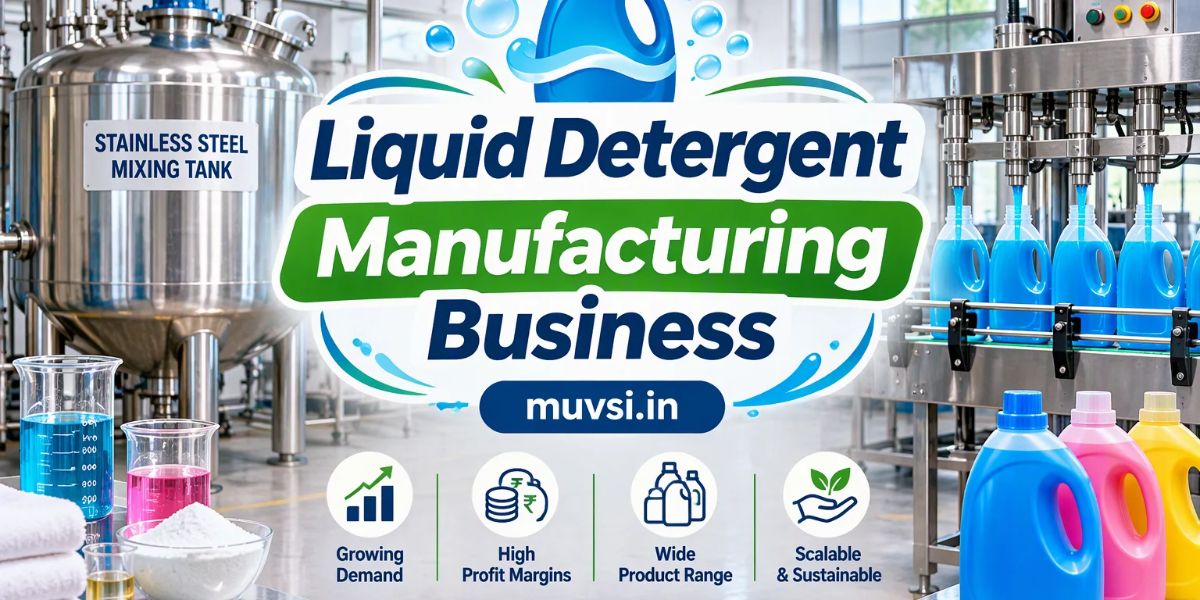
Starting a liquid detergent manufacturing business in India is one of the most accessible low-investment production ideas for new MSME founders. Liquid laundry detergents, dishwashing liquids, and multi-purpose surface cleaners use straightforward batch blending rather than heavy mechanical pressing or high-temperature kilns, allowing you to launch within a compact ₹2 lakh to ₹8 lakh budget.
Even better, cleaning liquids are fast-moving consumables with frequent repeat orders. Once a household, hotel, hospital, or housing society switches to a reliable, cost-effective cleaning formula, refill demand recurs every few weeks—whether you start as a compact micro-unit or scale toward a medium-scale manufacturing business.
This guide covers practical batch formulation basics, SS mixing tank and filling machine specs, key chemical raw materials, bottle/can packaging economics, PMEGP financing, and B2B institutional selling.
Why Liquid Detergent Is Strong for Low-Investment Founders
- Modest Capital & Fast Setup: A starter blending and semi-automatic or manual filling setup fits inside 400 to 1,000 sq. ft. with standard single-phase or three-phase power, keeping initial capital requirements low compared to heavy machinery lines.
- High Repeat Consumption: Dishwashing gel/liquid, laundry liquid, floor cleaners, and hand/surface cleaners get used up continuously, creating recurring monthly reorders when quality and viscosity stay consistent.
- Dual Retail + B2B Institutional Reach: You can sell retail pouches/bottles through local stores while supplying bulk 5-litre, 20-litre, and 35-litre cans to hotels, hospitals, schools, offices, and residential complexes.
Startup Investment Tiers (₹2 Lakh – ₹8 Lakh+)
Keep your initial capital split realistic: reserve roughly 35% to 45% of your budget for raw chemicals, bottles/cans, labels, and initial stock rather than locking everything into equipment.
New ebook from MUVSI
Starting a factory? Read this before you buy a machine.
UDYOG SAATHI is a practical guide for first-time manufacturers in India: 46 chapters on checking demand, costing your factory, funding it and, above all, selling.
Get the ebook, ₹299Instant PDF download. Built for reading on your phone.
Setup Tier | Indicative Batch / Daily Scale | Indicative Total Investment | Best Fit For |
|---|---|---|---|
Lean Starter Unit | ~100 – 250 litres per batch | ₹2 Lakh – ₹4.5 Lakh | First-time founders testing local retail & housing societies |
Standard Commercial Unit | ~300 – 500+ litres per batch | ₹5 Lakh – ₹8 Lakh | Steady regional distributors, hotels, hospitals & bulk cans |
SS Mixing Tank & Filling Machine Specs
Because surfactants, acids/alkalis, and cleaning agents can corrode ordinary mild steel or react poorly with improper vessels, use food/chemical-grade stainless steel—typically SS 304 for general liquid detergent/dishwash/cleaner batches, or SS 316 where higher chloride/corrosive exposure is expected. You can browse verified machinery vendors through our industrial machinery suppliers directory.
- SS Mixing Tank (Agitator Kettle): Typically 100 L to 500 L capacity in SS 304 with a dished or conical bottom for clean draining, a gear-motor stirrer/agitator (often ~1 HP to 2 HP depending on batch volume and viscosity), and a bottom discharge valve.
- Holding / Settling Tank: A secondary SS tank (or food-grade HDPE tank for compatible neutral/mild formulations) used to rest batches so entrained air bubbles escape, and foam settles before bottling.
- Liquid Filling Machine: Starter units often use gravity/volumetric piston or gear-pump fillers (single-head or double-head semi-automatic fillers) suitable for free-flowing to medium-viscosity liquids, paired with a handheld or semi-automatic capper and batch coder.
- Basic Quality & Lab Tools: Digital pH meter or pH strips, digital weighing scale, measuring cylinders, and viscosity/clarity check jars to ensure every batch matches your standard.
Batch Formulation Basics & Key Raw Materials
A liquid detergent manufacturing business relies on simple cold/warm mixing and pH balancing rather than complex chemical synthesis, but every ingredient plays a functional role—and raw materials typically account for the largest share of operating cost. Always work with a qualified formulator or technical supplier and run small test batches to check clarity, foam stability, skin mildness, and shelf-life separation.
- LABSA (Linear Alkyl Benzene Sulphonic Acid / Acid Slurry): An anionic surfactant widely used in cleaning formulations; because LABSA is acidic, it requires careful neutralisation (commonly with caustic soda lye/solution or triethanolamine depending on the formulation) and pH verification so the finished product is safe and stable.
- SLES (Sodium Lauryl Ether Sulphate): A widely used foaming surfactant that boosts lather, grease-cutting/cleaning performance, and mildness in dishwashing liquids and liquid detergents.
- Caustic Soda (Sodium Hydroxide): Used carefully as a neutralizing/alkaline agent (especially when neutralising LABSA) or in specific heavy-duty/industrial cleaner formulas—requires strict PPE (gloves, goggles, apron) and controlled addition to avoid overheating or hazardous splashing.
- Supporting Additives: Water quality (softened/DM or clean filtered water prevents cloudiness and mineral precipitation), hydrotropes/solubilizers, thickeners/salt or rheology modifiers (adjusted carefully so viscosity stays stable), preservatives, colourants, and fragrances.
Packaging Bottle Costs & Format Strategy
For liquid products, packaging containers, caps, labels, and outer cartons often cost nearly as much as the liquid inside—especially for small 250 ml to 1 litre packs. Source bottles and jerrycans from local blow-moulding suppliers near your city to save on freight.
- Retail Bottles & Pouches (250 ml, 500 ml, 1 Litre): HDPE or PET bottles with flip-top/screw caps and waterproof/BOPP labels for kirana stores and local supermarkets; check cap-seal leak testing so bottles do not leak in transit.
- Bulk Institutional Cans (5 Litre, 20 Litre, 35 Litre): Heavy-duty HDPE jerrycans with tamper-evident caps and sturdy handles cut per-litre packaging cost sharply for commercial and institutional buyers.
How to Sell B2B to Hospitals, Hotels & Housing Societies
Retail shelves can be slow and credit-heavy for a new brand. Pairing local retail with direct B2B institutional sales often generates faster, more predictable repeat orders:
- Hotels, Restaurants & Caterers (HoReCa): Pitch 5L and 20L dishwashing liquids, degreasers, and floor cleaners by offering a free trial sample can and demonstrating consistent grease-cutting performance at a fair per-litre cost.
- Hospitals, Clinics & Diagnostic Centres: Focus on hygiene reliability, odor/residue cleanliness, sealed tamper-evident cans, and consistent batch-to-batch supply.
- Housing Societies & Facility Managers: Resident welfare associations (RWAs) and facility maintenance teams regularly buy floor cleaners, glass/surface cleaners, and common-area cleaning supplies in bulk cans—especially when you provide clean GST invoices and dependable delivery schedules.
Licenses, PMEGP Financing & Quality Standards
- Business & Statutory Registrations: Register your entity, get Udyam Registration and GST registration, and check local municipal/industrial trade licenses as well as State Pollution Control Board (SPCB) consent rules for your state and scale.
- Quality & BIS Benchmarks: Maintain batch records, pH checks, and shelf-life stability logs, and review relevant Bureau of Indian Standards (such as IS 2905 / IS 6047 where applicable to synthetic detergents and scouring/cleaning products) as you scale.
- PMEGP Loan & Subsidy Option: Eligible new manufacturing micro-enterprises can apply under PMEGP for margin-money subsidy (15% to 35% on manufacturing projects up to ₹50 lakh project cost), subject to official scheme rules and bank approval. Estimate your loan and subsidy split using our PMEGP loan and subsidy calculator.
FAQs
How much investment is needed to start a liquid detergent manufacturing business in India?
A practical starter setup typically requires ₹2 lakh to ₹8 lakh depending on SS mixing tank and filling machine capacity, packaging stock, and initial working capital.
Which raw materials are used in liquid detergent manufacturing?
Common inputs include surfactants like SLES and LABSA (acid slurry), neutralising agents such as caustic soda (handled with strict safety and pH control), water, thickeners/additives, fragrance, and packaging bottles or cans.
Is liquid detergent manufacturing profitable for small startups?
Yes, when you control raw chemical and bottle costs, prevent batch spoilage or leaks, and build repeat volume through local shops, hotels, hospitals, and housing societies.
How do I get B2B orders from hotels, hospitals, and housing societies?
Start with local outreach using sample cans, clear per-litre pricing in 5L to 20L packs, reliable delivery schedules, and proper GST billing so facility managers and procurement buyers can reorder easily.
About to commit capital to machinery, space, or a loan or subsidy application?
Get a practical 1-on-1 review of your budget, equipment choices, and setup sequence before spending money—guided by 20+ years of hands-on SME business and marketing experience.

Rupak Chakrabarty is the Founder and Lead Business Coach at MUVSI. With over two decades of experience in entrepreneurship, marketing, and business consulting, he helps aspiring entrepreneurs and MSMEs build profitable, market-driven businesses. His expertise includes business planning, B2B marketing, customer acquisition, and digital growth strategies.