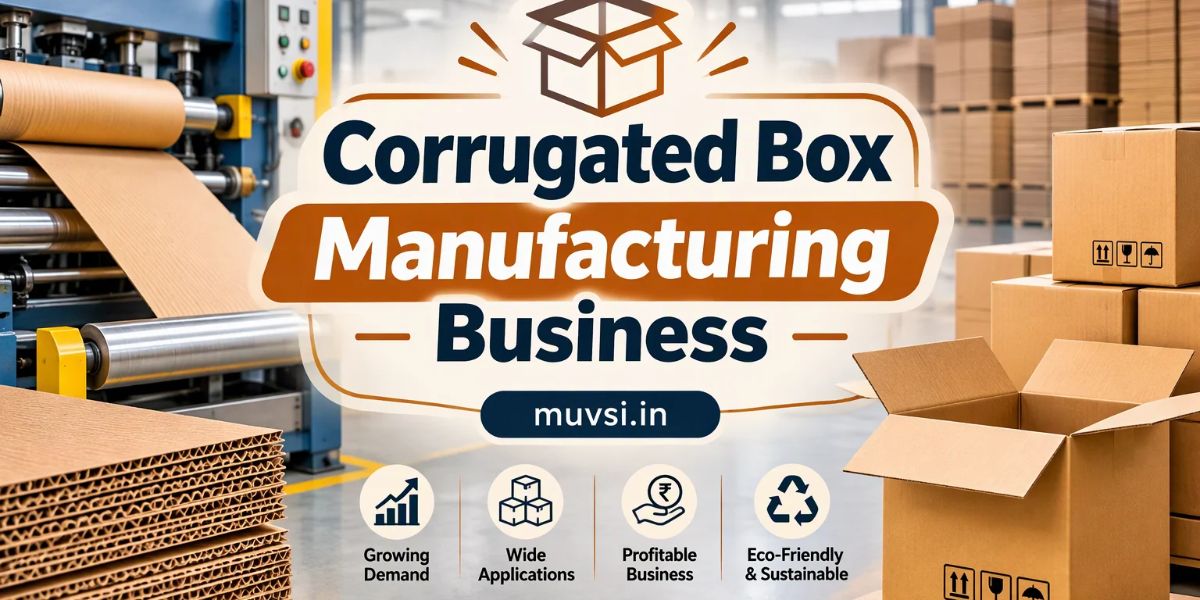
Starting a corrugated box manufacturing business in India is one of the most practical industrial B2B opportunities for MSME founders. Every e-commerce shipment, FMCG carton, pharmaceutical box, textile bale, and engineering spare part needs sturdy corrugated board packaging—and because freight costs eat into bulky boxes quickly, local buyers prefer nearby regional suppliers.
Unlike consumer fads, demand for corrugated cartons scales directly with commercial activity, retail expansion, and industrial output. Whether you start a compact semi-automatic unit or a small-scale manufacturing business supplying bulk industrial buyers, profitability depends on disciplined kraft paper sourcing, wastage control, and working capital management.
This guide covers plant configurations, machinery specifications, realistic project investment, kraft paper GSM and ply economics, licensing, PMEGP financing, and B2B sales strategies.
Why Corrugated Packaging Is a Strong B2B Manufacturing Niche
- Built-In Local Freight Advantage: Corrugated boxes take up substantial volume per rupee of value, giving nearby units a natural transport edge over distant manufacturers when serving local factories, food processors, and e-commerce warehouses.
- Diversified Buyer Base: You are not tied to a single industry—orders can come from food and beverage packers, footwear and garment makers, agro-input suppliers, hardware units, and online sellers.
- Scalable Machinery Path: Many founders start with semi-automatic corrugation, slotting, and stitching equipment and upgrade to high-speed automatic lines as monthly tonnage and repeat orders grow.
Plant Configurations: Semi-Automatic vs. Automatic Lines
Before requesting quotations, match your plant scale to your floor space, three-phase power availability, and working capital budget.
New ebook from MUVSI
Starting a factory? Read this before you buy a machine.
UDYOG SAATHI is a practical guide for first-time manufacturers in India: 46 chapters on checking demand, costing your factory, funding it and, above all, selling.
Get the ebook, ₹299Instant PDF download. Built for reading on your phone.
Plant Scale | Indicative Output | Suggested Floor Area | Indicative Project Cost | Best Fit For |
|---|---|---|---|---|
Compact Semi-Automatic Unit | 1.5 – 3 Tonnes/day (approx. 1,500–3,500 boxes/day) | 1,500 – 2,500 sq. ft. | ₹12 Lakh – ₹22 Lakh | First-time MSME founders targeting local B2B & SME buyers |
Standard Commercial Unit | 4 – 8 Tonnes/day | 3,500 – 6,000 sq. ft. | ₹28 Lakh – ₹55 Lakh | High-volume FMCG, pharma, apparel & regional industrial supply |
Automated High-Speed Plant | 10 – 20+ Tonnes/day | 8,000 – 15,000+ sq. ft. | ₹75 Lakh – ₹1.80 Crore+ | Large industrial clusters, export packaging & multi-shift volume |
Essential Corrugated Box Making Machinery
A complete production setup combines board formation, cutting/creasing, joining, and finishing equipment. You can compare verified equipment vendors through our industrial machinery suppliers directory.
- Corrugation Machine (Single / Double Flute): Forms the fluted inner medium (such as A, B, or C flute) and bonds it with kraft linerboard using starch/adhesive.
- Rotary Sheet Cutter / Reel-to-Sheet Cutter: Cuts kraft paper rolls into required sheet lengths and widths with minimal trim waste.
- Pasting / Lamination Table: Bonds multiple fluted and liner layers together to build 3-ply, 5-ply, or 7-ply corrugated boards.
- Rotary Slotting, Creasing & Die-Cutting Machine: Cuts box flaps, creates clean fold lines, and punches custom handle or ventilation slots.
- Box Stitching Machine & Folder-Gluer: Joins box corners using wire stitching or industrial adhesive glueing, followed by bundling presses for neat dispatch.
- GSM & Bursting Strength / ECT Testing Tools: Essential quality checks to verify paper GSM, flute height, and box stacking/compression strength before buyer delivery.
Supplier Verification Tip: Ask machinery vendors for live trial videos, check real power draw (HP/kW) across motors and heaters, confirm availability of spare rollers and stitching wire, and never release large advances without verifying GST and factory credentials.
Understanding Plies, Kraft Paper GSM & Box Economics
In a corrugated box manufacturing business, raw kraft paper typically accounts for 65% to 75% of total manufacturing cost. Understanding how plies and GSM (grams per square metre) work prevents costly quoting mistakes:
- 3-Ply vs. 5-Ply vs. 7-Ply Boxes: 3-ply cartons suit lighter retail, apparel, or dry food packs; 5-ply heavy-duty boxes are standard for heavier industrial parts, appliances, and long-distance shipping; 7-ply handles extra-heavy loads.
- Kraft Paper GSM & Burst Factor (BF): Higher GSM and higher Burst Factor increase strength and cost. Buyers specify requirements like 120–180+ GSM kraft and target BF ratings based on product weight, stacking height, and transit humidity.
- Trim & Wastage Control: Smart sheet layout planning keeps cutting and corrugation scrap low—every 2% to 3% drop in paper wastage directly protects your net margin.
Illustrative Sample Project Cost (Compact Semi-Automatic Unit)
Cost Component | Indicative Estimate (₹) |
|---|---|
Semi-Automatic Corrugation, Slotting, Creasing & Stitching Machinery | ₹6,50,000 |
Three-Phase Electrical Setup, Panel, Heaters & Installation | ₹1,25,000 |
Bundling Press, Weighing Scale & Basic Testing/Handling Gear | ₹75,000 |
Shed Setup / Rent Advance, Racks & Preliminary Expenses | ₹2,00,000 |
Working Capital (Kraft Paper Reels, Adhesive, Stitching Wire & Receivables) | ₹5,50,000 |
Total Indicative Project Cost | ₹16,00,000 |
Profit Margin Reality in Corrugated Box Manufacturing
In competitive B2B packaging, gross margins on corrugated boxes commonly sit around 15% to 25% over direct raw material cost, while net profit margins after power, wages, rent, transport, wastage, and interest typically range from 7% to 13% depending on volume, custom die-cutting complexity, and credit terms. High repeat volume and tight paper-buying discipline drive long-term profitability.
Step-by-Step Setup, Licenses & PMEGP Financing
- Validate Local Buyer Specs First: Visit 10–15 local factories, food packers, garment units, or traders to check the box sizes, ply counts, and credit cycles they buy most often.
- Secure Industrial Space & Power: Select a dry, well-ventilated shed with enough floor space for raw kraft rolls, production flow, and bulky finished-box stacking, plus adequate three-phase power and truck loading access.
- Complete Registrations & Clearances: Obtain business registration, Udyam Registration, GST registration, local trade/factory permissions, and applicable State Pollution Control Board (SPCB) consent (typically Green/White category depending on state rules and boiler/heating equipment).
- Arrange Term Loan & Working Capital: Prepare a realistic Detailed Project Report (DPR) with vendor quotations, capacity ramp-up, and working capital cycle. Eligible new micro-manufacturing units can explore PMEGP (15% to 35% margin-money subsidy on manufacturing projects up to ₹50 lakh)—estimate your loan and subsidy numbers using our PMEGP loan and subsidy calculator.
How to Win Repeat B2B Box Orders
- Quote Accurately by Box Dimensions & Board Spec: Always calculate exact blank size (accounting for flaps, overlap, and flute take-up) and confirm GSM/BF before quoting a per-box rate so paper price spikes do not wipe out your profit.
- Deliver Consistently on Size & Lead Time: Buyers switch packaging vendors quickly when boxes arrive late, crush during stacking, or vary in dimensions.
- Offer Standard Sizes + Custom Die-Cuts: Keep fast-moving standard sizes ready and build repeat relationships around custom-printed or die-cut cartons once your core line runs smoothly.
FAQs
How much investment is required to start a corrugated box manufacturing business in India?
A compact semi-automatic unit typically requires ₹12 lakh to ₹22 lakh, including basic machinery, power setup, and initial working capital, while larger commercial or automated plants range from ₹28 lakh to ₹1.80 crore+ depending on capacity and automation.
What is the profit margin in a corrugated box business?
Typical net profit margins range from 7% to 13% in well-run B2B operations, shaped heavily by kraft paper purchase rates, sheet wastage control, capacity utilisation, and buyer credit discipline.
Is a corrugated box manufacturing unit eligible for PMEGP?
Yes. Eligible new manufacturing micro-enterprises can apply under PMEGP (15% to 35% margin-money subsidy up to ₹50 lakh manufacturing project cost), subject to scheme guidelines, bank appraisal, and eligibility rules.
What licenses are needed to start a corrugated box plant?
You generally need business registration, Udyam MSME registration, GST registration, local municipal/industrial trade or factory approvals, and State Pollution Control Board consent, as applicable in your state.
About to commit capital to machinery, space, or a loan or subsidy application?
Get a practical 1-on-1 review of your budget, equipment choices, and setup sequence before spending money—guided by 20+ years of hands-on SME business and marketing experience.

Rupak Chakrabarty is the Founder and Lead Business Coach at MUVSI. With over two decades of experience in entrepreneurship, marketing, and business consulting, he helps aspiring entrepreneurs and MSMEs build profitable, market-driven businesses. His expertise includes business planning, B2B marketing, customer acquisition, and digital growth strategies.