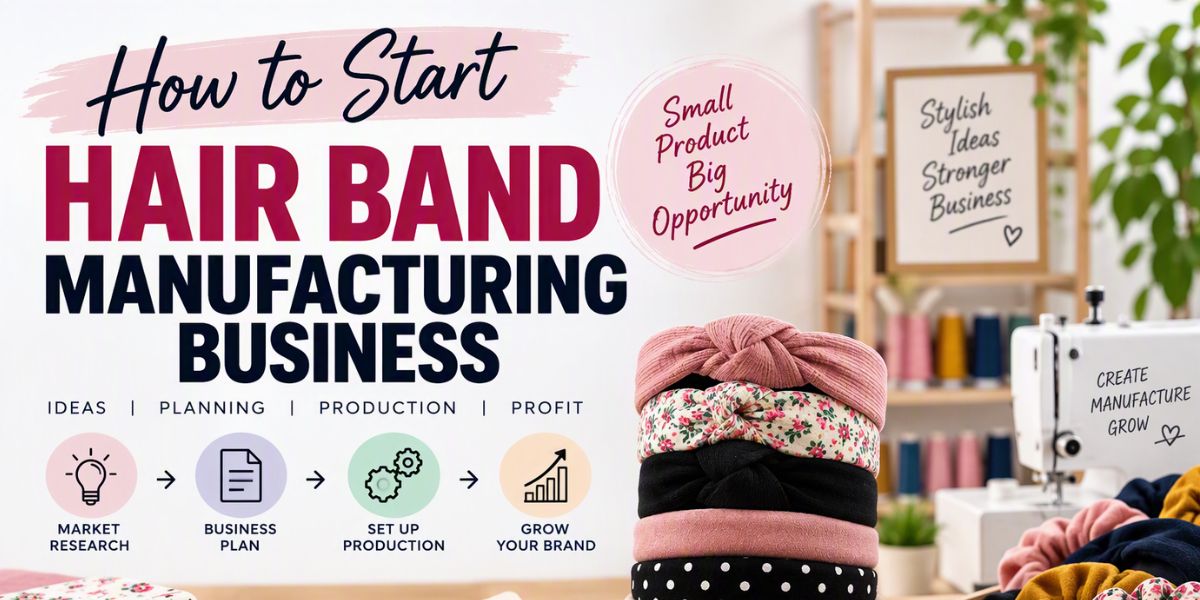
Despite the rise of digital fashion trends and online retail, a hair band manufacturing business in India continues to serve a massive, daily consumer staple market across local cosmetic stores, retail boutiques, wholesale hubs, salons, and e-commerce platforms. From everyday elastic hair ties and satin scrunchies to padded fashion headbands and kids’ accessories, demand remains steady and recession-resistant across urban and semi-urban markets.
This guide covers every phase of setting up a hair band manufacturing unit — from choosing a business model and machinery line to legal registration, raw material sourcing, cost breakdowns, and distribution strategy.
Hair Band Manufacturing Business: Quick Feasibility Snapshot
- Minimum Capital Required: ₹3 Lakh – ₹8 Lakh (Includes machinery, initial raw materials & working capital)
- Space Required: 400 – 800 sq. ft. (Clean, well-lit workspace with standard single-phase/three-phase power)
- Typical Net Profit Margin: 18% – 30% (Design-driven and volume-backed margins)
- Break-even Period: 6 – 12 Months
- Key Licenses Needed: Udyam (MSME), GST Registration, Trade License
- Government Loans & Subsidies: PMEGP (15%–35% subsidy), MUDRA Kishor/Tarun, CGTMSE
Applying for a Bank Loan under MUDRA, PMEGP, or CGTMSE? Get a tailored project profile and financial projections built for your setup.
Is Hair Band Manufacturing Business Right for You?
Hair band manufacturing is not a passive income stream. It requires hands-on daily supervision, quality control on stitching and elastic tension, and persistent B2B sales outreach.
Ideal Candidate Profile
- First-Gen Entrepreneurs (MSME Entry): Looking to enter light manufacturing with lower capital barriers than heavy machinery sectors.
- Existing Retailers & Wholesalers: Cosmetic and fashion accessory traders looking to backwards-integrate into in-house manufacturing.
- Small Business Owners: Crafters or boutique owners looking to scale up from home production to commercial machinery.
- Entrepreneurs with B2B Networks: Individuals connected with wholesale market hubs, salon chains, or gift item distributors.
Hair Band Manufacturing Models & Margin Profiles
Profitability varies depending on the product mix and target audience. Standard plain elastic ties move in massive volumes on thinner margins, while premium satin scrunchies, embellished headbands, and custom-branded packaging offer higher profitability.
- Local Wholesale Supply: General merchants, local accessory shops, weekly markets | Approx. Net Margin: 15% – 18%
- Scrunchies & Fashion Headbands: Boutiques, cosmetic stores, Instagram/e-commerce brands | Approx. Net Margin: 22% – 30%
- Salon & Institutional Supply: Professional hair salons, hotel chains, spa suppliers | Approx. Net Margin: 18% – 22%
- OEM / White-Label Production: Established cosmetic and personal care brands | Approx. Net Margin: 15% – 18%
Production Capacity & Machinery Selection
Selecting the right machinery prevents underutilization and unnecessary capital lock-up. Match your equipment line to your target product range and anticipated order volume.
- Basic Sewing & Cutting Line: 500 – 800 pieces per day | Micro setups, custom scrunchies & boutique production | Estimated Cost (Machinery Only): ₹60,000 – ₹1,00,000
- Semi-Automated Line: 1,500 – 2,500 pieces per day | Growing units with wholesale distribution | Estimated Cost (Machinery Only): ₹1,50,000 – ₹2,50,000
- High-Volume Automated Line: 4,000 – 7,000 pieces per day | Large wholesale and institutional suppliers | Estimated Cost (Machinery Only): ₹3,00,000 – ₹5,50,000
Essential Machinery Setup:
- Industrial Lockstitch Sewing Machine: Core machine for assembling fabric casings, securing joints, and stitching headbands.
- Overlock / Serger Machine (3 or 4-Thread): Provides clean edge-finishing on satin, velvet, and cotton fabrics to prevent fraying.
- Mini Circular Knitting Machine: Used for high-speed production of continuous seamless elastic tubing (popular for nylon-rubber baby bands and hair ties).
- Pneumatic Fabric Cutting Press & Dies: Speeds up cutting multi-layer fabric strips for scrunchies and bows.
- Elastic Cutting & Tipping Machine: Heat-seals and cuts elastic bands to exact lengths without edge fraying.
Detailed Investment Breakdown (₹3 Lakh – ₹8 Lakh)
A major failure point for new manufacturers is allocating all funds to machinery while neglecting working capital reserves.
- Machinery & Equipment: ₹1,50,000 – ₹4,00,000 | Sewing machines, overlock, knitting machine, cutting tools
- Installation & Electrical Setup: ₹15,000 – ₹40,000 | Wiring, workbench setup, lighting, basic tools
- Initial Raw Material Stock: ₹50,000 – ₹1,50,000 | Bulk rubber yarn, fabric rolls (satin, velvet, cotton), backing cards
- Factory Setup & Office: ₹20,000 – ₹50,000 | Rented workspace deposit, storage racks, cutting tables
- Working Capital Buffer: ₹65,000 – ₹1,60,000 | 2–3 months of labour, electricity, and packaging stock buffer
- Total Estimated Investment: ₹3,00,000 – ₹8,00,000 | Varies based on automation level and product variety
“Looking for funds to start your hair accessory manufacturing unit? Check our PMEGP Loan & Subsidy Calculator“
Detailed Step-by-Step Hair Band Manufacturing Process
Mastering the production workflow is essential for minimising fabric scrap, controlling labour time, and ensuring consistent elasticity and finish. Below is the expanded, step-by-step manufacturing process for setting up an efficient production floor:
1. Raw Material Inspection & Preparation
Production begins with rigorous incoming quality control. Fabric rolls (satin, velvet, cotton, organza) and elastic spools are inspected for colour consistency, width uniformity, and tensile strength defects. Fabric rolls are unrolled and conditioned to relax any tension introduced during factory transit or weaving before moving to the cutting station.
2. Precision Fabric Cutting & Die-Stamping
Depending on your automation level, fabric cutting is handled via two primary methods:
- Manual Rotary & Straight-Knife Cutting: Ideal for micro setups and custom velvet/satin scrunchies. Operators lay fabrics in precise layers (up to 20–30 plies) and use straight-knife cutting machines guided by acrylic templates.
- Pneumatic Press Die-Cutting: Essential for high-volume units. Custom steel-rule dies stamp out uniform fabric strips, bow shapes, or headband blanks in seconds, drastically reducing dimensional errors and fabric waste.
3. Overlock Edge-Finishing & Hemming
Raw fabric edges fray easily, especially slippery textiles like satin and organza. Cut strips are passed through 3-thread or 4-thread industrial overlock machines (sergers) to lock the raw edges cleanly. For structured headbands and fabric-wrapped alice bands, edge-folding and pre-hemming are executed at this stage to prepare the casings for inner lining or plastic frames.
4. Industrial Stitching, Tubular Assembly & Elastic Insertion
This is the core value-addition phase on the production floor:
- Scrunchie Assembly: Industrial lockstitch sewing machines join the overlocked fabric strips into continuous tubes, which are then inverted using loop-turners. Elastic bands are threaded through the tube using specialized loop-pullers, and the elastic ends are securely bar-tacked or joined. Finally, the open ends of the fabric casing are closed with a clean internal seam.
- Seamless Elastic Hair Ties: Produced using mini circular knitting machines that weave continuous elastic tubing from rubber cores and covering yarns, which are subsequently cut and ultrasonically heat-sealed or joined.
5. Quality Control, Tension Testing & Thread Trimming
Every batch undergoes strict quality checks before packaging:
- Stretch Memory & Tensile Check: Random samples from each production run are stretched repeatedly to test elastic recovery and ensure they do not snap or lose elasticity under tension.
- Finishing & Trimming: Assistants use thread-snipping shears to clear all stray loose threads, inspect seam integrity, and reject pieces with crooked stitching or fabric stains.
6. Carding, Branding & Wholesale Packaging
Finished hair accessories are mounted onto custom-printed hanging backing cards (featuring your brand logo, barcode, and MRP details) using staple pins or eco-friendly paper tucks. Carded items are packed into OPP self-adhesive clear plastic sleeves in dozens (12 pieces) or gross packs (144 pieces), and finally organized into heavy-duty master cartons for B2B wholesale dispatch.
Comprehensive Raw Material Sourcing & Quality Checkpoints
Raw materials typically account for 50% to 60% of total operational expenditure. Sourcing directly from regional textile hubs (such as Surat, Ludhiana, or local wholesale yarn and fabric markets) ensures optimal pricing and healthy profit margins.
Core Raw Material Categories
- Rubber & Spandex Cores: High-tenacity extruded rubber threads or spandex elastane cores that form the functional skeleton of the hair band. Premium cores guarantee high elongation and long-term stretch recovery without premature sagging.
- Covering Yarns: Polyamide (Nylon) or Polyester multi-filament yarns wound tightly around the rubber core. Nylon provides a softer, smoother hand-feel, while polyester offers superior tensile strength and cost efficiency.
- Outer Fabrics: Sourced in bulk rolls. High-demand variants include stretch velvet, heavy bridal satin, sheer organza, cotton hosiery knits, and synthetic PU leather strips for premium braided headbands.
- Packaging & Presentation Stock: Custom-designed hanging backing cards (300+ GSM art board with gloss/matte lamination), OPP transparent self-adhesive sleeves, branded woven labels, and corrugated master shipping cartons.
Critical Warehouse Storage Guidelines
Improper storage is a leading cause of ruined stock in textile accessory manufacturing. Follow these mandatory guidelines on the shop floor:
- Pallet Elevation: Always store fabric rolls and elastic spools off the concrete floor on clean wooden or plastic pallets. Direct contact with damp flooring draws moisture into the textiles.
- Climate Control & Moisture Prevention: Keep the storage room well-ventilated and dry. High humidity compromises elastic rubber tension, causing rubber cores to degrade, stick together, or lose elasticity prematurely.
- Light Protection: Store dyed fabric rolls away from direct sunlight to prevent UV fading and discolouration along the outer folds of the rolls.
Factory Space, Power & Manpower Setup
Covered Space: 400 – 800 sq. ft. Clear division into:
- Raw material storage (Fabric and yarn racks)
- Production floor (Cutting tables and stitching line)
- Finished goods packaging and sorting area
Power Requirement: Standard single-phase connection (or small 3-phase connection if operating heavy multi-head industrial equipment).
Core Team Required:
- 1 Skilled Machine Operator / Master Tailor
- 1–2 Sewing / Assembly Assistants
- 1 Owner / Manager (Procurement, Quality Check & Sales)
Types of Hair Bands You Can Manufacture
Diversifying your catalogue helps secure orders across different retail segments:
- Classic elastic hair ties (seamless and metal-joined)
- Fabric scrunchies (satin, velvet, cotton, organza)
- Padded headbands and cloth-wrapped alice bands
- Bow headbands and knotted hair bands
- Kids’ printed and character hair bands
- Sports sweatbands and elastic headbands
The most commonly produced items are standard scrunchies and nylon elastic bands, as they enjoy year-round demand and minimal inventory obsolescence.
Licenses & Business Compliance
To supply to retail chains, boutiques, and apply for government credit schemes, secure the following licenses:
- Udyam MSME Registration: Free online registration; unlocks priority sector lending and credit subsidies.
- GST Registration: Mandatory for B2B supply, interstate transport, and e-commerce platform onboarding.
- Local Trade License: Obtained from your local municipal body or panchayat.
How to Find Your First Customers
In manufacturing, sales should begin before production reaches full capacity. Identify potential buyers in your area, such as:
- Wholesale cosmetic and accessory markets (e.g., Burra Bazar, Sadar Bazaar, local wholesale hubs)
- Retail boutiques and gift shops
- Salon and spa supply distributors
- E-commerce brand owners looking for local manufacturing partners
- Institutional buyers and corporate event planners
Registering your business on B2B marketplaces can also help generate inquiries from regional retailers. Build your reputation on consistent elasticity retention, neat stitching, and reliable delivery schedules.
Common Mistakes to Avoid
- Buying Excess Machinery Too Soon: Never purchase a fleet of industrial machines before securing initial wholesale distribution channels.
- Underestimating Working Capital: Wholesalers often operate on 30–45-day payment cycles. Always keep a 2-month cash reserve.
- Neglecting Quality Control: A weak elastic core or loose stitching leads to high product return rates from retailers.
- Competing Solely on Price: Fighting on price alone erodes margins. Focus on superior fabric quality, clean finishing, and attractive custom card packaging.
Frequently Asked Questions
How much investment is required to start a hair band manufacturing business?
A small-scale unit generally requires an investment of ₹3 lakh to ₹8 lakh, depending on the machinery automation level and working capital buffer.
Is hair band manufacturing profitable?
Yes. A well-managed unit can achieve 18% to 30% net profit margins, especially when producing designer scrunchies and custom-packaged accessories.
What are the main raw materials?
The primary raw materials are elastic rubber cores, covering yarns (nylon/polyester), fabric rolls (satin, velvet, cotton), and packaging cards.
How much space is required?
Most small accessory manufacturing units require approximately 400 to 800 square feet of clean covered space.
Can I start this business from home?
Yes. Many entrepreneurs begin small-scale scrunchies and headband production from home with 1 or 2 sewing machines before shifting to a dedicated commercial workspace.
Who are the major buyers?
Accessory wholesalers, cosmetic store owners, local boutiques, salons, gift shops, and e-commerce sellers.
How long does it take to recover the initial investment?
With consistent wholesale orders and active market distribution, most operators recover their investment within 6 to 12 months.

Rupak Chakrabarty is the Founder and Lead Business Coach at MUVSI. With over two decades of experience in entrepreneurship, marketing, and business consulting, he helps aspiring entrepreneurs and MSMEs build profitable, market-driven businesses. His expertise includes business planning, B2B marketing, customer acquisition, and digital growth strategies.