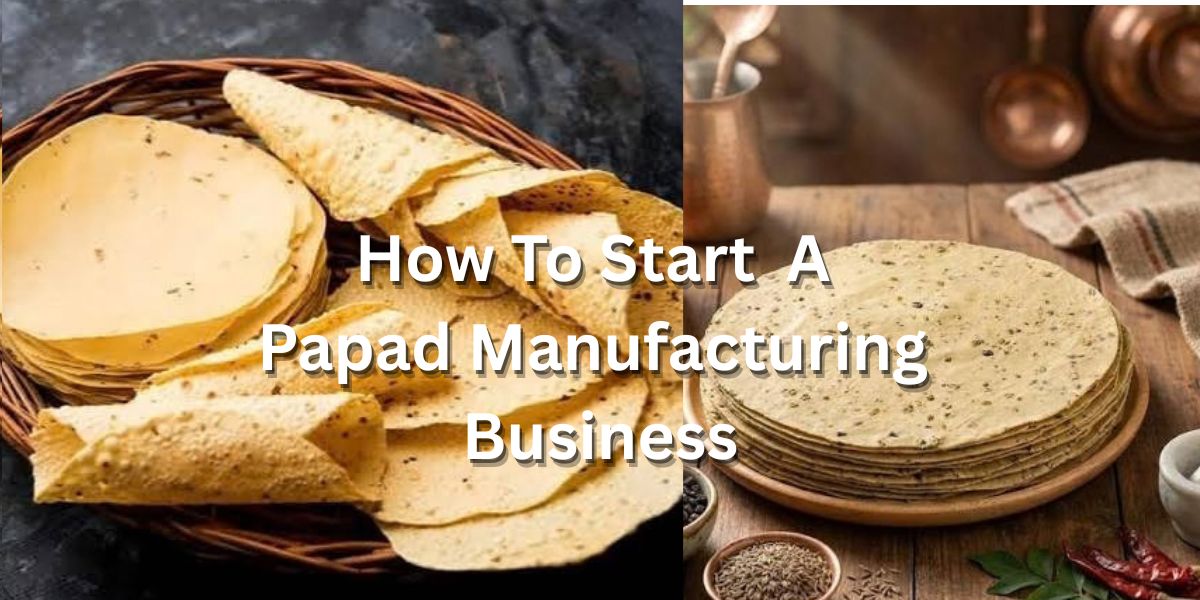
Whether you plan to launch a cottage-scale unit or an automated commercial facility, this comprehensive guide walks you through every stage—from licensing and machinery selection to cost estimation and marketing strategies.
1. Business Overview & Market Potential of Papad Manufacturing in India
Industry Overview
The Indian papad industry is transitioning from informal home production to organized manufacturing units equipped with motorized dough mixers, electric presses, and solar or tray dryers. Standardized quality, branded moisture-proof packaging, and strict food safety compliance are key drivers in today’s market.
Market Demand & Potential
- Daily Consumption: Serves as a staple side dish, starter, and snack in millions of homes daily.
- B2B Surge: High demand from hotel chains, restaurants, marriage halls, and catering service providers.
- Festive Demands: Demand surges during festivals, weddings, and harvest seasons.
- Global Scope: Substantial export opportunities to countries with large Indian diaspora populations, including the UAE, USA, UK, Canada, Australia, and Malaysia.
Target Audience
- B2C (Business to Consumer): Local kirana stores, retail chains, supermarkets, hypermarkets, and D2C online shoppers.
- B2B (Business to Business): Wholesalers, institutional buyers, corporate canteens, hotels, restaurants, and catering networks (HORECA).
2. Papad Manufacturing Business Planning & Choosing the Right Scale
Choosing the correct scale depends on your initial investment capacity, target market reach, and production targets.
Operating Scale | Production Capacity | Required Space | Estimated Machinery Cost | Best Suited For |
|---|---|---|---|---|
Micro / Home-Based | 10 – 30 kg / day | 200 – 400 sq. ft. | ₹15,000 – ₹50,000 | Local direct sales & testing |
Small-Scale (Semi-Automated) | 50 – 200 kg / day | 500 – 1,000 sq. ft. | ₹1.5 Lakh – ₹4 Lakh | Regional distribution & local retail |
Large-Scale (Fully Automated) | 500+ kg / day | 1,500 – 3,000+ sq. ft. | ₹8 Lakh – ₹25+ Lakh | State-wide retail, supermarkets & exports |
3. Licenses, Registrations & Legal Required for Starting A Papad Manufacturing Business
Food safety and regulatory compliance are critical when starting a food manufacturing unit.
- Business Structure Registration: Register as a Sole Proprietorship, Partnership Firm, LLP, or Private Limited Company based on your scale.
- FSSAI License:
- State License: For turnover up to ₹20 Crore/year.
- Central License: Mandatory if manufacturing capacity exceeds 2 Metric Tons per day or for export businesses.
- GST Registration: Required for inter-state trading and supplying to formal retail channels.
- MSME / Udyam Registration: Free online registration providing access to collateral-free bank loans, subsidies, and government tender benefits.
- Trade License & Municipal Clearance: Local NOC from the municipal corporation or Gram Panchayat.
- Trademark Registration: Secures your brand name and prevents counterfeiting.
4. Location, Infrastructure & Space Requirements
Space & Setup Specifications
- Space Needed: A 500 to 1,000 sq. ft. covered area is ideal for a semi-automated unit to comfortably separate raw material storage, mixing, rolling, drying, and packaging sections.
- Utilities:
- Power Supply: 3-phase electrical connection (minimum 5 kW to 15 kW depending on motor load).
- Water Facility: Potable water supply for dough mixing and equipment sanitization.
- Hygiene Standards: Epoxy or tiled flooring, smooth washable walls, fly-catchers, proper drainage, and dust-free drying zones as mandated by FSSAI.
5. Raw Materials & Standardization for Manufacturing Papad
Core Ingredients:-
- Flours & Pulses: Urad dal flour (most common), Moong dal flour, Chana dal flour, Rice flour, or Potato flakes depending on regional variants.
- Spices & Flavorings: Black pepper, Cumin seeds (jeera), Asafoetida (hing), Red chili powder, Garlic, or Ajwain.
- Processing Agents: Salt, Edible vegetable oil (Sesame, Groundnut, or Mustard), and Papad Khar (Sodium Bicarbonate) to ensure puffing and crispness.
Sourcing & Recipe Standardization:-
Procure pulses directly from millers or wholesale grain markets to maintain a low cost per kg. Standardize exact moisture levels and spice ratios to ensure every batch matches in taste, thickness, and shelf life.
6. Machinery & Equipment Required for Papad Manufacturing
Modern automated lines significantly cut down labour requirements and increase throughput.
Key Equipment Breakdown:-
- Dough Mixer / Heavy Duty Kneader: Ensures thorough and uniform blending of flour, water, and spices.
- Papad Sheeting & Press Machine: Rollers compress dough into thin uniform sheets, while rotary cutters cut circular discs.
- Drying System:
- Solar Dryer / Cabinet Tray Dryer: Ensures consistent moisture reduction without exposure to ambient dust and insects.
- Conveyor Belt Dryer: Integrated directly into automated production lines.
- Continuous Band Sealer / Nitrogen Pouch Packaging Machine: Seals moisture-proof poly pouches for high shelf life.
7. Step-by-Step Papad Manufacturing Process
- Raw Material Sieving & Batching:
Pass flours through fine mesh sieves to eliminate impurities and ensure a uniform texture. Weigh spices, salt, and papad khar precisely per batch requirements. - Dough Mixing & Kneading:
Transfer ingredients to the heavy-duty mixer. Add measured quantities of water and oil to prepare a stiff, pliable dough. - Sheet Rolling & Cutting:
Feed dough balls into motorized rollers to form thin, uniform sheets. The rotary die cuts them into perfectly circular papads of the required diameter (e.g., 5 inches to 7 inches). - Controlled Moisture Drying:
Place wet papads into solar or tray dryers. Reduce moisture levels from around 30% down to 10–12% to prevent mold growth without making them overly brittle. - Quality Inspection & Sorting:
Inspect dried papads to remove broken, misshapen, or cracked pieces prior to final packaging. - Moisture-Proof Packaging & Batch Coding:
Pack papads into food-grade poly bags (100g, 200g, 500g, or 1kg packs). Seal using a continuous band sealer and print manufacturing date, MRP, batch number, and FSSAI details.
8. Financial Project Report: Investment & Profitability
Capital Expenditure
Item | Estimated Cost (INR) |
|---|---|
Dough Mixer & Semi-Automatic Papad Machine | ₹1,80,000 |
Solar / Cabinet Tray Dryer | ₹80,000 |
Continuous Band Sealer | ₹25,000 |
Weighing Scales, Trays & Working Tables | ₹35,000 |
Licensing, FSSAI & Brand Setup | ₹20,000 |
Total Initial Machinery & Setup Cost | ₹3,40,000 |
Working Capital & Operating Expenditure
Expense Category | Monthly Cost (INR) |
|---|---|
Raw Materials (Urad dal flour, spices, oil @ 2,500 kg/month) | ₹2,25,000 |
Packaging Pouches & Outer Cartons | ₹20,000 |
Labor Salaries (1 Skilled Operator + 2 Helpers) | ₹40,000 |
Power, Water & Utilities | ₹12,000 |
Marketing, Transport & Freight | ₹15,000 |
Total Monthly Operating Cost | ₹3,12,000 |
Profit Margin & Revenue Analysis of an Papad Manufacturing Unit
- Monthly Production: Approximately 2,500 kg
- Total Cost per Kg (Production + Overhead): Approximately ₹125 / kg
- Wholesale Selling Price: ₹160 – ₹180 / kg
- Monthly Gross Revenue: ₹4,00,000 (at ₹160/kg average)
- Net Monthly Profit: ₹88,000
- Expected Profit Margin: 20% – 25%
- Estimated Payback Period: 10 – 14 months
9. Government Subsidies & Financial Schemes Aavailable
Starting a food enterprise gives you access to several government incentives:
- PM FME Scheme (PM Formalisation of Micro Food Processing Enterprises): Offers a 35% credit-linked capital subsidy (up to ₹10 Lakh) for new or upgrading food processing units.
- PMEGP (Prime Minister’s Employment Generation Programme): Provides up to 15%–35% subsidy on total project cost for manufacturing ventures.
- MUDRA Loans: Offers collateral-free business loans up to ₹10 Lakh under Kishor and Tarun categories for equipment purchase.
10.Papad Packaging, Branding & Marketing Strategy
Packaging & Labeling Excellence
Invest in high-barrier laminated packaging to protect against humidity. Ensure your label displays:
- Full Brand Logo and Product Name (e.g., Urad Special Punjabi Papad)
- FSSAI License Number & Logo
- Complete Ingredients List and Nutritional Chart
- Net Weight, Batch Number, Manufacturing Date, and Best Before Date
11. Distribution Channels
- Traditional Retail: Build a local distributor network supplying kirana stores and supermarkets.
- Institutional Sales (HORECA): Offer 1 kg or 5 kg bulk packs to hotels, restaurants, and caterers at wholesale rates.
- Quick-Commerce & E-Commerce: List products on Amazon, Flipkart, Blinkit, Zepto, and Instamart.
- White Labeling: Produce under contract for larger regional FMCG brands.
12. Frequently Asked Questions (FAQs)
1. What is the standard shelf life of manufactured papad, and how can I increase it?
Properly dried papad (with moisture reduced below 10–12%) sealed in high-barrier, food-grade poly bags has a standard shelf life of 9 to 12 months at room temperature. To maximize shelf life without adding chemical preservatives:
- Ensure papads are thoroughly dried in tray or solar dryers to prevent fungal growth.
- Use 3-ply nitrogen-flushed or vacuum-sealed foil laminates to block air and humidity.
- Store finished batches in a cool, dark, and elevated dry room off the ground.
2. Is GST applicable on papad manufacturing in India?
Papad currently falls under HSN Code 1905 and is taxed at 0% GST. This zero-tax rating makes it one of the most cost-effective and consumer-friendly food products to manufacture in India, keeping compliance overheads minimal for new micro-enterprises. (Note: Always verify current GST council updates before filing returns).
3. How many pieces of papad are produced per kilogram of flour?
The exact yield per kilogram depends on the diameter and thickness of the papad:
- Standard 5-inch to 6-inch papad (Urad Dal base): Approximately 65 to 75 pieces per kg.
- Large 8-inch to 9-inch dinner papad: Approximately 25 to 35 pieces per kg.
- Moong dal & Rice papad: Tends to be lighter, yielding around 80 to 90 pieces per kg.
4. How do I maintain production quality during the rainy season?
Monsoon humidity is the biggest practical operational bottleneck for traditional producers relying solely on open sun-drying. To maintain uninterrupted year-round production:
- Invest in an enclosed tray dryer or solar dryer from Day 1.
- Maintain a temperature controlled between 45°C to 55°C inside the drying chamber to prevent cracking or over-brittleness.
- Avoid packing papads immediately after machine drying—let them cool in a humidity-controlled staging room to prevent internal moisture condensation inside the bag.
5. Can I get a government loan or subsidy to start a papad unit?
Yes. Food processing is heavily promoted by government schemes:
- PM FME Scheme: Offers a credit-linked capital subsidy of 35% (up to ₹10 Lakh) on machinery and plant setup.
- PMEGP: Offers financial support with 15% to 35% margin money subsidies depending on category and region.
- MUDRA (Kishor/Tarun): Provides collateral-free loans up to ₹10 Lakh specifically for equipment purchases.
- Special incentives and zero-interest loans are also offered under state-specific women entrepreneur schemes (such as Mukhyamantri Mahila Udyami Yojana).
6. What is the average piece breakage rate, and how do I minimize raw material loss?
Manual handling and machine pressing usually incur an average 3% to 5% breakage rate. Rather than counting this as a total loss:
- Un-dried trim edges and broken wet dough discs can immediately be fed back into the dough mixer for re-kneading.
- Fully dried broken papad pieces can be crushed, spiced, and re-packaged as Papad Churi / Khakhra Mix for regional snack markets.
Conclusion
Starting a papad manufacturing business in India offers a high-yield, recession-proof venture with strong year-round market demand and low regulatory friction. By transitioning from traditional manual drying to hygienic solar or tray drying, standardizing your formulation, and tapping into both local FMCG networks and government subsidies like PM FME, you can establish a highly profitable regional brand.
The key to long-term success lies in consistent quality control, moisture-proof branding, and expanding distribution beyond kirana stores into HORECA and modern quick-commerce channels. Take the first step by preparing your project report, securing your FSSAI registration, and sourcing machinery that fits your initial production capacity.

Rupak Chakrabarty is the Founder and Lead Business Coach at MUVSI. With over two decades of experience in entrepreneurship, marketing, and business consulting, he helps aspiring entrepreneurs and MSMEs build profitable, market-driven businesses. His expertise includes business planning, B2B marketing, customer acquisition, and digital growth strategies.