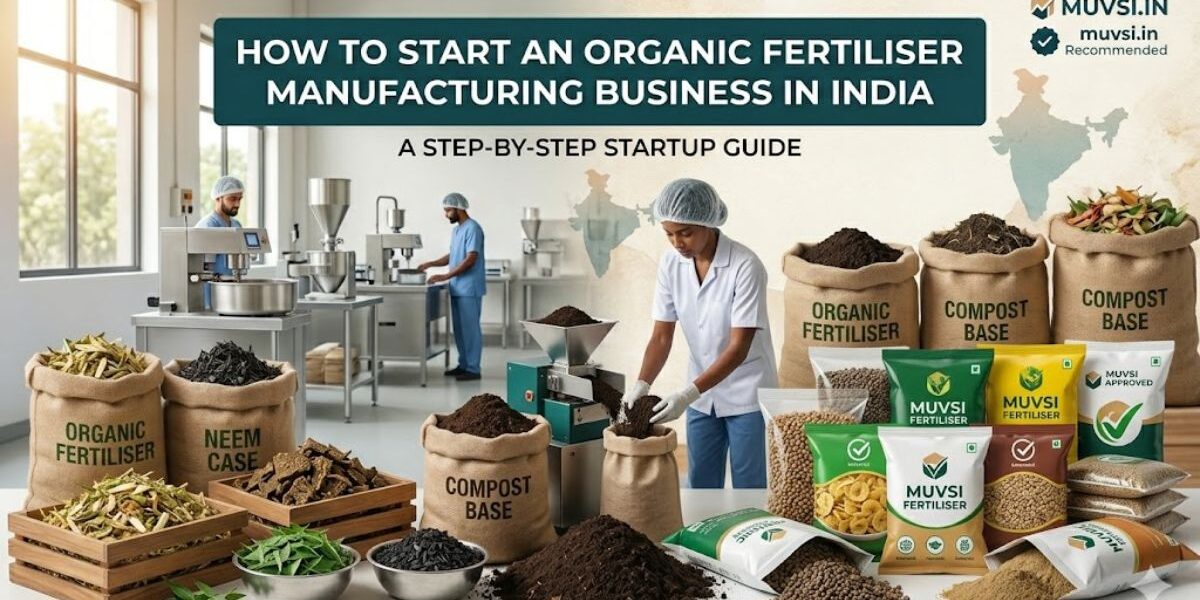
What if you could start a manufacturing business with ₹50,000, use raw materials that are essentially free, and earn profit margins of 50–65% — one of the highest in any manufacturing sector in India?
That is the vermicompost and organic fertiliser business at present.
India’s organic farming area crossed 4.4 million hectares in 2024 and is still growing fast. Chemical fertiliser prices are rising sharply, and government policies under PM Pranam, PKVY, and the National Mission for Sustainable Agriculture are actively incentivising farmers to shift to organic inputs. The demand for quality vermicompost, bio-fertilisers, and organic compost is growing at 11.9% CAGR — and supply is nowhere near keeping up.
The global vermicompost market is projected to grow from USD 95.72 billion in 2025 to USD 263.31 billion by 2034. India — with the world’s largest cattle population providing abundant free raw material — is perfectly positioned to manufacture and export organic fertilisers at scale.
This guide covers everything: types of organic fertilisers, investment breakdown, the full production process, FCO licensing, government subsidies, profit calculation, where to sell, and top buyers across India.
Jump to:
Market opportunity · Types of organic fertilisers · Investment breakdown · Equipment needed · Raw materials · Production process · Step-by-step startup · Licenses & FCO · Government subsidies · Profit calculation · Where to sell · FAQ
Why Organic Fertiliser Is One of the Best Businesses to Start
- Chemical fertiliser prices are at all-time highs. Urea and DAP prices have risen 35–50% in the last three years. Farmers are actively seeking affordable, effective alternatives. Organic fertilisers — especially vermicompost — fill that gap at a price farmers can justify, especially when soil quality improvement benefits are factored in.
- Government policy is a structural tailwind. The PM Pranam scheme (Promotion of Alternate Nutrients for Agriculture Management) is actively promoting the reduction of chemical fertiliser use and supporting organic input producers. The PKVY scheme provides direct support for organic farming clusters, and every organic cluster needs local organic input suppliers.
- Raw material is free or nearly free. India’s vast cattle population provides an abundant, largely cost-free supply of cow dung — the primary feedstock for vermicomposting. Agricultural residues, food waste, and crop by-products are available at scale across India’s farming belts. This near-zero raw material cost is what generates those extraordinary 50–65% gross margins.
- Multiple revenue streams from one operation. A vermicompost unit can simultaneously produce: finished vermicompost (primary product), vermi-wash liquid fertiliser (secondary product, high value), earthworm cultures (sold to other vermicompost entrepreneurs), and oilseed cake residue. Many operators also sell compost kits to urban gardeners — a growing D2C segment in 2026.
- Urban gardening boom creates new buyers. In 2026, terrace gardens, kitchen gardens, and apartment balcony gardens are mainstream in Indian cities. Urban gardeners are active buyers of small-pack vermicompost (₹50–150 for a 1 kg pack) at margins significantly higher than bulk farm sales. This is a new channel that did not exist at scale 5 years ago.
- Export opportunity is large. Traditional Indian pickles have a massive international market. Similarly, certified organic vermicompost from India is increasingly exported to organic farmers in the Middle East, Southeast Asia, and Europe who cannot easily source high-quality organic inputs locally.
Types of Organic Fertilisers: What to Manufacture
Product | How it’s made | Investment | Best market |
|---|---|---|---|
Vermicompost | Earthworms break down organic waste (cow dung + agricultural residue) in 45–60 days | ₹50,000 – 5 lakh | Farmers, nurseries, urban gardeners, organic farms — the widest demand |
Compost (aerobic) | Microbial decomposition of agricultural waste in windrows — 90–120 days | ₹1 – 4 lakh | Farmers, garden centres — highest volume, lower price than vermicompost |
Bio-fertiliser | Live microbial cultures (Rhizobium, Azospirillum, PSB) formulated on carrier material | ₹3 – 8 lakh | Agri-input dealers, organic farms, government supply — premium niche |
Vermi-wash (liquid fertiliser) | Liquid collected from vermicompost beds is rich in plant growth hormones and micronutrients | No extra investment — by-product of vermicompost | Organic farms, nurseries, urban gardeners — high-margin by-product |
Neem cake fertiliser | By-product of neem oil extraction — enriched with neem’s natural pesticide properties | ₹1 – 3 lakh | Organic farms, horticulture — dual-use fertiliser + natural pesticide |
Organic granular fertiliser blends | Blended and granulated mix of vermicompost + neem cake + bone meal + other organics | ₹5 – 12 lakh (granulator needed) | Premium farmers, export, modern retail — shelf-friendly format |
2026 recommendation: Start with vermicompost — the lowest investment, highest margin, and widest buyer base of any organic fertiliser. Add vermi-wash immediately as a zero-additional-investment by-product. Once production is established, add neem cake if neem oil mills are in your region. Graduate to granular organic blends once you have a loyal B2B buyer base.
Investment Breakdown: How Much Does It Cost?
Scale | Total Investment | Monthly Output | Best For |
|---|---|---|---|
Home/backyard unit | ₹50,000 – 1.5 lakh | 500 kg – 1 tonne/month | Testing, local sales, urban gardener market |
Small commercial unit | ₹2 – 5 lakh | 3–8 tonnes/month | Local farmers, nurseries, and agri-input dealers |
Mid-scale unit | ₹6 – 15 lakh | 20–50 tonnes/month | Government contracts, institutional supply, and regional wholesale |
Detailed cost breakdown — small commercial vermicompost unit (₹2–4 lakh)
Item | Estimated Cost |
|---|---|
Shed / covered structure (500–1,000 sq ft, low-cost construction) | ₹40,000 – 1.2 lakh |
Vermicompost beds (brick or HDPE — 10–15 beds of 3×1×0.6 m) | ₹20,000 – 50,000 |
Earthworm culture (Eisenia fetida — 10 kg per bed) | ₹15,000 – 35,000 |
Sieving machine / rotary screen (4mm mesh) | ₹20,000 – 45,000 |
HDPE / PP woven bags (packaging) | ₹10,000 – 20,000 |
Weighing scale, moisture meter | ₹4,000 – 8,000 |
Watering cans/sprinklers | ₹3,000 – 8,000 |
FCO license + GST + Udyam | ₹8,000 – 18,000 |
Branding (bag design, labels) | ₹5,000 – 15,000 |
Working capital (initial raw material, earthworms, misc) | ₹30,000 – 60,000 |
Total | ₹1.6 – 3.6 lakh |
NABARD subsidy tip: NABARD and state agriculture departments offer 50–75% subsidies for organic input units. Before spending on construction and beds, visit your nearest NABARD District Development Manager or state agriculture department office. A 50% subsidy on a ₹3 lakh unit means your effective investment is ₹1.5 lakh. Apply before construction begins.
Equipment Needed
Equipment | Purpose | Price range | Priority |
|---|---|---|---|
Vermicompost beds | Raised beds where earthworms process organic material. Can be brick masonry, HDPE troughs, or even ground-level pits. | ₹1,500 – 5,000 per bed (brick construction) | Essential |
Shade net/shed | Protects beds from direct sunlight and rain — both of which are fatal to earthworms | ₹15,000 – 1 lakh (depending on size) | Essential |
Rotary sieving machine | Separates finished vermicompost from unprocessed material and worms. 4mm mesh is standard. | ₹20,000 – 50,000 | Essential for commercial scale |
Moisture meter | Checks bed moisture (target 40–60%) — too dry or too wet kills earthworms | ₹3,000 – 8,000 | Essential |
Weighing scale (platform, 100 kg) | Weighing output for bagging and sales | ₹4,000 – 10,000 | Essential |
Watering system (drip or sprinkler) | Maintains consistent moisture in beds — manual watering is time-consuming and uneven | ₹8,000 – 25,000 | Strongly recommended |
Bag stitching/sealing machine | Seals HDPE/PP bags for wholesale dispatch | ₹5,000 – 15,000 | Needed for wholesale |
Vermi-wash collection system | Sloped floor or collection tray at bed base collects liquid vermi-wash — high-value by-product | ₹5,000 – 15,000 | Highly recommended — adds revenue |
Raw Materials: What You Need and Where to Get It
Raw material | Purpose | Cost | Where to source |
|---|---|---|---|
Cow/buffalo dung | Primary feedstock — provides carbon, nitrogen, and microbial inoculum for vermicomposting | Free – ₹2/kg | Local dairy farms, cattle sheds, goshalas — often given free or at nominal cost |
Agricultural residue (crop waste, straw) | Carbon-rich bulking material — balances the nitrogen-rich dung | Free – ₹1/kg | Local farms — often available for free as waste disposal |
Kitchen/food waste | Additional organic feedstock — high in nutrients | Free | Restaurants, canteens, and vegetable markets — available free with minimal transport |
Eisenia fetida earthworms (red wigglers) | The biological engine of vermicomposting converts organic matter to compost in 45–60 days | ₹150 – 300/kg | Existing vermicompost units, agricultural universities, Krishi Vigyan Kendras (KVKs) |
Green leaves/garden waste | Additional nitrogen-rich feedstock | Free | Municipal parks, gardens, and local farms |
HDPE / PP woven bags | Final packaging for wholesale and retail | ₹8 – 25 per bag | Local packaging suppliers: IndiaMART |
Earthworm selection: Use Eisenia fetida (red wigglers) — the most efficient vermicomposting species available in India. Do not use common soil earthworms — they are not suited for the dense, moist conditions of vermicompost beds. Source your initial culture from KVKs (Krishi Vigyan Kendras) near you — they usually sell at subsidised rates and provide free technical guidance.
What NOT to add to vermicompost beds: Citrus peels, onion skins, meat, fish, oily food, salt, chemicals, and synthetic fertilisers. These harm earthworms and contaminate the final product. Also, avoid adding fresh, undried dung directly — it generates heat during decomposition that can kill worms. Pre-compost dung for 2–3 weeks before adding to beds.
The Full Vermicompost Production Process
Stage | What happens | Time |
|---|---|---|
1. Raw material pre-composting | Mix cow dung and agricultural waste in 1:1 ratio. Pile in windrows and allow to partially decompose for 15–21 days with occasional watering and turning. This removes excess heat and makes the material worm-friendly. | 15–21 days |
2. Bed preparation | Spread a 6-inch layer of pre-composted material in the vermicompost bed. Ensure moisture is 40–60% (feels like a wrung-out wet cloth — not dripping wet). | 1 day |
3. Earthworm inoculation | Spread earthworm culture (1–2 kg of worms per square metre of bed surface) evenly over the prepared material. Cover lightly with a damp gunny sack or shade net to retain moisture and darkness. | 1 day |
4. Daily maintenance (feeding & watering) | Add 2–3 inch layers of fresh pre-composted organic material every 2–3 days. Maintain moisture at 40–60% with light sprinkling. Check temperature — if above 30°C, increase shade and watering. | Daily — 15–20 mins per bed |
5. Vermi-wash collection | Liquid drains from the base of the bed (if a collection system is installed). Collect and bottle as a liquid fertiliser. High in humic acid, growth hormones, and micronutrients. | Continuous — collect weekly |
6. Maturation (45–60 days) | Stop adding fresh material 2 weeks before harvest. Worms process the remaining material. Finished vermicompost looks dark brown-black, crumbly, and smells like fresh earth — no foul odour. | 45–60 days total from inoculation |
7. Worm separation | Push finished compost to one side — worms naturally migrate toward fresh material. Or use light (worms migrate away from light) to move them to one end of the bed. | 1–2 days |
8. Sieving | Pass harvested compost through a rotary sieve (4mm mesh) to remove unprocessed material, worm cocoons that will hatch in the next batch, and any debris. | 2–4 hrs per tonne |
9. Drying (if needed) | Spread sieved compost in shade for 1–2 days to reduce moisture to 15–25% (FCO specification). Do not sun-dry — it destroys beneficial microorganisms. | 1–2 days (shade) |
10. Quality testing | Test pH (should be 6.5–7.5), moisture content (15–25%), total organic carbon (minimum 18%), and nitrogen content (minimum 1.0%). These are FCO-specified parameters. Document every batch. | Lab test — 1–3 days turnaround |
11. Bagging & labelling | Bag in HDPE/PP woven bags (5 kg, 25 kg, or 50 kg sizes). Apply FCO-compliant label: product name, nutrients (N-P-K), moisture content, batch number, manufacturing date, FCO license number, and seller details. | 1–2 hrs per tonne |
One complete production cycle: 60–75 days from raw material loading to bagged output. With 15 beds running in rotation (staggered start dates), you can produce a harvested batch every 4–5 days once the operation matures. Production capacity from 15 beds: approximately 4–6 tonnes per month.
Step-by-Step: How to Start Your Organic Fertiliser Business
Step 1 — Visit your local Krishi Vigyan Kendra (KVK) (Week 1)
Before spending anything, visit the KVK (agricultural extension centre) nearest to you. They provide free technical training on vermicompost production, supply earthworm cultures at subsidised rates, help you apply for state subsidy schemes, and can connect you with farmer buyer groups. This one visit can save you months of learning curve and thousands of rupees in subsidies you would otherwise miss.
Step 2 — Register Udyam and apply for subsidies (Week 1–2)
Register on udyamregistration.gov.in for MSME status. Then apply for available subsidies through your state agriculture or horticulture department and NABARD. Subsidies of 50–75% are available in many states under PKVY and organic farming promotion schemes. Apply before construction — retroactive subsidy claims are often rejected.
Step 3 — Apply for FCO license (Week 2–4)
Apply for a Fertiliser License under the Fertiliser Control Order (FCO) 1985 through your State Agriculture Department or the Department of Agriculture, Cooperation and Farmers’ Welfare. This is mandatory for the commercial sale of vermicompost, compost, and bio-fertiliser. The application requires: site details, product specifications, and test reports from a recognised laboratory. Processing time: 2–6 weeks, depending on the state.
Step 4 — Secure raw material supply (Week 2–3)
Identify and formalise relationships with 2–3 raw material sources: a local dairy farm or goshala for cow dung (ideally within 5 km — transport cost is your main variable), a farm or two for agricultural residue, and a restaurant or canteen for food waste if available. Formalise with a simple letter of understanding. Consistent raw material supply is the foundation of consistent production.
Step 5 — Build beds and set up production (Week 3–6)
Build your vermicompost beds under a shade structure. Brick masonry beds are the most durable; HDPE troughs are faster to set up. Start with 5–10 beds for a pilot run — do not build 50 beds before you have mastered earthworm management in your specific local climate. The pilot run will teach you the right moisture level, feeding frequency, and temperature management for your location.
Step 6 — Inoculate with earthworms and begin production (Week 6–7)
Purchase earthworm culture from your KVK or a verified supplier. Load pre-composted material into beds and inoculate. Begin daily maintenance routine. Keep a production log — date of inoculation, material added each day, moisture readings, and any observations. This log is required for FCO compliance and helps you improve each batch.
Step 7 — First harvest and quality testing (Week 10–12)
Your first harvest arrives 45–60 days after inoculation. Sieve, dry, and test for FCO-required parameters (pH, moisture, organic carbon, nitrogen) at a NABL-accredited laboratory. Get your FCO license by this point — you need it before commercial sale. Package in branded bags with your FCO license number on the label.
Step 8 — Approach buyers and sell (Week 12+)
Your first calls should be to organic farms, nurseries, and agri-input dealers within 50 km. Bring a sample and a test report. The test report showing your product’s nutrient content is your single most effective sales tool with serious buyers. Simultaneously, list on Amazon and Flipkart for urban gardener packs and register on Agribazaar and DeHaat for farmer-facing sales.
Licenses and Registrations Required
License / Registration | Where to apply | Cost | Notes |
|---|---|---|---|
FCO License (Fertiliser Control Order) | State Agriculture Department or Dept. of Agriculture, Cooperation & Farmers’ Welfare | ₹2,000 – 8,000 | Mandatory for commercial sale of any fertiliser — apply before first sale |
Udyam (MSME) Registration | udyamregistration.gov.in | Free | Required for NABARD and PMEGP subsidy access |
GST Registration | gst.gov.in | Free (agent ₹1,000–2,000) | Organic fertilisers: 5% GST — confirm HSN 3101 with CA |
Trade License | Local municipal body | ₹500 – 2,000/year | For commercial premises |
NPOP Certification (for ‘Certified Organic’ label) | Accredited certifying agencies — IMO, ECOCERT India, OneCert Asia | ₹15,000 – 40,000/year | Optional but necessary for premium organic buyers and export commands a 30–50% price premium |
IEC (for export) | dgft.gov.in | ₹500 | Only if exporting |
FCO compliance for vermicompost labels: Under the FCO 1985 and its amendments, your vermicompost bag label must include: product name (“Vermicompost”), grade, nutrient content (minimum N-P-K percentages), moisture content, pH, batch/lot number, date of manufacture, FCO license number, and manufacturer’s name and address. Non-compliant labels can result in product seizure and license suspension.
FCO-specified minimum standards for vermicompost:
- Moisture: 15–25% by weight
- Colour: Dark brown to black
- Odour: Absence of foul odour
- Particle size: Minimum 90% material passes 4.0 mm IS Sieve
- Total Organic Carbon: Minimum 18% by weight
- Total Nitrogen (as N): Minimum 1.0% by weight
- pH: 6.5 – 7.5
Government Subsidies: What You Can Claim
Scheme | Subsidy offered | Where to apply | Notes |
|---|---|---|---|
NABARD schemes for organic inputs | 50–75% capital subsidy | NABARD District Development Manager | Varies by state — among the most generous subsidies for this sector |
PKVY (Paramparagat Krishi Vikas Yojana) | ₹50,000 per hectare to organic clusters, including input producers | State Agriculture Department | Excellent for units supplying organic farming clusters |
PMEGP | 25–35% of project cost (rural applicants get 35%) | kviconline.gov.in or nearest KVIC office | Maximum project: ₹25 lakh for service sector; ₹50 lakh for manufacturing |
State Horticulture Mission | Varies — 30–50% subsidy on organic input equipment | State Horticulture Department | Check your state’s scheme — highly variable; some states are extremely generous |
NHM (National Horticulture Mission) | 50% subsidy on vermicompost unit construction up to ₹60,000 | State Horticulture Department | Specifically covers vermicompost bed construction cost |
Important: Subsidy stacking is possible in some states — meaning you can claim NABARD subsidy AND state horticulture subsidy on the same project if they cover different cost components. Always check with your KVK and state agriculture department for the full picture before investing.
Profit Calculation: What Can You Actually Earn?
Scenario A — Small commercial vermicompost unit (15 beds, 5 tonnes/month)
Item | Monthly figures |
|---|---|
Vermicompost output (15 beds × ~330 kg/bed/cycle) | 5,000 kg (5 tonnes) |
Blended selling price (wholesale ₹8/kg + retail packs ₹15/kg, 60/40) | ~₹10.80/kg avg |
Vermicompost revenue | ₹54,000 |
Vermi-wash by-product (200 litres × ₹80/litre) | ₹16,000 |
Earthworm culture sales (2 kg × ₹250/kg) | ₹5,000 |
Total revenue | ₹75,000 |
Cow dung / raw material (near-free — transport only) | ₹3,000 |
Earthworm maintenance, consumables | ₹2,000 |
Packaging (bags, labels) | ₹6,000 |
Labour (1 part-time worker) | ₹8,000 |
Water, electricity, misc | ₹3,000 |
Total operating cost | ₹22,000 |
Monthly net profit | ₹53,000 (~71%) |
Scenario B — Mid-scale unit with urban gardener focus (50 beds, 15 tonnes/month)
Item | Monthly figures |
|---|---|
Production | 15,000 kg (15 tonnes) |
Selling price (premium branded 2 kg packs at ₹80 = ₹40/kg, 50% + wholesale ₹8/kg, 50%) | ~₹24/kg avg |
Vermicompost revenue | ₹3,60,000 |
Vermi-wash + earthworm sales | ₹45,000 |
Total revenue | ₹4,05,000 |
Raw material transport + consumables | ₹18,000 |
Premium branded packaging (2 kg boxes) | ₹60,000 |
Labour (2 workers) | ₹28,000 |
Water, electricity, misc | ₹12,000 |
Total operating cost | ₹1,18,000 |
Monthly net profit | ₹2,87,000 (~71%) |
The urban gardener premium is the biggest margin lever. The same kg of vermicompost that sells for ₹8 in a 50 kg wholesale bag sells for ₹40–80 in a branded 1–2 kg retail pack to an urban apartment gardener. Splitting your sales between bulk farm supply and premium urban retail maximises both volume and margin.
Break-even: A home-based vermicompost unit (₹1–1.5 lakh) recovers investment in 2–4 months. A mid-scale commercial unit (₹5–6 lakh) breaks even in 4–8 months — among the fastest paybacks of any agricultural manufacturing business.
Where to Sell Your Organic Fertiliser
Agricultural and institutional buyers (highest volume)
- Organic farms and farmer groups — Farms certified under NPOP require certified organic inputs. One organic farm cluster (20–30 farmers) can absorb 10–20 tonnes per month. Contact your state organic farming board for farmer group contacts.
- Horticulture nurseries — Nurseries producing saplings, seedlings, and potted plants use vermicompost year-round. A single large nursery buys 2–5 tonnes per month. Visit nurseries in your district with a sample and test report.
- Government agriculture departments — State agriculture departments run organic farming schemes that require the supply of certified inputs. Tie up with KVKs and state organic certification agencies to get listed as an approved supplier.
- Agri-input dealers — Fertiliser dealers and agri-input shops stock organic fertilisers alongside chemical inputs. One dealer in a farming-dominated block can move 500 kg–2 tonnes per month.
Urban and premium channels (highest margin)
- Amazon and Flipkart (urban gardener packs) — Package in 1 kg, 2 kg, and 5 kg branded packs. Urban buyers on Amazon pay ₹50–150 per kg for good quality, well-packaged vermicompost. This channel has high margins and growing demand as apartment and terrace gardening expands.
- Garden centres and nurseries in cities — Urban garden centres sell small packs of premium vermicompost to hobbyist gardeners at ₹60–120 for a 1 kg pack. Approach the store owner with samples and a wholesale price list.
- Community farming groups — WhatsApp groups, RWA (resident welfare association) networks, and terrace farming communities are active buyers of quality vermicompost. One engaged urban farming community can order 100–300 kg per month with zero marketing cost.
- D2C through Instagram — Urban home gardening is an active Instagram niche in 2026. A vermicompost brand with a clear sustainability story, production process videos, and plant growth result photos builds a loyal online buyer base.
Institutional and export channels (month 4+)
- GeM portal — Government agriculture departments, forest departments, and municipalities procure organic fertilisers through GeM. Register with your FCO license and MSME certificate.
- Agribazaar and DeHaat — B2B agri-input platforms connecting manufacturers directly with farmer buyers across India. High reach, lower margin than direct sales, but zero sales effort once listed.
- Export (Middle East, SE Asia) — NPOP-certified vermicompost from India is exported to organic farms in the UAE, Singapore, Malaysia, and increasingly to European markets. Register with APEDA to access export support.
Common Mistakes to Avoid
- Adding fresh undried dung to beds. Fresh cow dung generates heat during decomposition — up to 50–60°C — which kills earthworms. Always pre-compost dung in an open pile for 15–21 days before adding to vermicompost beds. This is the #1 cause of worm death in new units.
- Wrong moisture levels. Too dry (below 30% moisture) = worms stop moving and eventually die. Too wet (above 70%) = worms suffocate. The correct level feels like a wrung-out wet cloth — 40–60% moisture. Check with a meter, not by guessing.
- No shade over beds. Direct sunlight heats beds above 35°C — earthworms die above this temperature. Direct rain waterlogging suffocates worms. A proper shade structure is not optional — it is critical infrastructure.
- Selling before getting the FCO license. Selling fertiliser commercially without an FCO license is illegal under the Fertiliser Control Order. State agriculture departments conduct inspections, and violations result in fines and product seizure. Apply for the license before your first sale.
- Skipping product testing. Without a test report showing your vermicompost meets FCO minimum parameters (organic carbon ≥18%, N ≥1.0%, moisture 15–25%, pH 6.5–7.5), you cannot sell to serious institutional buyers and risk FCO non-compliance. Get every batch tested — laboratory costs are minimal (₹500–1,500 per sample).
- Not collecting vermi-wash. Many beginners leave the liquid draining from their beds to waste. Vermi-wash sells for ₹50–150 per litre — a high-margin by-product with zero additional production cost. Install a simple collection tray from day one.
Read: Top Manufacturing Business Ideas in India
Frequently Asked Questions
How much investment is needed to start an organic fertiliser business in India?
A home-based vermicompost unit with 2–3 beds can be started for as little as ₹50,000–1 lakh. A small commercial unit with 10–15 beds producing 500 kg per month requires ₹1.5–3 lakh. A mid-scale unit with 50+ beds targeting wholesale and government contracts needs ₹5–10 lakh.
What license is required for organic fertiliser manufacturing in India?
A Fertiliser License under the Fertiliser Control Order (FCO) 1985 is mandatory for commercial sale of organic fertilisers, including vermicompost, bio-fertiliser, and compost. You also need GST registration and Udyam (MSME) registration. For selling as ‘certified organic’, NPOP certification from an accredited body is required.
What is the profit margin in vermicompost manufacturing?
Vermicompost has among the highest profit margins of any agri-input business — gross margins of 50–65% and net margins of 25–40% are achievable because raw materials (cow dung, agricultural waste) are free or nearly free, while finished vermicompost sells at ₹10–18 per kg retail and ₹6–10 per kg wholesale.
What government subsidies are available for organic fertiliser manufacturing in India?
NABARD and state agriculture departments offer 50–75% subsidies for organic input units under various schemes. The PKVY scheme supports organic input producers. PMEGP offers a 25–35% subsidy on the project cost. The National Horticulture Mission offers 50% subsidy on vermicompost unit construction up to ₹60,000. Check your state agriculture department for current schemes.
Where can I sell vermicompost in India?
Key buyers include organic vegetable farms, horticulture nurseries, flower growers, terrace garden communities in cities, government agriculture departments (bulk procurement), agri-input dealers, and online platforms like Amazon, Agribazaar, and DeHaat. Direct-to-farmer sales within your district eliminate middlemen and provide the highest margin.
Conclusion
Without question, it may be the single best business on this entire list for someone starting with limited capital in a rural or semi-urban location. The investment is the lowest of any manufacturing business covered here. The raw material is free. The margins are exceptional. Government subsidies cover up to 75% of the setup cost. And the market is growing at 11.9% CAGR through 2034.
Visit your KVK first. Apply for subsidies before spending. Get the FCO license before the first sale. Collect vermi-wash from day one. And split your sales between bulk farm supply and premium urban packs to maximise both volume and margin.
You are not just starting a business. You are converting agricultural waste into one of the most valuable inputs in India’s growing organic farming economy.

Rupak Chakrabarty is the Founder and Lead Business Coach at MUVSI. With over two decades of experience in entrepreneurship, marketing, and business consulting, he helps aspiring entrepreneurs and MSMEs build profitable, market-driven businesses. His expertise includes business planning, B2B marketing, customer acquisition, and digital growth strategies.