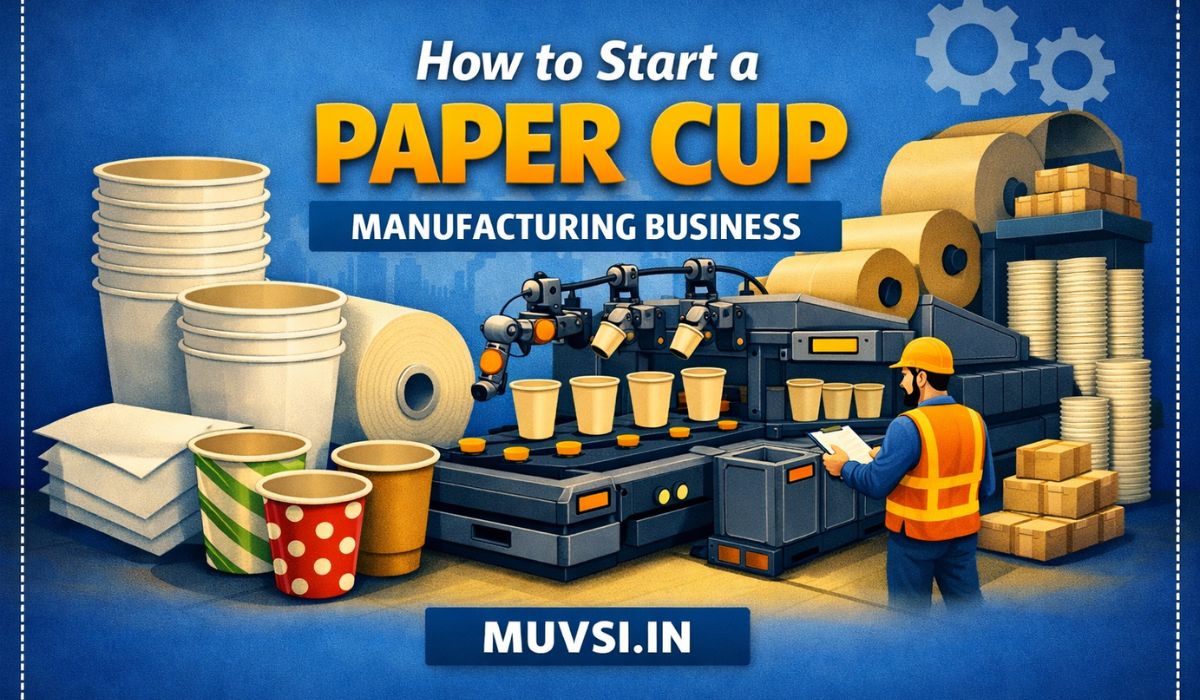
Every week, aspiring entrepreneurs ask me for a manufacturing business that requires moderate capital yet offers steady, year-round demand. Paper cup manufacturing business regularly tops my shortlist because it caters to a daily consumable item—from roadside tea stalls and corporate offices to hospitals and food delivery chains.
However, many advertisements make paper cup manufacturing look effortless: buy a machine, press a button, and print money. The reality is different. Your profitability depends on raw material cost control, machine efficiency, minimising scrap, and building a network of repeat B2B buyers.
Paper Cup Manufacturing Business – Quick Feasibility Snapshot
Parameter | Detail |
|---|---|
Minimum Capital Required | ₹15 Lakh – ₹35 Lakh (Includes machinery & working capital) |
Space Required | 800 – 1,500 sq. ft. (Covered, ventilated space with 3-phase power) |
Typical Net Profit Margin | 10% – 20% (Volume-driven business) |
Break-even Period | 24 – 36 Months |
Key Licenses Needed | Udyam (MSME), GST, Trade License, PCB Consent |
Government Loans & Subsidies | PMEGP (15%–35% subsidy), MUDRA Kishor/Tarun, CGTMSE |
Applying for a Bank Loan under MUDRA, PMEGP, or CGTMSE? Get a tailored project profile and financial projections built for your setup.
Is Paper Cup Manufacturing Business Right for You?
Paper cup manufacturing is not a passive income stream. It requires hands-on daily supervision, quality control, and persistent B2B sales outreach.
Ideal Candidate Profile
- First-Gen Existing Entrepreneurs (MSME Entry)
- Existing Business Owners
- Distributors & Institutional Wholesalers
Best Suited For:
- First-generation entrepreneurs entering the manufacturing sector.
- Distributors of disposable items looking to move from trading to manufacturing.
- Small business owners looking to diversify into packaging/consumables.
- Entrepreneurs with existing networks in wholesale markets, catering, hotels, or corporate supply chains.
Paper Bag Manufacturing Business Models & Margin Profiles
Profitability varies depending on the product mix and target audience. Standard plain cups move in massive volumes on thinner margins, while customised and double-walled cups offer higher profitability.
Business Model | Primary Target Buyer | Approx. Net Margin |
|---|---|---|
Local Wholesale Supply | Wholesalers, tea stalls, local shops | 10% – 12% |
Custom-Printed Cups | Cafés, QSR chains, corporate offices | 15% – 22% |
Institutional Supply | Hospitals, colleges, large factories | 12% – 15% |
OEM / White-Label | Established packaging brands | 8% – 10% |
Production Capacity & Machinery Selection
Selecting the right machine capacity prevents underutilization and unnecessary capital lock-up. Match your machinery to your confirmed sales capacity rather than buying the largest machine available.
Machine Speed | Approximate Daily Output (8-Hour Shift) | Best Suited For | Estimated Cost (Machinery Only) |
|---|---|---|---|
50 – 60 Cups/Min | 24,000 – 30,000 cups | Micro/Small setups entering local markets | ₹7.5 Lakh – ₹10 Lakh |
80 – 90 Cups/Min | 38,000 – 44,000 cups | Growing units with wholesale distribution | ₹11 Lakh – ₹15 Lakh |
100 – 120 Cups/Min | 48,000 – 60,000 cups | High-volume & institutional suppliers | ₹16 Lakh – ₹24 Lakh |
Essential Machinery Setup:
- Paper Cup Forming Machine: Performs bottom sealing, wall forming, and rim curling.
- Die-Cutting Machine: Cuts printed sheets into cup blanks (optional if buying pre-cut blanks).
- Air Compressor: Supplies required pneumatic pressure to the forming unit.
- Packing & Wrapping Machine: Seals finished cups in hygienic plastic sleeves.
Check: Paper Cup Making Machine Price in India
Detailed Investment Breakdown (₹15 Lakh – ₹35 Lakh)
A major failure point for new manufacturers is allocating all funds to machinery while neglecting working capital.
Expense Head | Estimated Cost Range | Remarks / Notes |
|---|---|---|
Machinery & Equipment | ₹8,00,000 – ₹20,00,000 | Cup forming machine, air compressor, inspection tables |
Installation & Electrical Setup | ₹1,00,000 – ₹3,00,000 | 3-phase wiring, panel setup, earthing, stabiliser |
Initial Raw Material Stock | ₹2,00,000 – ₹5,00,000 | PE-coated paper rolls, bottom paper, packaging material |
Factory Setup & Office | ₹50,000 – ₹2,00,000 | Rented shed deposit, racks, basic office setup |
Working Capital Buffer | ₹3,00,000 – ₹8,00,000 | 2–3 months of labour, electricity, and stock buffer |
Total Estimated Investment | ₹15,00,000 – ₹35,00,000 | Varies based on machine capacity and automation |
“Looking for funds to start your paper cup manufacturing unit? Check our PMEGP Loan & Subsidy Calculator“
Step-by-Step Paper Cup Manufacturing Process
   ┌───────────────────────┐
   │ 1. Raw Material       │  Food-grade PE-coated paper
   └───────────┬───────────┘
               ▼
   ┌───────────────────────┐
   │ 2. Printing & Cutting │  Flexo printing & blank die-cutting
   └───────────┬───────────┘  (Or purchased pre-cut)
               ▼
   ┌───────────────────────┐
   │ 3. Cup Wall Forming   │  Ultrasonic/heat sealing side walls
   └───────────┬───────────┘
               ▼
   ┌───────────────────────┐
   │ 4. Bottom Attachment  │  Punching and heating bottom disc
   └───────────┬───────────┘
               ▼
   ┌───────────────────────┐
   │ 5. Rim Curling        │  Top edge curling for structural strength
   └───────────┬───────────┘
               ▼
   ┌───────────────────────┐
   │ 6. Inspection & Pack  │  Leak test, counting, and poly-bag packaging
   └───────────────────────┘
Raw Material Sourcing & Quality Checkpoints
Raw material constitutes up to 70%–75% of operational costs. Saving even ₹1–₹2 per kg on paper yields significant annual profit gains.
- PE-Coated Paper (170 – 250 GSM): Single PE-coated paper for cold/standard beverages; Double PE-coated for cold liquids/ice cream.
- Bottom Roll Paper (140 – 180 GSM): Matched to wall GSM for consistent heat sealing.
- Food-Grade Printing Inks: Non-toxic water-based inks compliant with food safety norms.
Storage Warning: Always store paper rolls on wooden pallets in a dry, humidity-controlled environment. Damp paper causes feed jams and weak bottom seals during high-speed production.
Check: Paper Cup Machine Suppliers in India
Factory Space, Power & Manpower Setup
- Covered Space: 800 – 1,500 sq. ft. Clear division into:
- Raw material storage (Moisture-free)
- Production floor (Vibration-free foundation)
- Finished goods warehouse
- Office & Quality Testing Area
- Power Requirement: 5 to 15 kW (3-Phase power connection).
- Core Team Required:
- 1 Skilled Machine Operator
- 1–2 Unskilled Packing Assistants / Helpers
- 1 Owner / Manager (Sales & Procurement)
Types of Paper Cups You Can Manufacture
One advantage of entering this industry is the variety of products you can offer. As your business grows, you don’t have to limit yourself to a single type of cup.
Some of the most popular products include:
- Tea paper cups
- Coffee paper cups
- Juice cups
- Ice cream cups
- Vending machine cups
- Ripple wallpaper cups
- Double-walled paper cups
- Printed promotional cups
- Paper cups with custom branding
The most commonly used sizes range from 90 ml to 350 ml, although larger sizes are also available for cold beverages.
When selecting your product range, study local demand first. For example, tea vendors generally require smaller cups, while cafés often prefer larger printed cups with premium finishes. Understanding your target customers before purchasing machinery can save considerable time and investment.
Licenses & Business Compliance
To sell to corporate clients and apply for government subsidies, secure the following licenses:
- Udyam MSME Registration: Free online registration; unlocks credit subsidies.
- GST Registration: Mandatory for B2B supply and interstate sales.
- Local Trade License: Obtained from your local municipal body.
- State Pollution Control Board (NOC): Consent to Establish/Operate (Category green/white depending on state).
- Factory License: Required if labour count exceeds municipal thresholds.
How to Find Your First Customers
A common mistake is assuming customers will automatically appear once production starts.
In manufacturing, sales should begin before production.
Identify potential buyers in your area, such as:
- Tea and coffee wholesalers
- Restaurants
- Hotels
- Cafés
- Caterers
- Educational institutions
- Hospitals
- Event management companies
- Corporate offices
- Food distributors
Registering your business on B2B marketplaces can also help generate enquiries from retailers and distributors across India.
Rather than competing only on price, build your reputation on three factors:
- Consistent product quality
- Timely delivery
- Professional customer service
Repeat customers are the foundation of a profitable manufacturing business.
Common Mistakes to Avoid
- Buying Machinery Without Market Research: Never purchase a high-speed machine before securing regional wholesale buyers.
- Underestimating Working Capital: Outstanding payment cycles from wholesalers can take 30–60 days. Always keep 2–3 months of working capital reserve.
- Neglecting Preventive Maintenance: A failing heating element or misaligned die can cause whole batches to leak, destroying brand reputation.
- Competing Solely on Price: Fighting on price alone shrinks margins to zero. Focus on timely delivery, leak-proof quality, and custom branding options.
Future Growth Opportunities
One of the biggest advantages of entering the paper cup manufacturing industry is that it can become the foundation for a larger disposable products business.
Once your operations become stable, you can diversify into related products such as:
- Paper bowls
- Paper plates
- Ripple wall cups
- Ice cream cups
- Food containers
- Paper straws
Since many of these products use similar raw materials and serve the same customer base, diversification becomes easier and more cost-effective.
This approach not only increases revenue but also reduces your dependence on a single product category.
As your customer network grows, you’ll find that many buyers prefer sourcing multiple disposable products from one reliable supplier.
That’s often how a small manufacturing unit gradually evolves into a larger and more profitable enterprise.
Related Guides
If you’re planning to start a paper cup manufacturing business, these resources may also help:
Reading these guides alongside this article will give you a complete understanding of the investment, production process, profitability, and day-to-day operations of the business.
Final Thoughts
Paper cup manufacturing continues to be an attractive opportunity for entrepreneurs looking to enter the manufacturing sector with a moderate investment. The market benefits from recurring demand, a wide customer base, and opportunities to expand into related disposable packaging products.
However, success depends on much more than purchasing a machine. Understanding your market, selecting the right production capacity, maintaining product quality, and building strong customer relationships are equally important.
If you’re planning to start this business, don’t rush into buying equipment based solely on advertisements or production claims. Take time to prepare a realistic business plan, estimate your working capital requirements, and identify potential buyers before making your investment.
A manufacturing business built on careful planning is far more likely to succeed than one built on optimism alone.
Frequently Asked Questions
How much investment is required to start a paper cup manufacturing business?
A small-scale unit generally requires an investment of ₹15 lakh to ₹35 lakh, depending on machine capacity, automation level, and working capital requirements.
Is paper cup manufacturing profitable?
Yes. A professionally managed business can typically achieve 10% to 20% net profit margins, although profitability depends on production efficiency and market demand.
What is the main raw material?
The primary raw material is food-grade PE-coated paper, along with bottom rolls and packaging materials.
How much space is required?
Most small manufacturing units require approximately 800–1,500 square feet of covered space.
Can I start this business from rented premises?
Yes. Many MSMEs begin operations in rented industrial sheds before investing in their own factory.
Who are the major buyers?
Tea vendors, cafés, restaurants, hotels, caterers, hospitals, schools, corporate offices, distributors, and wholesalers.
How long does it take to recover the investment?
With consistent production and regular orders, many businesses recover their investment within two to three years.
Which paper cup size sells the most?
Demand varies by market, but 90 ml, 150 ml, and 250 ml paper cups are among the most commonly used sizes in India.
Is previous manufacturing experience necessary?
No. With proper training, reliable machinery, and sound business planning, first-time entrepreneurs can successfully establish a paper cup manufacturing unit.
What should I research before buying a machine?
Compare machine capacity, after-sales service, spare part availability, electricity consumption, production speed, and total operating costs—not just the purchase price.

Rupak Chakrabarty is the Founder and Lead Business Coach at MUVSI. With over two decades of experience in entrepreneurship, marketing, and business consulting, he helps aspiring entrepreneurs and MSMEs build profitable, market-driven businesses. His expertise includes business planning, B2B marketing, customer acquisition, and digital growth strategies.