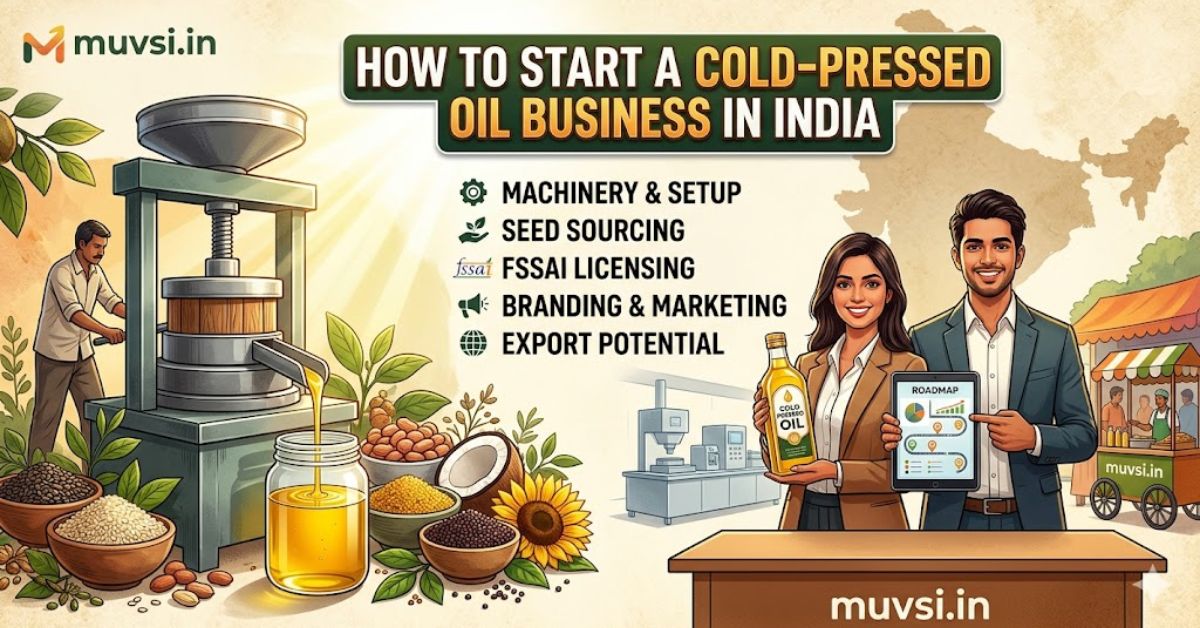
India’s cooking oil market is undergoing a major shift. Millions of health-conscious consumers are turning away from refined oils — with their chemical solvents, bleaching agents, and stripped nutritional profiles — toward cold-pressed, wood-pressed, and unrefined oils that deliver real nutrition and authentic flavour.
The Indian cold-pressed oil market was estimated at ₹12,500 crore in 2025 and is growing at a CAGR of over 14% — one of the fastest growth rates in any food segment. And the key driver is not a passing wellness trend. It is a permanent structural shift in how educated Indian consumers think about cooking oil.
Cold-pressed oils sell at 2–4x the price of refined equivalents. Groundnut oil that costs ₹200–230 per litre to produce sells for ₹350–450. Premium sesame oil sells for ₹600–800 per litre. The raw material (oilseeds) is widely available across India, machinery is accessible, and the government offers up to 35% subsidy on your project cost through PMEGP.
This guide covers everything you need to start: oil types, investment breakdown, machinery selection, the full production process, FSSAI licensing, profit calculation, where to sell, and top oilseed and machinery suppliers.
Jump to:
Market opportunity · Which oil to produce · Investment breakdown · Machinery guide · Raw materials & sourcing · Production process · Step-by-step startup · Licenses · Profit calculation · Where to sell · Top suppliers · FAQ
Why Cold-Pressed Oil Is a Strong Business in 2026
- Consumer awareness is creating permanent demand. Rising consumer understanding of the nutritional differences between cold-pressed and refined oils — driven by social media, nutritional education, and healthcare provider recommendations — is directly and structurally increasing demand for cold-pressed oils across urban and semi-urban consumer segments. This is not a niche anymore — it is mainstream.
- Premium pricing is structural. Cold-pressed oils consistently command retail price premiums of 2–4x over refined alternatives, supported by documented nutritional superiority, clean label credentials, and traditional production heritage.
- Market is growing fast. The Indian cold-pressed oil market is projected to reach ₹12,500 crore, with a CAGR of over 14%. While groundnut, mustard, sesame, and coconut oil currently dominate the market, newer entrants like flaxseed and avocado oil are gaining popularity among health-conscious consumers.
- Government subsidies are generous. Under the PMEGP scheme, subsidies of up to 25% are provided for the general category and up to 35% for special categories (SC/ST/OBC/women) in rural areas. In states like Bihar and Uttar Pradesh, the “Oil Crushing Mill Scheme” provides a direct subsidy of 33% on units costing up to ₹9.90 lakh.
- Oil cake is a bonus revenue stream. After pressing, the remaining oilseed cake (peanut cake, sesame cake, mustard cake) is sold as cattle feed or organic fertiliser at ₹20–50/kg — a secondary income that reduces your effective raw material cost.
- D2C is ideally suited for this product. A bottle of cold-pressed oil with a clear origin story (“wood-pressed sesame oil from Rajasthan farmers”) sells for ₹500–800 online. The same oil at a local wholesale market sells for ₹180–250. The D2C margin difference is enormous.
Which Cold-Pressed Oil to Produce: Comparison Guide
Oil type | Raw material | Oil yield | Wholesale price (2026) | D2C retail price | Best market |
|---|---|---|---|---|---|
Groundnut (peanut) oil | Groundnut seeds | 42–48% | ₹200 – 250/litre | ₹350 – 480/litre | All India — highest volume, widest demand |
Sesame oil | Sesame seeds | 48–52% | ₹350 – 450/litre | ₹550 – 800/litre | South India, export, premium health segment |
Mustard oil | Mustard seeds | 38–44% | ₹180 – 240/litre | ₹280 – 420/litre | North India — daily kitchen staple |
Coconut oil | Dry copra | 60–65% | ₹200 – 280/litre | ₹350 – 550/litre | South India, export, cosmetic & hair oil buyers |
Flaxseed oil | Flaxseeds | 35–40% | ₹500 – 700/litre | ₹900 – 1,400/litre | Health food, Omega-3 buyers, export — premium niche |
Castor oil | Castor seeds | 45–50% | ₹120 – 180/litre | ₹250 – 400/litre | Industrial, cosmetic, export — dual-use market |
Walnut/almond oil | Walnut/almond | 50–60% | ₹800 – 1,200/litre | ₹1,500 – 2,500/litre | Premium D2C, baby care, export — ultra-high margin |
Recommendation for beginners: Start with groundnut oil — highest volume demand, widest availability of raw material, easiest to sell locally and online. Add sesame oil as your premium SKU. Once operations are stable, expand to flaxseed or walnut for higher-margin health food buyers.
Regional strategy: Match your primary oil to your state’s dominant oilseed crop. Rajasthan/Gujarat = groundnut + mustard. Tamil Nadu/Kerala = sesame + coconut. West Bengal/Odisha = mustard. This keeps your raw material cost lowest and builds a credible local origin story.
Investment Breakdown: How Much Does It Cost?
Scale | Total Investment | Daily Output | Best For |
|---|---|---|---|
Mini/home unit | ₹1 – 3 lakh | 15–40 litres/day | Home-based testing, local D2C sales |
Small commercial unit | ₹4 – 8 lakh | 60–120 litres/day | Local wholesale + branded D2C |
Mid-scale unit | ₹10 – 20 lakh | 200–500 litres/day | Regional wholesale, institutional, export |
Detailed cost breakdown (small commercial unit — ₹5–8 lakh)
Item | Estimated Cost |
|---|---|
Cold press expeller machine (100–150 kg/hr capacity) | ₹1.5 – 4 lakh |
Seed cleaning & destoning machine | ₹30,000 – 70,000 |
Oil filtration unit (filter press) | ₹40,000 – 80,000 |
Storage tanks (food-grade stainless steel) | ₹25,000 – 50,000 |
Filling & sealing machine (for bottles) | ₹35,000 – 80,000 |
Workspace (500–700 sq ft, 3 months rent) | ₹25,000 – 55,000 |
Initial oilseed stock (1 month) | ₹80,000 – 1.5 lakh |
Packaging (bottles, caps, labels, cartons) | ₹30,000 – 60,000 |
FSSAI + GST + Udyam registration | ₹8,000 – 15,000 |
Branding (logo, label design) | ₹10,000 – 25,000 |
Working capital buffer | ₹50,000 – 80,000 |
Total | ₹4.5 – 9 lakh |
PMEGP subsidy opportunity: Cold-pressed oil manufacturing is fully eligible under PMEGP. A rural applicant in the general category receives 25% subsidy; SC/ST/OBC/women in rural areas receive 35%. Apply before investing — this can reduce your effective out-of-pocket cost by ₹1.5–3 lakh on a ₹6–8 lakh unit.
Machinery: Types, Capacity, and What to Buy
Core machine: the cold press expeller
Machine type | Capacity | Price range | Best for |
|---|---|---|---|
Mini cold press (home/micro) | 2–8 kg/hr oilseed input | ₹60,000 – 1.5 lakh | Home-based, testing, D2C, small scale |
Small commercial expeller | 15–50 kg/hr | ₹1.5 – 3.5 lakh | Small unit, 60–120 litres/day |
Medium expeller | 50–150 kg/hr | ₹3.5 – 8 lakh | Commercial unit, 150–400 litres/day |
Traditional wooden Ghani (kolhu) | 20–40 kg/hr | ₹80,000 – 2 lakh | Premium “wood-pressed” positioning — commands a higher price |
Ghani vs expeller: A traditional wooden Ghani (rotating wooden pestle) runs at a lower speed, generates less heat, and produces oil that commands a “wood-pressed” premium — selling at ₹50–150/litre more than standard cold-pressed. If your target is the premium D2C or export market, a Ghani is worth the investment. For high-volume wholesale, a modern stainless steel expeller is more efficient.
Supporting equipment
Equipment | Purpose | Price range |
|---|---|---|
Seed cleaner / destoner | Removes stones, dust, and husk from raw seeds before pressing | ₹25,000 – 70,000 |
Oil filter press | Removes sediment and fine particles from pressed oil for clear, shelf-stable output | ₹35,000 – 80,000 |
Stainless steel storage drums | Stores filtered oil — must be food-grade stainless or food-grade HDPE | ₹8,000 – 25,000 each |
Oil bottle filling machine | Fills bottles consistently without spillage or contamination | ₹30,000 – 80,000 |
Moisture meter | Checks seed moisture before pressing — above 10% moisture reduces yield and oil quality | ₹3,000 – 8,000 |
Buying advice: Buy your expeller from an established manufacturer — not from a generic reseller. Ask for: stainless steel barrel and worm shaft (not MS), minimum 1-year warranty on wearing parts, free installation and 2-day operator training, and references from at least 3 existing customers. Machine manufacturers in Coimbatore, Rajkot, and Ludhiana have the strongest cold-press expeller ecosystems in India.
Raw Materials: Oilseeds, Sourcing, and Quality
Oilseed | Top-producing states | Wholesale price (2026 approx.) | Oil yield |
|---|---|---|---|
Groundnut (peanut) | Gujarat, Rajasthan, Andhra Pradesh, Tamil Nadu | ₹60 – 90/kg | 42–48% |
Sesame seeds | Rajasthan, Gujarat, Madhya Pradesh, Odisha | ₹100 – 160/kg | 48–52% |
Mustard seeds | Rajasthan, Haryana, West Bengal, MP | ₹55 – 80/kg | 38–44% |
Copra (dry coconut) | Kerala, Tamil Nadu, Karnataka, AP | ₹90 – 140/kg | 60–65% |
Flaxseeds (alsi) | Madhya Pradesh, Odisha, Bihar, Chhattisgarh | ₹80 – 120/kg | 35–40% |
Castor seeds | Gujarat, Rajasthan, Andhra Pradesh | ₹35 – 55/kg | 45–50% |
Where to source oilseeds
- Local APMC mandis — Best starting point for any city. Prices are close to farmgate rates. Build relationships with 2–3 regular traders for consistent supply and credit terms.
- Directly from farmers / FPOs — Once your volume exceeds 500 kg/month per oilseed, contact Farmer Producer Organisations (FPOs) in producing states. Prices are 15–25% better than mandi rates, and you get traceability for your premium brand story.
- Key wholesale markets: Unjha (Gujarat) for sesame and groundnut — one of India’s largest oilseed markets. Bikaner and Jaipur (Rajasthan) for mustard and sesame. Raichur (Karnataka) for sesame. Erode (Tamil Nadu) for sesame and groundnut.
Oilseed quality checklist before buying
- Moisture content: below 8–10% (test with moisture meter before bulk purchase)
- Colour: uniform, no dark spots or mould
- Smell: fresh, nutty — no rancid or musty odour
- Cleanliness: minimal stones, husk, and foreign matter
- Oil content test: press a small 1 kg sample batch and weigh the output before committing to bulk
The Full Cold-Pressed Oil Production Process
Stage | What happens | Time / Notes |
|---|---|---|
1. Oilseed receiving & inspection | Check moisture, colour, and smell. Reject any batch with signs of mould or rancidity. Weigh and log each intake. | 30 mins per batch |
2. Cleaning & destoning | Run seeds through the cleaning machine to remove stones, husk, dust, and foreign matter. This protects the press barrel from damage and prevents contamination. | Continuous — 50–150 kg/hr |
3. Drying (if needed) | If moisture is above 8%, sun-dry or mechanically dry seeds to 6–8% moisture. High moisture reduces oil yield and shortens oil shelf life. | 2–6 hrs (sun) or 1–2 hrs (dryer) |
4. Cold pressing | Feed cleaned, dried seeds into the expeller. The screw worm crushes seeds at low temperature (below 50°C), pressing oil out through the barrel. Crude oil and oil cake are separated automatically. | Continuous — 30–150 kg/hr, depending on the machine |
5. Primary settling | Allow freshly pressed crude oil to settle in a food-grade tank for 12–24 hours. Fine sediment settles to the bottom naturally. | 12–24 hrs |
6. Filtration | Pass settled oil through a filter press to remove remaining fine particles. Output is clear, shelf-stable oil. | 1–3 hrs per batch |
7. Quality check | Check colour, aroma, and taste. Test free fatty acid (FFA) level — below 1% for good quality. Check peroxide value for freshness. Document each batch with date, oilseed source, and yield. | 30 mins |
8. Bottling & labelling | Fill into food-grade glass or PET bottles. Apply labels with: product name, net volume, manufacturing date, best-before date, FSSAI license number, batch number, nutritional information, and storage instructions. | 1–2 hrs per batch |
9. Oil cake disposal/sale | Sell pressed oilseed cake to cattle feed dealers, organic fertiliser producers, or poultry farms. This is a secondary revenue stream of ₹20–50/kg. | Ongoing |
Critical temperature control: Cold-pressed oil must stay below 50°C during extraction to retain nutritional value and qualify for the “cold-pressed” label. Monitor your machine barrel temperature — if it runs hot consistently, reduce feed rate or allow cooling periods. A machine that runs too hot produces oil that cannot legally or ethically be sold as cold-pressed.
Step-by-Step: How to Start Your Cold-Pressed Oil Business
Step 1 — Choose your oil type and target market (Week 1)
Match your oil choice to your location’s raw material availability and your target buyer. If you are in Gujarat or Rajasthan, groundnut and sesame are natural choices. In Kerala or Tamil Nadu, coconut oil has the strongest regional story. For D2C and premium positioning, sesame or flaxseed gives better margins than groundnut. For wholesale volume, groundnut is king.
Step 2 — Register your business and apply for FSSAI (Week 1–3)
Register on udyamregistration.gov.in for a free MSME status. Then apply for your FSSAI State License (for annual turnover above ₹12 lakh) at foscos.fssai.gov.in. Apply for GST registration. In 2026, the government introduced the “Tatkal” license facility under the Ease of Doing Business initiative, allowing you to obtain the necessary permissions within just 7 days.
Step 3 — Apply for PMEGP subsidy (Week 1–2, in parallel)
Before spending a rupee on machinery, visit your nearest KVIC office or apply at kviconline.gov.in. The PMEGP subsidy (25–35% of project cost) can save you ₹1.5–3 lakh on a typical cold-pressed oil setup. Processing takes 4–8 weeks — apply early so approval arrives before you need to buy machinery.
Step 4 — Source and test oilseeds (Week 2–4)
Visit your local APMC mandi and identify 2–3 reliable oilseed traders. Buy a 50–100 kg test batch. Check moisture with a meter. Run a test press on a small machine (many machine suppliers will do this for you before purchase). Record your exact oil yield — this is the number that determines your entire cost-profit calculation.
Step 5 — Buy and install machinery (Week 3–6)
Get quotes from at least 3 machine manufacturers. Ask specifically for: stainless steel barrel (not MS), barrel temperature data for your target oilseed, oil yield test results from existing customers, and operator training included in the price. Never pay more than 30% advance before delivery and successful installation.
Step 6 — Set up workspace (Week 4–6)
Your workspace needs: 500–700 sq ft minimum, three-phase electricity, adequate ventilation (oil vapour and oilseed dust), smooth washable floors and walls (FSSAI requirement), separate areas for raw material storage, pressing, filtration, and finished goods. Ensure no pest entry — FSSAI inspectors check this specifically for food processing units.
Step 7 — Design packaging and brand story (Week 5–7)
Your bottle and label are your sales pitch. Key elements that drive premium pricing: glass bottles (not plastic) signal quality; origin story on the label (“cold-pressed from Rajasthani sesame, no heat, no chemicals”); clear “cold-pressed / wood-pressed” certification language; and nutritional highlights. Invest ₹10,000–25,000 in professional label design — the ROI is immediate.
Step 8 — Produce first batch and approach buyers (Week 7–8)
Press your first commercial batch, filter, bottle, and label. Do a 3-point quality check: colour (should be naturally golden to amber, not pale), aroma (strong, characteristic of the seed), and taste (clean, no bitterness or rancid notes). Then approach buyers: health food stores, organic shops, supermarkets, and list on Amazon and your own Instagram with your brand story.
Licenses and Registrations Required
License / Registration | Where to apply | Cost | Notes |
|---|---|---|---|
FSSAI License (mandatory) | foscos.fssai.gov.in | ₹3,000 – 7,500/year | State License for turnover ₹12L–20Cr. Basic registration for below ₹12L turnover (₹100/year) |
Udyam (MSME) Registration | udyamregistration.gov.in | Free | Apply first — required for PMEGP and Mudra loan |
GST Registration | gst.gov.in | Free (agent ₹1,000–2,000) | Edible oils: 5% GST. Confirm HSN code with CA. |
Trade License | Local municipal corporation | ₹500 – 3,000/year | Required for commercial premises |
Pollution Control NOC | State PCB | ₹5,000 – 15,000 | Required for mid-scale and large units generating effluent |
AGMARK Certification (optional) | agmark.in | ₹5,000 – 15,000 | Quality certification — significantly boosts wholesale and institutional buyer trust |
IEC + APEDA (for export) | dgft.gov.in / apeda.gov.in | ₹500 + ₹5,000 | Mandatory for export. APEDA unlocks export incentives and buyer connections. |
FSSAI label compliance for edible oils: Your oil label must include — product name (e.g. “Cold Pressed Groundnut Oil”), net quantity (in ml or litres), FSSAI license number, manufacturing date, best before date, batch number, nutritional information per 100ml, name and address of manufacturer, and storage instructions. Vegetable oil labels in India must also state the oil type — you cannot use generic terms like “edible oil” without specifying the source.
Profit Calculation: What Can You Actually Earn?
Scenario A — Small unit, groundnut oil, 80 litres/day
Item | Monthly figures |
|---|---|
Production (25 days × 80 litres/day) | 2,000 litres |
Oilseed consumed (80 litres ÷ 45% yield = ~178 kg/day × 25) | 4,440 kg groundnut |
Blended selling price (60% D2C ₹400 + 40% wholesale ₹220) | ~₹328/litre avg |
Gross revenue | ₹6,56,000 |
Groundnut seeds (₹72/kg × 4,440 kg) | ₹3,19,680 |
Packaging (glass bottles ₹35 + label ₹5 + cap ₹3 = ₹43/litre) | ₹86,000 |
Labour (2 operators × ₹14,000) | ₹28,000 |
Electricity, maintenance | ₹12,000 |
Rent (500 sq ft) | ₹12,000 |
Transport, misc | ₹15,000 |
Oil cake revenue (2,440 kg cake × ₹25/kg) | − ₹61,000 (income offset) |
Total net operating cost | ₹4,11,680 |
Monthly net profit | ₹2,44,320 (~37%) |
Scenario B — Premium sesame oil, D2C only, 40 litres/day
Item | Monthly figures |
|---|---|
Production (25 days × 40 litres/day) | 1,000 litres |
D2C selling price (250ml glass bottle at ₹180 = ₹720/litre) | ₹720/litre |
Gross revenue | ₹7,20,000 |
Sesame seeds (40L ÷ 50% yield = 80 kg/day × 25 × ₹130/kg) | ₹2,60,000 |
Packaging (premium glass 250ml bottles, labels) | ₹80,000 |
Labour, electricity, rent, shipping | ₹55,000 |
Oil cake offset (1,000 kg × ₹30/kg) | − ₹30,000 |
Net operating cost | ₹3,65,000 |
Monthly net profit | ₹3,55,000 (~49%) |
Break-even: A ₹5–7 lakh cold-pressed oil unit at 60% capacity typically breaks even in 8–14 months. Unlike traditional businesses, where payback takes 5–8 years, a cold-pressed oil unit with the right positioning and pricing can recover investment within 1–2 years.
Where to Sell Your Cold-Pressed Oil
Local channels (start immediately)
- Organic and health food stores — Your most natural first buyer. Visit with samples, FSSAI license copy, and a clear price list. Health food stores typically take a 25–35% trade margin — build this into your wholesale pricing.
- Supermarkets and modern trade — Chains like Reliance Fresh, Nature’s Basket, and D-Mart source from FSSAI-licensed local suppliers. Approach the purchase manager with samples and a product data sheet including oil yield, oilseed source, and shelf life.
- Ayurvedic clinics and practitioners — Sesame, coconut, and castor oil have strong Ayurvedic applications. Practitioners recommend specific oils to their patients — a referral relationship with 5–10 local Ayurvedic doctors can generate consistent monthly orders.
- Restaurants and cloud kitchens — Premium restaurants increasingly advertise “cooked in cold-pressed groundnut oil” as a selling point. Monthly orders of 20–50 litres per restaurant.
Online D2C channels (month 2+)
- Amazon and Flipkart — Cold-pressed oil is a strong repeat-purchase category online. Good product photography, detailed ingredient sourcing information, and FSSAI certification visible on the listing build trust. Expect 3–4 months to build rating and sales velocity.
- ONDC — India’s Open Network for Digital Commerce is a strong channel for food brands with lower commission than marketplace platforms.
- Instagram and WhatsApp — Share your pressing process (seeds going in, oil flowing out), oilseed sourcing trips, and nutritional content. Video of the actual cold pressing process gets strong organic reach. D2C orders through WhatsApp Business catalogue are the highest margin channel.
Institutional and export channels (month 4+)
- GeM portal — Government institutions, including hospitals, schools, and canteens, procure cooking oil through GeM. Register at gem.gov.in with your FSSAI license and MSME certificate.
- Export through APEDA — Cold-pressed sesame oil, coconut oil, and groundnut oil all have strong export markets in the USA, UAE, UK, Japan, and Singapore. Register with APEDA for export support, buyer-seller meets, and incentives.
- Private label for D2C health brands — Many wellness and nutrition D2C brands source cold-pressed oils from local manufacturers and sell under their own brand. Approach them with your product data, FSSAI license, and unit economics.
Top Oilseed and Machinery Suppliers
Oilseed wholesale markets
Market | Location | Best for |
|---|---|---|
Unjha APMC Market | Unjha, Gujarat | Sesame seeds, groundnut — one of India’s largest oilseed markets |
Rajkot APMC | Rajkot, Gujarat | Groundnut — Gujarat produces 40%+ of India’s groundnut |
Bikaner Mandi | Bikaner, Rajasthan | Mustard seeds, sesame |
Erode Market | Erode, Tamil Nadu | Sesame, groundnut — South India hub |
Alappuzha / Thrissur markets | Kerala | Dry copra for coconut oil |
Local APMC mandi | Your state / nearest city | Starting point — build relationships here first |
Cold-press machine manufacturers
Location | What they make | Price range |
|---|---|---|
Coimbatore, Tamil Nadu | Full range of expellers and cold press machines — India’s largest machinery hub | ₹80,000 – 12 lakh |
Rajkot, Gujarat | Expellers, filter presses, and complete oil mill setups | ₹1.5 – 10 lakh |
Ludhiana, Punjab | Mustard oil specific expellers and cold press machines | ₹1 – 6 lakh |
Indore, Madhya Pradesh | Mini and small commercial cold-press machines | ₹60,000 – 4 lakh |
Packaging suppliers (bottles and labels)
- Glass bottles: Firozabad (UP) — India’s glass capital. MOQ 500–1,000 pieces. Amber glass bottles are preferred for oil to prevent UV degradation.
- PET / HDPE bottles: Plastic bottle manufacturers in Ahmedabad, Mumbai, Chennai — MOQ 500 pieces.
- Labels: Local label printers or online platforms like PrintStop, Vistaprint — ensure labels are water and oil-resistant.
📲 Need supplier introductions?
We connect cold-pressed oil entrepreneurs with verified oilseed suppliers, expeller machine manufacturers, filtration equipment dealers, and packaging suppliers across India.
Click here to send your requirement
Tell us: your city · which oil you want to produce · daily capacity target
Common Mistakes to Avoid
- Buying cheap oilseeds without quality checking. Low-quality, high-moisture, or partially rancid oilseeds produce oil that smells off and has a short shelf life. Always test a small batch before committing to bulk. The raw material is 65–75% of your operating cost — never compromise here.
- Letting the machine run too hot. If the barrel temperature exceeds 50°C consistently, you are producing hot-pressed oil, not cold-pressed. You lose the nutritional advantage, the premium price justification, and technically the right to use the “cold-pressed” label. Monitor temperature on every batch.
- Skipping oil filtration. Unfiltered oil with sediment has a short shelf life, looks unappealing, and fails institutional buyer quality checks. Always filter before bottling — even if it adds 1–2 hours to production.
- Storing oil in direct sunlight or heat. Cold-pressed oils are sensitive to light and heat. Always store in a cool, dark area. Use amber glass bottles or opaque packaging. Poor storage is the #1 cause of premature rancidity and customer complaints.
- Undervaluing the oil cake. Many beginners throw away the oilseed cake or sell it as waste. Groundnut cake sells for ₹30–50/kg as cattle feed or protein supplement. Sesame cake sells for ₹40–60/kg. On a 100 kg/day pressing unit, oil cake adds ₹30,000–50,000 per month to revenue — do not leave it on the table.
- Pricing at refined oil rates. If you sell cold-pressed groundnut oil at ₹150/litre because the refined version costs ₹130, you have destroyed your entire value proposition and your margin. Cold-pressed oil is a premium product. Price it at ₹320–480/litre for D2C and ₹200–250/litre for wholesale.
Conclusion: Is Cold-Pressed Oil Manufacturing Worth Starting?
Yes — especially if you are in an oilseed-rich state and can build a credible origin story around your product. The cold-pressed oil market in India is growing at 14%+ annually, government subsidies cover up to 35% of your startup cost, and the premium pricing that D2C and health-conscious consumers are willing to pay makes this one of the most financially rewarding small food manufacturing businesses available.
Start with one oil type. Build your FSSAI compliance from day one. Price as a premium product. Sell the origin story as hard as the oil itself. And never let the machine run hot.
Frequently Asked Questions
A small cold-pressed oil unit can be started with ₹3–8 lakh, covering a cold press expeller machine, initial oilseed stock, filtration equipment, and packaging. A mini home-use machine starts at ₹60,000–1.5 lakh. A mid-scale unit producing 100–200 litres per day requires ₹8–15 lakh.
Profit margins in cold-pressed oil manufacturing range from 25–40% for wholesale supply. Branded D2C cold-pressed oils command margins of 40–55% because they sell at 2–3x the price of refined oils. Groundnut oil that costs ₹200–230 per litre to produce sells for ₹350–450 per litre retail.
FSSAI license is mandatory for all edible oil businesses. You also need GST registration and Udyam (MSME) registration. A trade license from your local municipal body is required. If exporting, you need an IEC (Import Export Code) and APEDA registration.
Cold-pressed oil is extracted mechanically at low temperatures (below 50°C), preserving natural nutrients, antioxidants, and flavour. Refined oil uses chemical solvents and high heat to extract maximum yield, which removes most natural nutrients. Cold-pressed oils are unrefined, traceable, and sell at 2–4x the price of refined oils.
Groundnut and sesame oil are the most profitable because oilseeds are widely available in India, pressing yield is high, and consumer demand is strong. Coconut oil (especially in South India) and mustard oil (in North India) are also highly profitable. Newer varieties like flaxseed oil command premium prices in the health food segment.

Rupak Chakrabarty is the Founder and Lead Business Coach at MUVSI. With over two decades of experience in entrepreneurship, marketing, and business consulting, he helps aspiring entrepreneurs and MSMEs build profitable, market-driven businesses. His expertise includes business planning, B2B marketing, customer acquisition, and digital growth strategies.