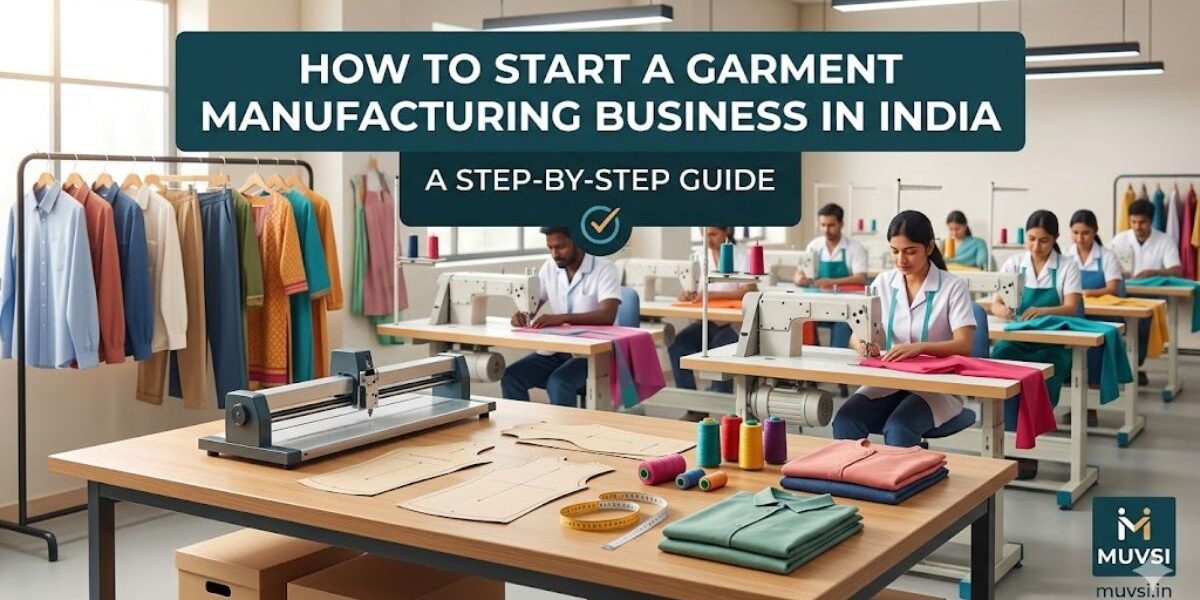
India’s garment industry is at a rare inflexion point. Domestically, the apparel market is projected to cross $100 billion by 2030, driven by rising incomes, a young population, and the explosion of D2C clothing brands on Instagram and Meesho. Internationally, the China+1 strategy is shifting global fashion brand orders to Indian manufacturers, and small units with quality stitching and reliable delivery are winning contracts that were unthinkable five years ago.
You do not need a fashion degree or a factory in Tirupur to start. A micro garment unit with 5 sewing machines in 400 sq ft can produce 150–200 pieces per day, generating ₹1.5–3 lakh in monthly revenue. A 10–15 machine unit can do ₹4–8 lakh per month. The business is labour-intensive, but it is one of the few manufacturing sectors where skilled labour is widely available across India.
This garment manufacturing business guide covers everything: niche selection, investment breakdown, machinery, fabric sourcing, the production process, licenses, profit calculation, where to sell in India and internationally, and the key mistakes that cause garment units to fail.
📊 QUICK FEASIBILITY SNAPSHOT: Garment Manufacturing Business
- Minimum Space: 400 – 1000 Sq. Ft. (Commercial/Industrial Shed)
- Required Capital: ₹7 Lakhs (Micro) to ₹18–25 Lakhs (Small Unit)
- Expected Gross Margin: 30% – 50%
- Mandatory Licenses: Udyam MSME, GST Registration
Applying for a Bank Loan under MUDRA, PMEGP, or CGTMSE?
Get a tailored project profile and financial projections built for your setup.
Jump to:
Market opportunity · Choosing your niche · Investment breakdown · Machinery guide · Fabric & raw material sourcing · Production process · Step-by-step startup · Licenses · Profit calculation · Where to sell · Top suppliers · FAQ
Why Garment Manufacturing Is a Strong Opportunity at Present
- India’s apparel market is growing fast. The Indian apparel market is growing steadily, with projections to cross ₹16 lakh crore (approx. US$193 billion) by 2030. The ready-made garment sector contributes significantly because of mass appeal and further penetration into semi-urban and rural areas. D2C clothing brands, e-commerce, and growing interest in small-batch and niche lines have opened ample scope for micro and small-scale garment producers.
- China+1 is real and accelerating. Global fashion brands — from fast fashion to activewear — are actively onboarding Indian manufacturers as backup and primary suppliers. Export opportunities have opened up, especially in the Middle East, Africa, and Southeast Asia, which have high respect for Indian garments because of their quality and pricing.
- E-commerce has lowered the barrier to D2C. Selling garments on Meesho, Flipkart, Amazon, and ONDC no longer requires a physical retail presence. A garment unit in Jaipur, Bhopal, or Coimbatore can sell nationally from day one. Meesho, in particular, has created a massive market for value-priced ethnic and casual wear from small manufacturers.
- Uniform and institutional demand is steady and large. School uniforms, corporate uniforms, hospital scrubs, and workwear generate repeat bulk orders that are price-stable and relationship-driven. One contract with a school chain or hospital can sustain a small unit’s cash flow for months.
- Job work model eliminates inventory risk. If brand-building feels too early, job work (contract stitching for established brands or exporters) lets you earn ₹15–25 per piece with zero fabric investment and zero inventory risk. Many successful unit owners start as job workers, build their team, and gradually shift to their own brand.
Choosing Your Niche: The Most Important Decision
The biggest mistake first-time garment manufacturers make is trying to make everything. Your niche determines your fabric sources, machinery configuration, buyer network, and pricing power. Pick one and master it before expanding.
Niche | Investment | Margin | Key buyers | Best for |
|---|---|---|---|---|
Kids’ wear | ₹5 – 12 lakh | 25–40% | Local retailers, Meesho, Amazon, exporters | High repeat purchase, low trend risk, strong demand all year |
Ethnic wear (kurtis, salwar suits) | ₹6 – 15 lakh | 25–40% | Local boutiques, wholesale, Meesho, Flipkart | India’s largest apparel segment — year-round demand with festival peaks |
T-shirts & casual wear | ₹8 – 20 lakh | 15–25% | Wholesale, brand job work, export | High volume, standardised production, export-ready |
School & corporate uniforms | ₹5 – 12 lakh | 18–28% | Schools, corporates, hospitals, government tenders | Guaranteed bulk orders, low marketing effort, predictable cash flow |
Activewear/athleisure | ₹10 – 25 lakh | 25–40% | D2C brands, gyms, export to UAE/UK/USA | Fastest growing segment globally — India has huge cost advantage |
Nightwear/innerwear | ₹8 – 18 lakh | 20–30% | Wholesale, Meesho, supermarkets, private label | Daily-use product, high volume, repeat purchase |
Job work (contract stitching) | ₹4 – 10 lakh | 12–18% on labour only | Export houses, established garment brands | Zero fabric risk, immediate cash flow, learn the process before investing more |
2026 recommendation: Start with kids’ wear or ethnic wear (kurtis) if you want to sell domestically on Meesho and to local retailers. Start with T-shirts or activewear if you want to target export markets. Start with uniforms if you want predictable B2B orders without marketing complexity.
Investment Breakdown: How Much Does It Cost?
Scale | Machines | Total Investment | Daily Output | Best For |
|---|---|---|---|---|
Micro unit | 5 machines | ₹5 – 8 lakh | 100–200 pieces/day | Testing market, job work, local supply |
Small unit | 10–15 machines | ₹12 – 20 lakh | 300–500 pieces/day | Local wholesale, Meesho/Amazon, small export |
Mid-scale unit | 25–40 machines | ₹25 – 50 lakh | 800–1,500 pieces/day | Regional wholesale, export orders, brand building |
Detailed cost breakdown (small unit — 10 machines, ₹12–18 lakh)
Item | Estimated Cost |
|---|---|
Single-needle lock-stitch machines (7 units × ₹18,000) | ₹1,26,000 |
Overlock/serger machines (2 units × ₹22,000) | ₹44,000 |
Cutting table + straight knife cutting machine | ₹35,000 – 60,000 |
Steam iron + pressing table (2 units) | ₹20,000 – 35,000 |
Button-hole machine (1 unit) | ₹25,000 – 45,000 |
Workspace rent + deposit (600–800 sq ft, 3 months) | ₹30,000 – 70,000 |
Electrical work (3-phase connection, wiring) | ₹20,000 – 40,000 |
Initial fabric stock (1 month) | ₹1.5 – 3 lakh |
Accessories (thread, buttons, zippers, labels, tags) | ₹20,000 – 40,000 |
Packaging (polybags, cartons, hangtags) | ₹15,000 – 30,000 |
GST + Udyam + Factory/Shops license | ₹8,000 – 15,000 |
Working capital (salaries, misc — 2 months) | ₹2 – 3 lakh |
Total | ₹7 – 13 lakh |
Tip on machinery: New sewing machines from brands like Juki, Brother, or Jack cost ₹15,000–25,000 each. Reconditioned machines from established dealers in Surat, Tirupur, or Delhi cost ₹7,000–14,000 and perform nearly as well for standard stitching. Start with a mix — new overlock and cutting machines (where quality matters most) and reconditioned basic lock-stitch machines.
Machinery: What You Need and When to Add It
Machine | Purpose | Price (new) | Priority |
|---|---|---|---|
Single-needle lock-stitch machine | Main stitching — seams, joins, collars, sleeves | ₹15,000 – 25,000 | Essential — buy first |
Overlock/serger (5-thread) | Finishes raw edges, prevents fraying — gives professional finish | ₹18,000 – 30,000 | Essential |
Straight knife cutting machine | Cuts multiple fabric layers at once — 10–20x faster than scissors | ₹8,000 – 18,000 | Essential |
Steam iron + pressing board | Final pressing before packing — critical for product quality | ₹5,000 – 12,000 | Essential |
Button-hole machine | Creates consistent button holes — needed for shirts, kurtas, trousers | ₹25,000 – 50,000 | Add in month 2–3 |
Flat-lock machine | Flat seam stitching — essential for T-shirts, activewear, innerwear | ₹20,000 – 40,000 | Only if making knitwear |
Snap button/rivet machine | Attaches metal snaps and rivets — needed for denim and kidswear | ₹5,000 – 12,000 | Niche-specific |
Label printer | Prints brand labels, size labels, price tags | ₹8,000 – 20,000 | Add when building own brand |
Machine brands in India (2026): Jack (Chinese, widely sold in India — best value for money), Juki (Japanese — premium quality, preferred by exporters), Brother (Japanese — reliable, good for small units), and Singer (entry-level, home to semi-commercial). For a small commercial unit, Jack machines offer the best balance of price and durability.
Fabric & Raw Material Sourcing: India’s Best Markets
Fabric sourcing — where to buy
Market | Location | Best for | MOQ |
|---|---|---|---|
Surat textile market | Surat, Gujarat | Synthetic fabrics, georgette, chiffon, printed fabric, saree material — India’s largest fabric market | 20–50 metres |
Tirupur cluster | Tirupur, Tamil Nadu | Knitted fabrics, T-shirt fabric (jersey, rib), innerwear fabric, export-grade cotton | 10–50 kg |
Gandhi Nagar, Delhi | New Delhi | Cotton fabrics, ethnic wear fabric, embroidered fabric, and ready-to-cut dress materials | 10–50 metres |
Bhiwandi / Dadar, Mumbai | Maharashtra | Cotton, linen, denim, canvas — wholesale fabric market | 20–100 metres |
Ichalkaranji | Maharashtra | Power loom woven fabrics — direct from mills | 100 metres+ |
Local wholesale fabric markets | All major cities | Starting point — 10–20 metre MOQ, cash purchase | 10 metres |
Other raw materials
Material | Source | Approx. cost |
|---|---|---|
Thread (polyester + cotton) | Local tailoring supply shops; Coats, Madura thread dealers | ₹80 – 150 per cone |
Buttons, snaps, hooks | Chandni Chowk (Delhi), local accessories markets | ₹0.50 – 5 per piece |
Zippers | YKK dealers (premium); local zippers (economy) — all major cities | ₹3 – 25 per zipper |
Elastic bands | Local trimmings suppliers | ₹20 – 60 per metre |
Interlining / fusible webbing | Garment accessories suppliers, Surat | ₹30 – 80 per metre |
Hangtags, size labels, woven labels | Label printers — local or online (IndiaMART) | ₹1 – 5 per piece |
Polybags, cartons for packing | Packaging suppliers, local | ₹0.50 – 3 per polybag |
Fabric buying strategy for beginners: Do not buy more than 2 months of fabric stock upfront. Fabric prices fluctuate, and unsold stock ties up working capital — the #1 cause of small garment unit failures. Start with a 3–4 week rolling stock, pay for fabric after receiving confirmed orders wherever possible, and always buy a 1–2 metre test swatch before placing a bulk order from a new supplier.
The Full Garment Production Process
Stage | What happens | Notes |
|---|---|---|
1. Design & pattern making | Create or buy master patterns for each style and size. Patterns determine fabric consumption per piece — accurate patterns reduce wastage. | Critical for cost control — 5% fabric wastage difference = significant margin impact |
2. Fabric inspection | Check each fabric roll for defects — colour variation, weaving faults, width inconsistency. Reject or segregate defective fabric before cutting. | Undetected fabric defects cause finished garment rejections — expensive to fix after stitching |
3. Spreading & laying | Spread fabric on cutting table in multiple layers. Lay master pattern pieces on top for marker planning (minimising waste). | Aim for less than 8% fabric wastage through efficient marker planning |
4. Cutting | Cut all pieces using a straight knife or band knife machine. Bundle cut pieces by size and style with a bundle ticket. | Accurate cutting ensures consistent sizing — size complaints from buyers always trace back here |
5. Stitching (assembly line) | Pieces move through sewing stations in sequence — join front/back, attach sleeves, collar, pockets. Each operator does one operation and passes to the next. | Assembly line (not individual tailors making whole garments) gives 3–5x more output per worker |
6. Overlock finishing | Raw edges of seams are finished using overlock machine to prevent fraying and improve durability. | — |
7. In-line quality check | Quality checker inspects every 10th garment during stitching. Catches issues before the entire batch is complete — much cheaper than end-of-line rejection. | In-line QC reduces final rejection rate from 8–12% to 2–3% |
8. Pressing/ironing | Steam-press each finished garment to remove creases and give a professional, retail-ready appearance. | Never skip this step — unpressed garments get rejected by all serious buyers |
9. Final inspection | 100% inspection of each piece: measurements, stitching quality, appearance, missing buttons/threads. Tag and label each approved piece. | — |
10. Packing | Fold, insert size label and hangtag, pack in polybag. Pack polybags into cartons with style number, size ratio, and quantity on outer label. | — |
Assembly line vs individual tailors: The biggest productivity mistake small units make is having each tailor make an entire garment. An assembly line — where each operator does one specific operation — gives 3–5x more output per worker. Train your team for specific operations and standardise from day one.
Step-by-Step: How to Start Your Garment Manufacturing Unit
Step 1 — Choose your niche and identify 5 buyers first (Week 1–2)
Do not buy a single machine before identifying 5 potential buyers in your niche. Visit local wholesale garment markets in your city. Talk to retailers. Ask which products are moving, what price they buy at, and what their minimum order quantity is. Real market intelligence — gathered on foot, not from Google — is what separates successful garment units from failed ones.
Step 2 — Register your business (Week 2–3)
Register on udyamregistration.gov.in for a free MSME status. Apply for GST. Get a Shops and Establishment license from your state Labour Department (or Factory License if 10+ workers in a factory premises). Total: ₹8,000–15,000 and 1–2 weeks.
Step 3 — Find and set up workspace (Week 2–4)
A 10-machine unit needs 600–800 sq ft minimum with good natural light, three-phase electricity, and ventilation. Industrial areas on the city outskirts give you lower rent and easier logistics. Ensure the space has washrooms — required under the Factories Act for any unit with workers. Rent with option to expand is preferable at this stage.
Step 4 — Buy machinery (Week 3–5)
Get quotes from at least 3 machine dealers. Visit the showroom. Ask for a stitching demo on your specific fabric type before purchase. For new machines, negotiate free installation + operator training. For reconditioned machines, insist on a 3-month warranty. Always buy your overlock and cutting machine new — these are the highest-wear machines and quality matters most.
Step 5 — Hire and train your team (Week 4–6)
Recruit experienced tailors from ITIs (Industrial Training Institutes), local tailoring clusters, or worker groups. Your team is your most critical asset — quality control, output speed, and reliability all depend on skill. Pay market rates (₹12,000–20,000/month depending on skill level and city). Invest in 1–2 weeks of assembly-line training before starting production.
Step 6 — Source fabric and produce first batch (Week 5–8)
Source from your nearest wholesale fabric market with a small trial order. Produce 100–200 pieces of your confirmed style. Measure each piece against your size spec. Press and pack professionally. Share physical samples with your target buyers before producing in bulk.
Step 7 — Get first orders and deliver on time (Week 7–10)
In the garment business, your reputation is built entirely on two things: quality consistency and on-time delivery. Your first 3–5 orders determine whether buyers reorder. Never overpromise delivery dates. Build in a 2–3 day buffer for every order. A garment unit that delivers on time, every time, builds a customer base faster than any marketing spend.
Step 8 — Scale channels (Month 3+)
Register as a seller on Meesho and Flipkart. List on IndiaMART as a garment manufacturer to attract B2B and export enquiries. Approach export houses if your quality meets the bar. Add a second shift before adding more machines — it is cheaper and tests whether demand justifies the capital expansion.
Licenses and Registrations Required
License / Registration | Where to apply |
|---|---|
Udyam (MSME) Registration | udyamregistration.gov.in |
GST Registration | gst.gov.in |
Shops & Establishment License | State Labour Department |
Factory License | State Labour / Factory Inspector |
IEC (Import Export Code) | dgft.gov.in |
DGFT Exporter Registration | dgft.gov.in |
Labour law compliance: For any unit with 10+ workers, the Factories Act requires: proper ventilation, fire safety equipment, clean washrooms, a first aid box, and proper lighting. ESIC (Employees’ State Insurance) and PF (Provident Fund) contributions are mandatory once you cross 10 employees. Build these costs into your manpower budget from the start.
Profit Calculation: What Can You Actually Earn?
Scenario A — Small unit, kids’ kurtis, 300 pieces/day (10 machines)
Item | Monthly figures |
|---|---|
Production (25 days × 300 pieces) | 7,500 pieces |
Avg selling price (wholesale, kids’ kurti) | ₹120 per piece |
Gross revenue | ₹9,00,000 |
Fabric (avg ₹1.2 metres × ₹55/metre × 7,500) | ₹4,95,000 |
Thread, buttons, accessories (₹8/piece) | ₹60,000 |
Labour (8 operators + 1 cutter + 1 QC = 10 workers × ₹14,000) | ₹1,40,000 |
Electricity (10 machines + lighting) | ₹18,000 |
Rent (700 sq ft) | ₹14,000 |
Packaging, transport, misc | ₹22,000 |
Total operating cost | ₹7,49,000 |
Monthly net profit | ₹1,51,000 (~17%) |
Scenario B — Ethnic wear (kurtis), D2C + Meesho mix, 200 pieces/day
Item | Monthly figures |
|---|---|
Production (25 days × 200 pieces) | 5,000 pieces |
Blended selling price (60% Meesho ₹350 + 40% wholesale ₹160) | ~₹274/piece avg |
Gross revenue | ₹13,70,000 |
Fabric (avg 2.5 metres × ₹65/metre × 5,000) | ₹8,12,500 |
Accessories, thread, labels (₹15/piece) | ₹75,000 |
Labour (8 workers × ₹14,500) | ₹1,16,000 |
Electricity, rent, Meesho commission (12%), misc | ₹1,25,000 |
Total operating cost | ₹11,28,500 |
Monthly net profit | ₹2,41,500 (~18%) |
Key insight: Garment manufacturing margins appear lower (15–25%) than other manufacturing businesses on this list, but the absolute rupee profit is high because of volume. A 10-machine unit doing ₹1.5–2.5 lakh per month profit is achievable and scalable. Add a second shift and you double output without doubling fixed costs.
Break-even: A ₹12–15 lakh small garment unit at 70% capacity typically recovers investment in 12–20 months — longer than some other manufacturing businesses but with higher absolute monthly income potential at scale.
Where to Sell Your Garments
Domestic wholesale (start immediately)
- Local wholesale garment markets — Every city has a wholesale garment market (Gandhi Nagar Delhi, Linking Road Mumbai, Commercial Street Bengaluru, Fancy Bazaar Guwahati). Retailers from within a 200 km radius buy from these markets. Get your samples into 5–10 wholesalers and let their network distribute for you.
- Distributors and agents — One good garment agent in your city can place your goods with 50–100 retailers. Standard agent commission is 3–5% of invoice value. Worth every rupee at the early stage when you need volume more than margin.
- School and corporate uniform contracts — Approach school administrations, hospital purchase departments, and corporate HR teams directly with samples and a price list. One school uniform contract (500–2,000 pieces per year) provides predictable cash flow and zero marketing cost.
Online channels (month 2+)
- Meesho — The highest-volume channel for value-priced ethnic wear and kids’ clothing in 2026. Register at meesho.com/supplier. Ethnic kurtis, kids’ dresses, and night suits consistently rank among the top-selling categories. Expect commissions of 10–15% but extremely high volume reach.
- Flipkart and Amazon — Larger minimum requirements but higher ASP (average selling price) and more credibility with buyers. Best for branded garments or institutional buyers rather than commodity fashion.
- ONDC (Open Network for Digital Commerce) — India’s government-backed open e-commerce network charges lower commission than Meesho or Flipkart. Growing fast in 2026, especially for regional brands.
- Instagram — For ethnic, kids’, and premium casual wear, Instagram is a high-margin D2C channel. A well-run garment brand Instagram account (consistent posting, styling photos, Reels) can generate 200–500 DM orders per month within 6 months.
Export channels (month 4+)
- Export houses (job work to start) — Export houses in Tirupur, Bengaluru, Delhi, and Mumbai, sub-contract stitching to small units. Get on their approved supplier list by submitting sample garments. Start with job work to learn export quality standards before taking direct export orders.
- IndiaMART as exporter — List as a garment manufacturer on IndiaMART with export capability. Middle East, Africa, and Southeast Asian buyers frequently source from Indian garment manufacturers through these platforms.
- Textile fairs — Gartex Texprocess India (Delhi, August 2026) and India International Garment Fair are the two key events for meeting export buyers. Even one contract from a fair can sustain a small unit for 6 months.
Top Fabric and Machinery Suppliers
Fabric wholesale hubs
Market | City | Best fabrics |
|---|---|---|
Ring Road Textile Market / Surat Textile Market | Surat, Gujarat | Synthetic, georgette, chiffon, printed fabrics — India’s largest fabric market |
Gandhi Nagar wholesale market | Delhi | Cotton, ethnic fabrics, ready-to-cut dress materials |
Tirupur knitwear cluster | Tirupur, Tamil Nadu | Cotton knit fabrics for T-shirts, innerwear, activewear |
Bhiwandi textile market | Mumbai, Maharashtra | Cotton, linen, denim, canvas — wide variety |
Ichalkaranji mills | Kolhapur, Maharashtra | Power loom woven fabrics direct from mills at mill price |
Sewing machine dealers
Common Mistakes to Avoid
- No confirmed buyers before buying the machines. Every failed garment unit started by buying machines and then looking for buyers. Reverse this. Confirm at least 3 buyers and get a sample approval before spending on machinery. The buyer’s sample approval is your business case.
- Individual tailors making whole garments. Putting one tailor in charge of making a complete garment gives you inconsistent quality and low output. Set up an assembly line from day one — even with 5 machines. It is the single biggest productivity improvement in garment manufacturing.
- Buying too much fabric upfront. Fabric is your largest working capital item. Fashion changes, buyers cancel, and sizes don’t sell. Never hold more than 3–4 weeks of fabric inventory. Buy fabric against confirmed orders wherever possible.
- Ignoring size specs and shrinkage. Garment buyers return entire batches for size inconsistency. Test every fabric for shrinkage before cutting — wash a 50 cm swatch and measure after. Build shrinkage allowance into your patterns.
- Delaying payment follow-up. Garment buyers — especially small retailers — will delay payment by 30–60 days if you allow it. Set payment terms clearly on every invoice. Offer 1–2% discount for advance payment. Late payments are the #1 cash flow killer in garment businesses.
- Skipping pressing before packing. A well-stitched garment that is not pressed looks cheap and gets rejected. Steam-pressing takes 30 seconds per piece and adds significant perceived value. Never ship without it.
Read: Top Manufacturing Business Ideas in India
Conclusion: Is Garment Manufacturing Worth Starting Now?
Yes — if you approach it with discipline on two fronts: confirm your buyers before you buy your machines, and run an assembly line from day one. These two decisions determine whether your unit is profitable or a money pit.
India’s domestic apparel market is growing, e-commerce has opened up national distribution from any city, and the China+1 export opportunity is the biggest tailwind the Indian garment industry has seen in a generation. The capital requirement is accessible, the labour market is deep, and the government actively supports garment exporters through RoDTEP incentives and export credit schemes.
Start with a niche you understand. Find 5 buyers. Get sample approval. Then buy your machines.
Frequently Asked Questions.
How much investment is needed to start a garment manufacturing business in India?
What is the profit margin in garment manufacturing?
What machines are needed to start a garment manufacturing unit?
Which garment niche is most profitable in India?
<
Brand / Source | Price range | Best for |
|---|---|---|
Jack machines (Chinese brand) | ₹12,000 – 22,000 (new) | Best value for money — widely used in small Indian garment units |
Juki / Brother (Japanese) | ₹22,000 – 40,000 (new) | Premium quality — preferred by export-oriented units |
Reconditioned machines (local dealers) | ₹7,000 – 14,000 | Good for starting micro units — buy from established dealers with a warranty |
Local machine dealers | All garment hubs — Surat, Tirupur, Delhi, Bengaluru | Full range of new and used machines with local service support |
What licenses are required for garment manufacturing in India?

Rupak Chakrabarty is the Founder and Lead Business Coach at MUVSI. With over two decades of experience in entrepreneurship, marketing, and business consulting, he helps aspiring entrepreneurs and MSMEs build profitable, market-driven businesses. His expertise includes business planning, B2B marketing, customer acquisition, and digital growth strategies.