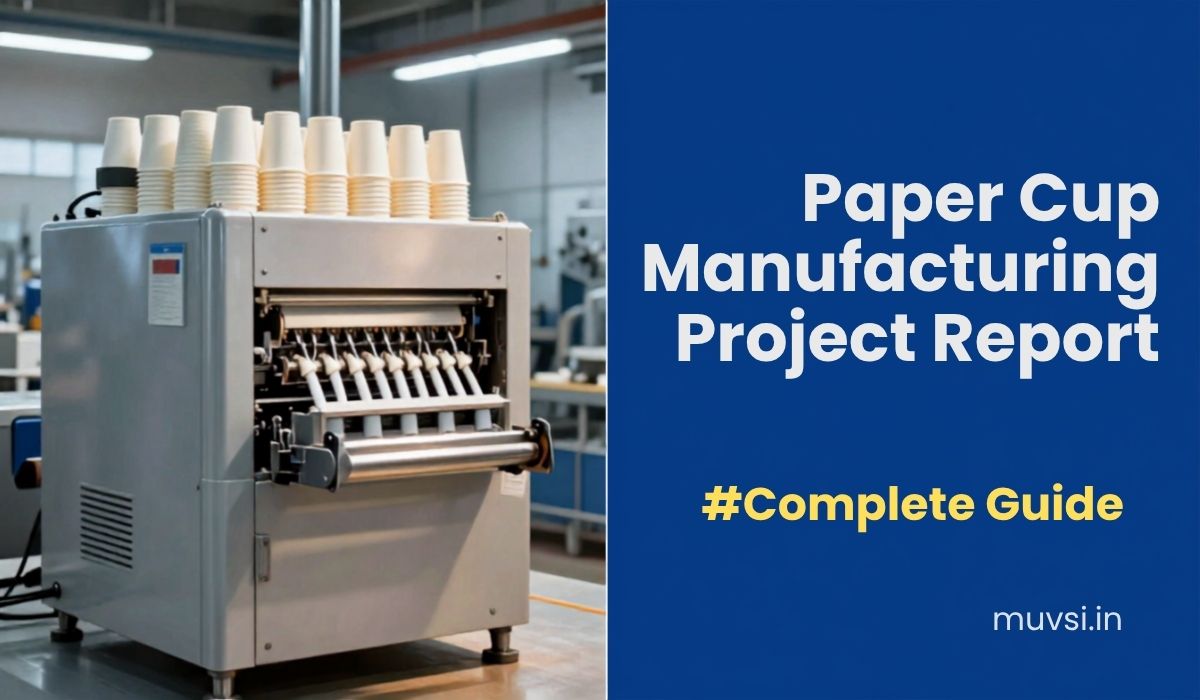
Starting a manufacturing business involves much more than purchasing machinery and renting a factory. Before investing your hard-earned capital, you need a clear understanding of the project’s financial viability, operational requirements, market potential, and expected returns. That’s precisely where a well-prepared project report becomes invaluable.
Whether you are planning to establish a small-scale paper cup manufacturing unit, applying for an MSME loan, seeking financial assistance from a bank, or simply evaluating the feasibility of the business, a comprehensive project report serves as your roadmap. It helps you estimate the total investment, calculate working capital requirements, assess profitability, identify operational risks, and make informed decisions before committing significant resources.
In this guide, I’ll walk you through the key components of a paper cup manufacturing project report based on practical business planning principles. While the financial figures used here are indicative and should be customised according to your location, production capacity, and machinery selection, the framework remains applicable for most small and medium-scale manufacturing units in India.
If you’re looking for a detailed, bank-ready DPR with financial statements, cash flow projections, break-even analysis, and Excel calculations, I’ll also explain what should be included in a professional project report later in this guide.
Executive Summary
The paper cup manufacturing industry has experienced steady growth over the past decade due to changing consumer preferences, increasing environmental awareness, and government initiatives aimed at reducing the use of single-use plastic products. Today, paper cups are widely used by tea stalls, coffee shops, restaurants, corporate offices, hospitals, educational institutions, caterers, and event organisers across India.
A paper cup manufacturing unit converts food-grade PE-coated paper into disposable cups of different sizes using automatic or semi-automatic machines. The finished products are then supplied through wholesalers, distributors, retailers, institutional buyers, or directly to commercial establishments.
A typical project involves investment in machinery, factory setup, electrical infrastructure, air compressor, dies, working capital, and raw materials. The profitability of the business depends largely on production efficiency, capacity utilisation, raw material costs, and the entrepreneur’s ability to build a consistent customer base.
From my experience working with entrepreneurs, the businesses that perform well are not necessarily those with the biggest machines. They are the ones that understand their market, control operating costs, and maintain regular production through repeat orders.
Project Snapshot
Particulars | Details |
|---|---|
Business | Paper Cup Manufacturing |
Industry | Disposable Paper Products |
Business Type | Manufacturing |
Investment Range | Small to Medium Scale |
Production Method | Automatic or Semi-Automatic |
Target Customers | Wholesalers, Distributors, Cafés, Hotels, Institutions, Caterers, Retailers |
Revenue Model | B2B Product Sales |
Expansion Opportunities | Paper Bowls, Paper Plates, Ripple Cups, Food Containers |
Why Prepare a Project Report?
Many first-time entrepreneurs prepare a project report only because the bank asks for one. In reality, the report should be prepared much earlier—before purchasing machinery or signing a factory lease.
A professionally prepared project report helps you:
- Estimate the total capital required for the project.
- Select the appropriate production capacity.
- Understand monthly operating expenses.
- Calculate working capital requirements.
- Evaluate expected profitability.
- Estimate the break-even period.
- Identify possible business risks before investing.
- Present a structured proposal to banks, financial institutions, or investors.
Think of it as a decision-making document rather than merely paperwork for loan approval.
Business Opportunity
The demand for disposable paper cups continues to grow across India due to changing consumption habits and the expansion of the food service industry. Tea stalls, quick-service restaurants, cafés, juice centres, cloud kitchens, offices, hospitals, and event organisers require disposable cups every day, creating a recurring market for manufacturers.
Unlike many consumer products that depend heavily on branding, paper cups are largely volume-driven. Buyers primarily evaluate suppliers based on consistent quality, timely delivery, competitive pricing, and the ability to fulfil repeat orders.
Another positive aspect of this industry is its scalability. Many successful manufacturers begin with standard paper cups and gradually diversify into products such as paper bowls, paper plates, ripple wall cups, and takeaway food containers. Since these products often serve the same customer base, diversification becomes a natural growth strategy.
However, market demand alone does not guarantee success. Entrepreneurs should conduct a local market survey to identify potential buyers, understand prevailing prices, analyse competitors, and estimate monthly sales before finalising their investment.
As I often advise aspiring manufacturers, never purchase machinery first and look for customers later. A business becomes financially sustainable when production is backed by a clear marketing strategy and a realistic sales pipeline.
Estimated Project Cost
The total investment required to establish a paper cup manufacturing unit varies depending on production capacity, level of automation, factory location, and working capital requirements.
A typical project may include the following cost components:
Cost Head | Estimated Share |
|---|---|
Paper Cup Making Machine | 40–50% |
Air Compressor & Accessories | 5–8% |
Electrical Installation | 3–5% |
Factory Rent & Security Deposit | 5–10% |
Furniture & Office Equipment | 2–3% |
Initial Raw Materials | 10–15% |
Packaging Materials | 2–3% |
Working Capital Reserve | 15–20% |
Miscellaneous & Contingency | 3–5% |
Rather than focusing only on the machinery cost, calculate the total project investment. Many entrepreneurs underestimate expenses such as installation, transportation, electrical work, initial inventory, labour salaries, and operating cash requirements. These hidden costs often create cash flow problems during the first few months of operation.
A comprehensive project report should therefore evaluate the entire investment requirement rather than simply estimating the price of the production machine.
Not sure if your numbers work?
Use our FREE Manufacturing Profitability Calculator
Machinery and Equipment Required
The machinery you select will have a direct impact on your production capacity, operating efficiency, maintenance costs, and ultimately the profitability of your business. While many first-time entrepreneurs focus primarily on the purchase price, experienced manufacturers evaluate a machine based on productivity, reliability, after-sales support, spare part availability, and ease of operation.
For a small or medium-scale paper cup manufacturing unit, a fully automatic paper cup making machine is generally the preferred choice. These machines offer consistent production quality, require fewer operators, and are capable of producing different cup sizes by changing moulds or dies.
Apart from the main production machine, you’ll also need supporting equipment to ensure smooth operations.
A typical setup includes:
- Fully Automatic Paper Cup Making Machine
- Air Compressor
- Cup Collection Table
- Paper Feeding System
- Dies and Moulds
- Electrical Control Panel
- Packing Table
- Hand Tools and Maintenance Equipment
Depending on your production plan, you may also invest in printing and die-cutting machines if you intend to manufacture printed paper blanks in-house. However, most new entrepreneurs initially purchase pre-printed paper blanks from specialised suppliers to reduce investment and simplify operations.
One mistake I frequently notice is entrepreneurs purchasing oversized machines simply because they promise higher production. Unless you already have confirmed buyers for large quantities, it’s often wiser to start with a machine that matches your expected sales volume. As demand grows, expanding production capacity becomes much easier than recovering from an underutilised investment.
Coach’s Note: Don’t choose a machine based only on price. Evaluate production speed, power consumption, service support, availability of spare parts, and the supplier’s reputation. A slightly more expensive machine from a reliable manufacturer often proves more economical over its lifetime.
Factory and Infrastructure Requirements
Unlike heavy engineering industries, a paper cup manufacturing unit does not require a large industrial complex. However, the production facility should be properly planned to ensure smooth workflow, safe storage of raw materials, and efficient movement of finished goods.
For a small-scale manufacturing unit, a workspace of approximately 800–1,500 square feet is generally sufficient. Larger units with multiple production lines may require considerably more space, depending on machine capacity and storage requirements.
The factory should ideally include separate areas for:
- Raw material storage
- Machine operation
- Quality inspection
- Packing section
- Finished goods storage
- Office and administrative work
Proper ventilation and lighting improve the working environment and help maintain product quality. Since paper is sensitive to moisture, raw material storage should remain clean, dry, and protected from water seepage.
A reliable three-phase electricity connection is essential for uninterrupted machine operation. Installing voltage stabilisation and maintaining an adequate compressed air supply also contribute to smoother production and lower maintenance issues.
Although water consumption is relatively low compared to many manufacturing industries, a continuous water supply should still be available for cleaning and general factory use.
Raw Materials Required
The quality of your finished paper cups depends largely on the quality of the raw materials used. Selecting reliable suppliers and maintaining consistent inventory levels are therefore critical aspects of production planning.
The primary raw materials required include:
PE-Coated Paper Blanks
These are food-grade paper sheets coated with polyethylene (PE), making the cups resistant to moisture and leakage. The thickness of the paper varies depending on the cup size and its intended use.
Bottom Reel
Bottom reels are used to form the base of the paper cup. They are usually purchased separately and should match the specifications of the paper blanks.
Printing Ink
If printed paper blanks are produced in-house, food-safe printing inks are required. Most small manufacturers, however, outsource printing and purchase ready-to-use printed blanks.
Packaging Materials
Finished paper cups are generally packed using:
- Polybags
- Corrugated cartons
- Strapping materials
- Adhesive tapes
- Labels
Maintaining an adequate stock of packaging materials ensures the timely dispatch of customer orders.
Whenever possible, establish long-term relationships with dependable raw material suppliers. Stable supply and consistent quality are often more valuable than marginal price savings.
Production Capacity Planning
Production capacity is one of the most important assumptions in any manufacturing project report because it directly influences revenue projections, manpower planning, and working capital requirements.
Capacity depends primarily on:
- Machine speed
- Cup size
- Production efficiency
- Operator skill
- Machine downtime
- Number of working shifts
For illustration, a fully automatic machine capable of producing approximately 80 cups per minute can manufacture nearly 38,000 to 40,000 cups during an eight-hour shift under normal operating conditions.
However, project reports should never assume 100% capacity utilisation from the beginning.
A more realistic approach is to estimate gradual utilisation, such as:
Year | Capacity Utilisation |
|---|---|
Year 1 | 60–65% |
Year 2 | 75–80% |
Year 3 | 85–90% |
These assumptions provide more realistic financial projections and are generally viewed more favourably by banks and financial institutions than overly optimistic estimates.
Manpower Requirement
The manpower requirement depends on the number of production lines, automation level, and production capacity. A small-scale unit can usually operate with a compact team during its initial phase.
A typical manpower structure may include:
Position | Responsibilities |
|---|---|
Machine Operator | Operating and monitoring production |
Helper | Material feeding and machine assistance |
Packing Staff | Counting, packing, and dispatch preparation |
Store Assistant | Inventory management |
Sales & Marketing Executive | Customer acquisition and order follow-up |
Supervisor/Owner | Production planning, quality control, and administration |
During the early stages, many entrepreneurs personally supervise production, procurement, customer communication, and accounts. This not only reduces operating costs but also provides valuable practical experience before expanding the workforce.
As production volume increases, responsibilities can gradually be delegated by appointing supervisors and specialised staff.
Working Capital Requirement
Many entrepreneurs estimate the cost of purchasing machinery but overlook the amount of working capital needed to run the business. In reality, insufficient working capital is one of the most common reasons why new manufacturing units struggle during their first year of operation.
Working capital refers to the funds required for day-to-day business operations. It covers expenses such as purchasing raw materials, paying employee salaries, electricity bills, transportation costs, factory rent, and other recurring operating expenses until payments are received from customers.
Unlike machinery, which is a one-time investment, working capital is continuously recycled as the business grows. The higher your production and sales volume, the greater your working capital requirement.
A typical paper cup manufacturing unit should plan for at least two to three months of operating expenses as working capital.
Major working capital components include:
- Purchase of PE-coated paper and bottom reels
- Packaging materials
- Employee salaries and wages
- Factory rent
- Electricity charges
- Transportation and delivery expenses
- Machine maintenance
- Administrative expenses
- Cash reserve for unexpected expenses
One important point that many first-time entrepreneurs ignore is the credit cycle. While raw material suppliers often expect payment within a short period, customers may take 30 to 60 days to settle invoices. Your project report should therefore include sufficient working capital to bridge this gap.
Coach’s Note: Never invest your entire budget in machinery. A production line without adequate working capital is like owning a vehicle without fuel. The machine may be installed, but production will eventually stop if you don’t have enough cash to purchase raw materials or meet monthly operating expenses.
Estimated Monthly Operating Expenses
Every project report should provide an estimate of recurring monthly expenses. These figures help entrepreneurs understand the minimum sales required to operate the business sustainably.
Although actual expenses vary depending on location, production capacity, and business scale, the major cost heads generally include:
Expense Head | Nature of Expense |
|---|---|
Raw Materials | Variable |
Employee Salaries | Fixed |
Factory Rent | Fixed |
Electricity | Semi-variable |
Packing Materials | Variable |
Transportation | Variable |
Machine Maintenance | Semi-variable |
Office & Administrative Expenses | Fixed |
Marketing & Sales | Variable |
Miscellaneous Expenses | Fixed |
Among these, raw materials account for the largest share of production costs. Even a small increase in paper prices can significantly affect profitability if selling prices remain unchanged.
Entrepreneurs should review operating expenses periodically and negotiate with suppliers wherever possible to maintain healthy margins.
Revenue Projections
Revenue projections form the backbone of any manufacturing project report. However, they should always be based on realistic assumptions rather than optimistic expectations.
When preparing financial estimates, consider the following factors:
- Production capacity of the machine
- Expected capacity utilisation
- Product mix
- Average selling price
- Market demand
- Production losses
- Machine downtime
For example, if a machine has a theoretical capacity of 40,000 cups per day, it is unrealistic to assume full utilisation immediately after installation.
A practical approach is to estimate gradual growth as the business establishes itself in the market.
A sample projection may look like this:
Financial Year | Capacity Utilisation |
|---|---|
Year 1 | 60–65% |
Year 2 | 75–80% |
Year 3 | 85–90% |
This approach reflects the time required to build a customer base, optimise production, and improve operational efficiency.
As production increases, economies of scale often reduce the cost per cup, leading to better profit margins over time.
Profitability Analysis
Profitability should never be evaluated solely on the selling price of a paper cup. A comprehensive analysis considers all production and operating expenses before estimating the actual earnings of the business.
The key factors influencing profitability include:
- Cost of raw materials
- Machine efficiency
- Production wastage
- Labour productivity
- Electricity consumption
- Selling price
- Transportation cost
- Capacity utilisation
Businesses operating below capacity usually experience lower profitability because fixed expenses such as rent, salaries, and administrative costs remain largely unchanged regardless of production volume.
Conversely, as production approaches optimum capacity, the fixed cost per unit decreases, improving overall profitability.
In my experience, entrepreneurs who consistently monitor production costs and review their pricing strategy are better positioned to maintain healthy margins, even during periods of fluctuating raw material prices.
Rather than focusing only on gross profit, evaluate the business based on sustainable net profitability after accounting for all operating expenses.
Break-even Analysis
Break-even analysis helps determine the point at which total revenue equals total operating costs. In simple terms, it indicates how much production or sales are required before the business starts generating profits.
Every manufacturing project incurs two broad categories of expenses:
Fixed Costs
These expenses remain relatively constant regardless of production volume.
Examples include:
- Factory rent
- Employee salaries
- Insurance
- Administrative expenses
- Equipment depreciation
Variable Costs
These expenses increase or decrease with production.
Examples include:
- Paper rolls
- Bottom reels
- Packaging materials
- Electricity consumption
- Transportation
Understanding this distinction is essential when estimating the break-even point.
A professionally prepared project report calculates:
- Monthly fixed costs
- Variable cost per unit
- Contribution margin
- Break-even production level
- Estimated payback period
Although the actual break-even period varies from project to project, businesses that maintain consistent production, efficient cost control, and a diversified customer base generally recover their investment more quickly than those operating with irregular orders or low machine utilisation.
Coach’s Note: Many entrepreneurs ask me how long it takes to recover their investment. My answer is always the same—it depends less on the machine and more on your ability to keep it running. A machine producing 30,000 cups every day is far more profitable than a larger machine sitting idle because there are no customer orders.
Financial Assumptions Used in a Project Report
Every financial projection is based on assumptions. Understanding these assumptions is just as important as understanding the numbers themselves.
Typical assumptions include:
- Number of working days per month
- Number of production shifts
- Machine efficiency
- Capacity utilisation
- Average selling price
- Annual increase in operating expenses
- Expected inflation in raw material prices
- Credit period offered to customers
- Collection period for receivables
Banks and investors generally prefer conservative assumptions because they present a more realistic picture of the project’s financial viability.
Avoid preparing project reports based on unrealistic production targets or unusually high profit margins. A well-balanced report builds greater credibility and helps entrepreneurs make informed investment decisions.
SWOT Analysis
Before investing in any manufacturing project, it is important to evaluate both the opportunities and the challenges associated with the business. A SWOT analysis provides a structured way to assess the internal strengths and weaknesses of the project, along with external opportunities and potential threats.
Strengths
The paper cup manufacturing business offers several advantages that make it attractive for small- and medium-scale entrepreneurs.
- Growing demand from the food service industry.
- Comparatively simple manufacturing process.
- Availability of automatic machinery.
- Repeat demand from commercial buyers.
- Opportunity to diversify into related disposable products.
- Scalable business model with relatively moderate investment.
Another strength is that paper cups are consumable products. Businesses such as tea stalls, cafés, restaurants, hospitals, and offices require them regularly, resulting in recurring demand rather than one-time purchases.
Weaknesses
Like every manufacturing business, paper cup production also has certain limitations.
- Profit margins can fluctuate due to changes in raw material prices.
- Significant working capital is required to manage inventory and customer credit.
- Success depends on maintaining consistent product quality.
- High dependence on production efficiency and machine uptime.
- Limited pricing flexibility in highly competitive markets.
Entrepreneurs entering the industry should understand these challenges beforehand and prepare realistic financial plans.
Opportunities
The long-term growth prospects for the industry remain encouraging.
Some important opportunities include:
- Rising demand for eco-friendly disposable products.
- Expansion of cafés and quick-service restaurants.
- Growth of food delivery platforms.
- Increasing institutional demand.
- Export opportunities in selected international markets.
- Product diversification into paper bowls, food containers, and paper plates.
Manufacturers that focus on quality, customer service, and timely delivery often find it easier to expand their market share over time.
Threats
Every business also faces external risks that cannot always be controlled.
Some major threats include:
- Volatility in paper prices.
- Entry of new competitors.
- Price-based competition.
- Delayed customer payments.
- Technological advancements requiring machinery upgrades.
- Changes in environmental regulations affecting raw materials.
Understanding these risks allows entrepreneurs to prepare suitable contingency plans instead of reacting after problems occur.
Risk Assessment and Mitigation
A good project report should not only highlight the opportunities but also explain the potential risks and how they can be managed.
Market Risk
Demand may fluctuate due to local competition or economic conditions.
Mitigation: Build a diversified customer base instead of depending on one or two buyers.
Raw Material Risk
PE-coated paper prices can change significantly during the year.
Mitigation: Develop relationships with multiple suppliers and maintain optimum inventory levels without overstocking.
Operational Risk
Machine breakdowns can interrupt production and delay customer deliveries.
Mitigation: Follow preventive maintenance schedules, maintain critical spare parts, and train operators properly.
Financial Risk
Insufficient working capital can create cash flow problems even when customer demand is strong.
Mitigation: Maintain adequate cash reserves and monitor receivables regularly.
Customer Concentration Risk
Some manufacturers depend heavily on a single distributor or institutional buyer.
Mitigation: Continuously acquire new customers and expand into different market segments.
Funding Options for a Paper Cup Manufacturing Project
One of the advantages of manufacturing businesses is the availability of institutional finance. Entrepreneurs with a well-prepared project report have several options for raising capital.
Depending on your eligibility and project size, funding may be available through:
- Commercial Banks
- Public Sector Banks
- Private Banks
- Non-Banking Financial Companies (NBFCs)
- Machinery Finance Companies
- MSME Financing Schemes
- State Financial Corporations
Many entrepreneurs also combine their own investment with bank finance to reduce borrowing costs while maintaining adequate working capital.
Before approaching any lender, ensure that your project report contains realistic financial projections, detailed investment estimates, projected profitability, and complete documentation.
A professionally prepared project report significantly improves the quality of discussions with financial institutions.
Common Reasons Banks Reject Manufacturing Loan Applications
During my interactions with entrepreneurs, I’ve observed that loan applications are rarely rejected because the business idea is weak. In many cases, the rejection occurs because the proposal itself is incomplete or unrealistic.
Some common reasons include:
- Unrealistic sales projections.
- Underestimation of working capital.
- Incomplete project reports.
- Lack of promoter contribution.
- Poor financial documentation.
- No market assessment.
- Weak repayment projections.
- Inadequate collateral, where applicable.
- Insufficient industry knowledge was demonstrated by the applicant.
Preparing a professional project report helps address many of these issues before the application reaches the bank.
Remember that banks evaluate not only the project but also the entrepreneur’s preparedness and understanding of the business.
My Professional Assessment
From a business consultant’s perspective, paper cup manufacturing remains one of the more accessible manufacturing opportunities for first-generation entrepreneurs. However, its success depends less on the machine you purchase and more on the business systems you build around it.
Entrepreneurs often spend considerable time comparing machinery but very little time identifying prospective customers, estimating working capital requirements, or planning their sales strategy. In reality, these factors have a far greater impact on long-term profitability than selecting a machine that produces a few extra cups per minute.
If I were advising a new entrepreneur today, my priorities would be:
- Conduct a local market survey before investing.
- Purchase machinery that matches realistic demand.
- Maintain sufficient working capital for at least three months.
- Build relationships with multiple raw material suppliers.
- Develop a structured sales plan before commercial production begins.
- Focus on repeat customers rather than one-time orders.
A manufacturing business becomes sustainable when production, finance, procurement, and marketing work together—not when any one of these functions is treated in isolation.
Related Guides
If you’re planning to start a paper cup manufacturing business, these resources may also help:
- How to Start a Paper Cup Manufacturing Business
- Paper Cup Making Machine Price
- How to Sell Paper Cups
- Paper Plate Machine Suppliers
Reading these guides alongside this article will give you a complete understanding of the investment, production process, profitability, and day-to-day operations of the business.
Final Thoughts from the Author
Over the years, I’ve interacted with many aspiring entrepreneurs who wanted to enter manufacturing. One pattern stands out: most people spend weeks comparing machines but very little time validating demand, estimating working capital, or planning their sales strategy.
A paper cup manufacturing business can certainly be profitable, but only when it is approached as a business—not merely as a machine purchase. Before investing, prepare realistic financial estimates, understand your local market, identify potential buyers, and build relationships with reliable machinery and raw material suppliers.
A well-researched project report is not just a document for bank finance. It is your roadmap for making informed business decisions. The more effort you invest in planning, the fewer surprises you’ll encounter after production begins.

Rupak Chakrabarty is the Founder and Lead Business Coach at MUVSI. With over two decades of experience in entrepreneurship, marketing, and business consulting, he helps aspiring entrepreneurs and MSMEs build profitable, market-driven businesses. His expertise includes business planning, B2B marketing, customer acquisition, and digital growth strategies.