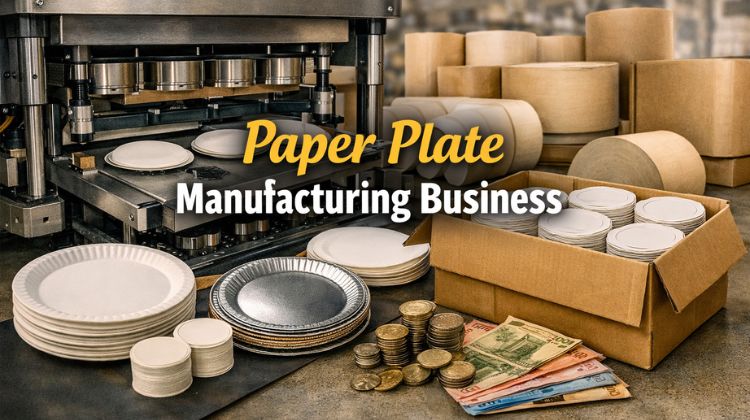
Every article about the paper plate manufacturing business describes it as a low-investment opportunity with high profits and ever-growing demand. While there is some truth to these claims, they often leave out the realities that determine whether a business succeeds or fails.
The demand for disposable paper plates continues to grow in India, driven by catering companies, restaurants, street food vendors, religious events, corporate gatherings, and the expanding food delivery industry. At the same time, increasing awareness about environmentally friendly alternatives to plastic has encouraged more businesses to adopt paper-based disposable products.
However, starting a paper plate manufacturing business is about much more than purchasing a machine and producing thousands of plates every day. Your profitability will depend on factors such as production efficiency, raw material procurement, pricing strategy, distribution network, and your ability to secure consistent orders.
One mistake I frequently notice among first-time entrepreneurs is that they spend weeks comparing machine specifications but very little time understanding their local market. The reality is simple: a machine can manufacture paper plates, but only customers can generate revenue. Entrepreneurs who establish relationships with wholesalers, distributors, caterers, and institutional buyers before investing in machinery generally perform far better than those who start production without a sales strategy.
Fortunately, the business remains attractive for entrepreneurs looking to enter the manufacturing sector. It requires a relatively moderate investment, the technology is easy to understand, and the business can be expanded gradually as demand increases.
In this comprehensive guide, you’ll learn everything you need to know about starting a paper plate manufacturing business in India, including investment requirements, machinery, raw materials, manufacturing process, licenses, profit margins, marketing strategies, common mistakes, and practical tips to build a sustainable manufacturing business.
Quick Business Snapshot
Particular | Details |
|---|---|
Industry | Disposable Paper Products |
Investment | ₹3 Lakhs – ₹25 Lakhs |
Profit Margin | 15%–30% (Net varies by scale) |
Space Required | 800–3,000 sq. ft. |
Electricity Requirement | 3–15 kW |
Raw Materials | PE-coated Paper, Printed Paper Board, Packaging Material |
Business Model | Manufacturing & Wholesale Supply |
Ideal For | First-time Entrepreneurs, MSMEs, Women Entrepreneurs |
Break-even Period | 18–36 Months |
Demand | High and Growing |
The Reality of the Paper Plate Manufacturing Business

Most people assume that once a paper plate machine is installed, profits will automatically follow. In reality, manufacturing is only one part of the business. The bigger challenge is maintaining consistent sales throughout the year.
Paper plates are generally sold in large volumes at relatively small margins. This means your profitability depends on machine utilisation rather than production capacity alone. A fully automatic machine capable of producing thousands of plates per hour offers little advantage if it remains idle for several days every month.
Raw material prices also fluctuate based on paper costs, transportation charges, and supplier availability. Entrepreneurs who purchase materials in bulk from reliable suppliers often enjoy better margins than those buying in small quantities.
Another important consideration is market competition. While demand continues to grow, many cities already have several local manufacturers supplying retailers and distributors. Before investing, spend time understanding your local market, identifying potential buyers, and analysing prevailing selling prices.
From my perspective, paper plate manufacturing should be viewed as a manufacturing plus distribution business. Efficient production reduces costs, but an effective sales network generates profits. If you can consistently secure wholesale customers, maintain product quality, and control operating expenses, this business can provide stable long-term returns.
Market Potential of the Paper Plate Manufacturing Business in India
The demand for disposable paper products has increased steadily over the last decade, making the paper plate manufacturing business one of the most attractive opportunities in the small-scale manufacturing sector. Rising urbanisation, changing lifestyles, growth of the food service industry, and increasing awareness about environmentally friendly products have significantly expanded the market for paper plates.
Paper plates are widely used in restaurants, food courts, street food stalls, sweet shops, catering businesses, schools, hospitals, temples, corporate cafeterias, weddings, birthday parties, exhibitions, and various social events. Since they are lightweight, economical, and hygienic, paper plates continue to replace traditional reusable utensils in many situations.
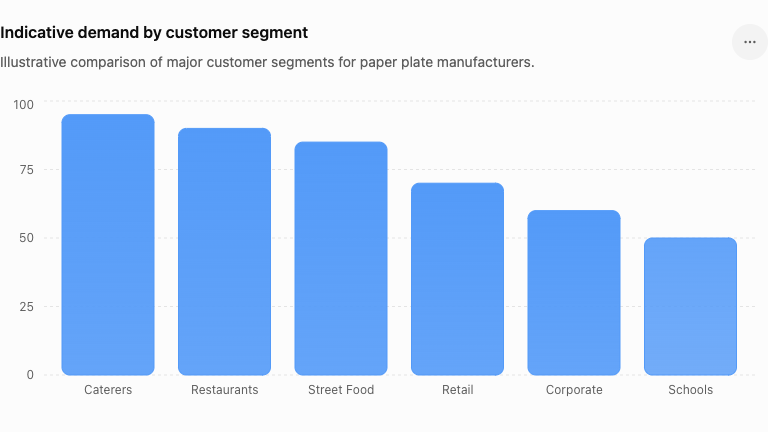
Government initiatives promoting eco-friendly alternatives to single-use plastic have also encouraged businesses and consumers to shift towards paper-based disposable products. Although plastic products have not disappeared completely, the long-term outlook for paper products remains positive.
Another advantage of this industry is that demand exists throughout the year. Festivals, marriage seasons, religious gatherings, political meetings, and community events often result in sharp increases in paper plate consumption, allowing manufacturers to benefit from seasonal spikes in sales.
However, demand alone does not guarantee success. Before investing, study your local market carefully. Identify existing manufacturers, wholesalers, distributors, retailers, and institutional buyers. Understanding local pricing, preferred plate sizes, and purchasing patterns will help you position your business more effectively.
Industries That Use Paper Plates
One of the biggest advantages of starting a paper plate manufacturing business is the diversity of customers. Instead of depending on a single industry, manufacturers can supply products to multiple sectors.
Industry | Application |
|---|---|
Restaurants | Takeaway meals and quick service |
Street Food Vendors | Serving snacks and fast food |
Catering Companies | Wedding and event catering |
Sweet Shops | Serving sweets and snacks |
Corporate Offices | Cafeterias and meetings |
Schools & Colleges | Functions and canteens |
Religious Organizations | Community meals and festivals |
Retail Stores | Household disposable products |
Online Sellers | E-commerce sales |
Instead of targeting every customer initially, focus on building long-term relationships with wholesalers and distributors. They purchase in larger quantities and provide recurring business.
Types of Paper Plates You Can Manufacture
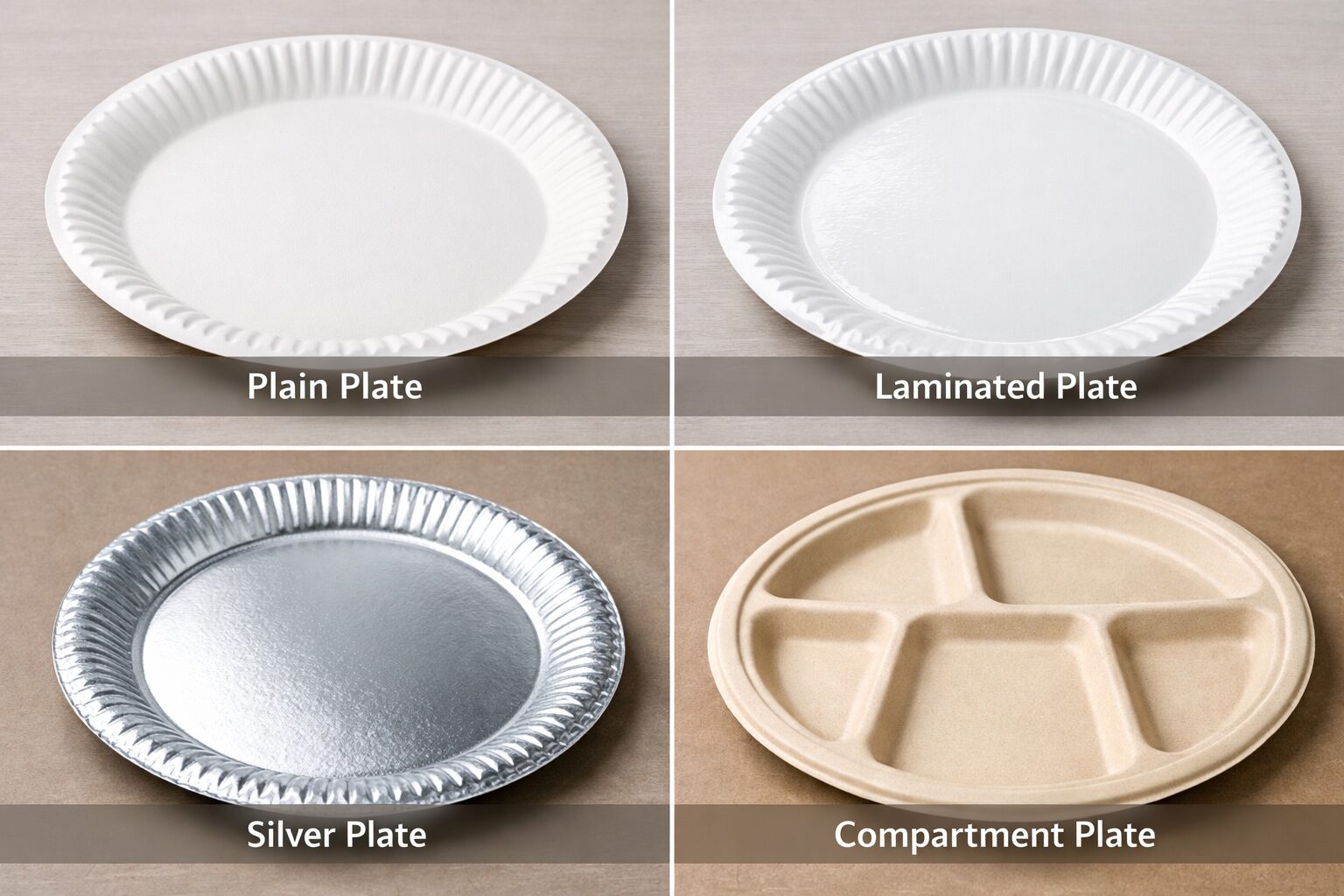
The paper plate market offers several product categories. Choosing the right products depends on your investment capacity, target customers, and machinery.
Type | Common Uses | Profit Potential |
|---|---|---|
Plain Paper Plates | Street food, tea stalls | Medium |
Laminated Paper Plates | Restaurants & Catering | High |
Printed Paper Plates | Events & Parties | High |
Silver Laminated Plates | Sweet Shops | High |
Compartment Plates | Meals & Buffets | Very High |
Custom Branded Plates | Hotels & Food Chains | Premium |
Many entrepreneurs begin by manufacturing standard round paper plates and gradually expand into compartment plates, laminated products, and customised designs as their customer base grows.
My Advice: Don’t try to manufacture every size from day one. Start with the two or three plate sizes that have the highest demand in your local market and expand your product range after establishing steady sales.
Investment Required to Start a Paper Plate Manufacturing Business
One of the biggest advantages of a paper plate manufacturing business is that it can be started at different investment levels. Whether you have ₹3 lakh or ₹30 lakh, you can choose a business model that matches your budget and production goals.
The total investment primarily depends on the type of machine you purchase, production capacity, working capital requirements, and whether you plan to manufacture plain, laminated, or printed paper plates.
For most first-time entrepreneurs, I recommend starting with a semi-automatic or entry-level automatic machine rather than investing heavily in a fully automatic production line. This allows you to understand the market, establish customers, and gain operational experience before expanding.
The table below provides an estimated investment requirement for a small-scale paper plate manufacturing unit.
Particular | Estimated Cost (₹) |
|---|---|
Paper Plate Making Machine | 2,50,000 – 8,00,000 |
Air Compressor & Accessories | 25,000 – 60,000 |
Electrical Installation | 20,000 – 50,000 |
Furniture & Office Equipment | 30,000 – 75,000 |
Factory Setup | 40,000 – 1,00,000 |
Raw Material (Initial Stock) | 75,000 – 2,00,000 |
Packaging Material | 25,000 – 50,000 |
Working Capital | 1,00,000 – 5,00,000 |
Total Estimated Investment | ₹5 Lakh – ₹18 Lakh |
These figures are indicative and may vary depending on your location, machine manufacturer, production capacity, and raw material prices.
Expert Tip:
Many entrepreneurs spend almost their entire budget on machinery and leave very little money for working capital. In my opinion, this is one of the biggest reasons why small manufacturing businesses struggle during their initial months. Always keep sufficient funds for raw materials, labour, transportation, and day-to-day operations.
Paper Plate Making Machines Required
The machine is undoubtedly the most important investment in your manufacturing unit. However, buying the most expensive machine doesn’t necessarily mean you’ll build the most profitable business.
Your choice should depend on expected production volume, available capital, labour availability, and target customers.
Machine Type | Production Capacity | Ideal For |
|---|---|---|
Manual Machine | Low | Home-based business |
Semi-Automatic Machine | Medium | Small manufacturers |
Automatic Machine | High | Commercial production |
Fully Automatic High-Speed Line | Very High | Large-scale manufacturing |
Most small entrepreneurs begin with a semi-automatic or automatic machine capable of manufacturing multiple plate sizes. As demand grows, additional dies and machines can be added without significantly changing the factory layout.
My Advice Before Buying a Machine
Don’t choose a machine simply because it offers the highest production capacity. Instead, calculate how many plates you can realistically sell every month.
A machine capable of producing 12 lakh plates per month offers little advantage if your market can absorb only 3 lakh plates. Lower utilisation increases your production cost per plate and delays your break-even.
Purchase machinery that matches your current market demand, not your future expectations.
Space Requirement for a Paper Plate Manufacturing Unit
The space requirement depends on production capacity and the number of machines installed. A small unit can usually operate comfortably from an area of around 800–1,000 square feet, while larger commercial units may require more than 3,000 square feet.
Your factory should have separate areas for:
- Raw material storage
- Production area
- Finished goods storage
- Packing section
- Office space
- Loading and unloading
A well-planned factory layout improves workflow, reduces material handling time, and minimises product damage.
Electricity Requirement
Paper plate manufacturing does not require extremely high power consumption. Most small and medium automatic machines operate efficiently with a three-phase electricity connection.
Business Size | Power Requirement |
|---|---|
Small Unit | 3–5 kW |
Medium Unit | 5–10 kW |
Large Unit | 10–15 kW |
Before purchasing machinery, confirm the electrical specifications with the manufacturer and ensure your factory has adequate wiring and safety equipment.
Raw Materials Required for Paper Plate Manufacturing
The quality of your finished paper plates depends largely on the quality of the raw materials you purchase. While machinery plays an important role in production efficiency, poor-quality paperboard can result in weak plates, improper shaping, excessive wastage, and customer complaints.
For this reason, developing relationships with reliable raw material suppliers should be one of your priorities before starting production.
The primary raw material used in paper plate manufacturing is food-grade paperboard. Depending on the type of plate you intend to manufacture, you may use plain paperboard, PE-coated paper, laminated paperboard, or printed sheets.
Raw Material | Purpose |
|---|---|
Paper Board Sheets | Main raw material |
PE Coated Paper | Moisture resistance |
Printed Paper Sheets | Decorative paper plates |
Silver Laminated Paper | Premium disposable plates |
Lamination Film | Additional protection |
Packing Covers | Packaging finished products |
Carton Boxes | Transportation |
Since paper prices fluctuate throughout the year, monitor supplier quotations regularly. Purchasing raw materials in bulk often reduces your production cost per plate and improves profit margins.
My Advice:
Don’t depend on a single supplier. Maintain relationships with at least three reliable paper suppliers. If one supplier experiences stock shortages or sudden price increases, your production schedule won’t be affected.
Paper Plate Manufacturing Process
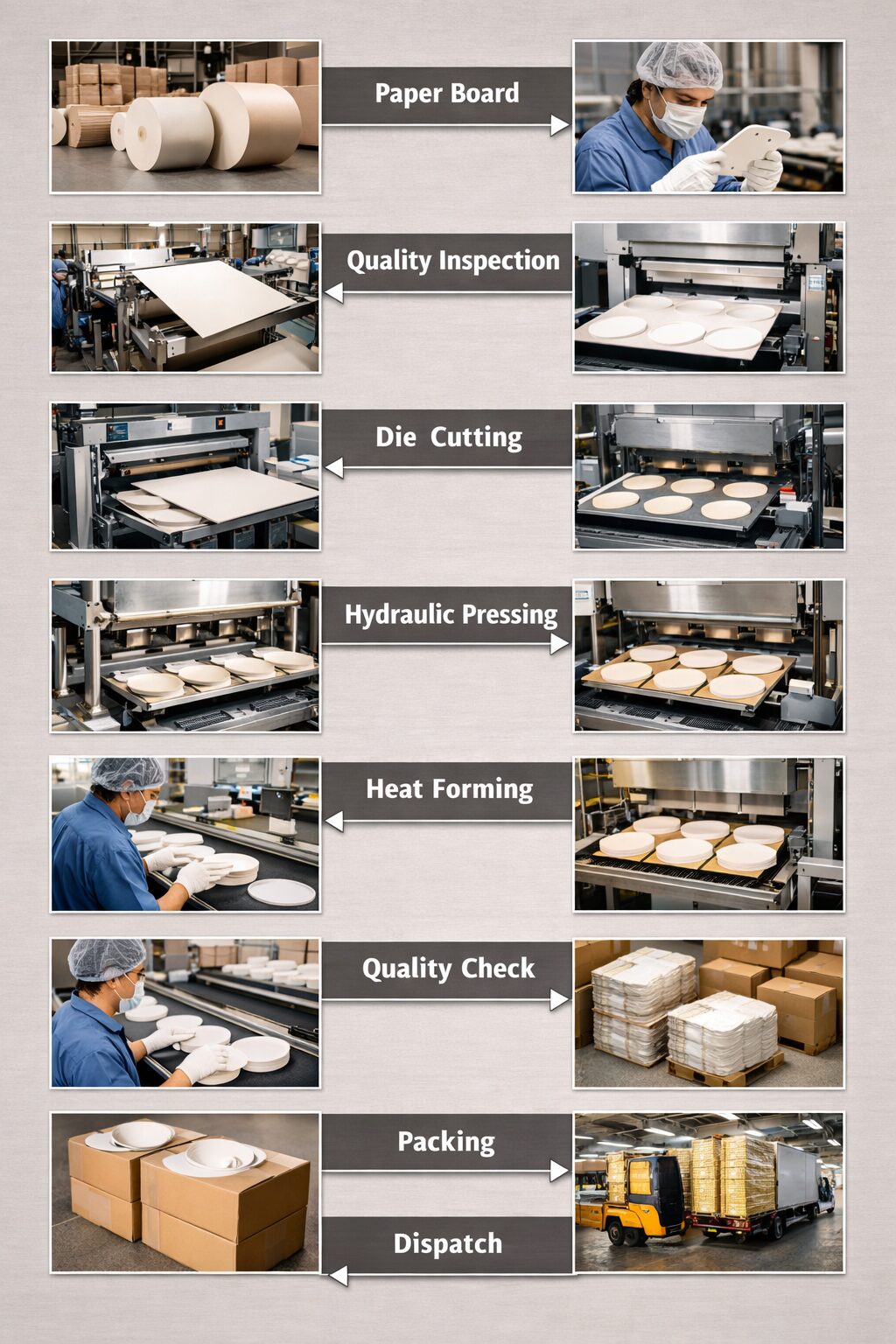
The manufacturing process is relatively simple and does not require highly specialised technical knowledge. Modern automatic machines complete most operations with minimal manual intervention, allowing entrepreneurs to focus on quality control and production planning.
The typical manufacturing process consists of the following stages.
- Procurement of paperboard sheets.
- Inspection of raw material quality.
- Loading paper sheets into the machine.
- Die cutting according to the required plate size.
- Hydraulic or pneumatic pressing.
- Heat sealing and shaping.
- Quality inspection.
- Counting and packing.
- Storage and dispatch.
Modern automatic machines can manufacture several plate sizes by simply replacing the dies, allowing manufacturers to diversify their product range without purchasing a completely new machine.
Production Tip:
Never ignore quality inspection. A small percentage of defective plates can damage your reputation with wholesalers, especially when supplying restaurants and catering companies that purchase in bulk.
Production Capacity
Production capacity depends on machine speed, plate size, operator efficiency, working hours, and machine maintenance.
Machine Type | Approximate Daily Production |
|---|---|
Manual Machine | 5,000–8,000 Plates |
Semi Automatic | 15,000–30,000 Plates |
Automatic Machine | 40,000–80,000 Plates |
High-Speed Automatic | 1,00,000+ Plates |
These figures are indicative and vary depending on machine specifications and plate size.
Licenses and Registrations Required
Although paper plate manufacturing is relatively simple, every business should comply with applicable legal and regulatory requirements.
License | Purpose |
|---|---|
Business Registration | Legal business entity |
Udyam Registration | MSME benefits |
GST Registration | Tax compliance |
Trade License | Local authority approval |
Factory License (where applicable) | Factory operations |
Pollution Control Approval (if applicable) | Environmental compliance |
Shop & Establishment Registration | State regulations |
The exact licenses required depend on your production scale, state regulations, and business structure. If you qualify as a Micro, Small, or Medium Enterprise, consider registering your business under the Udyam Registration Portal to access various government schemes and MSME benefits.
Manpower Requirement
A small paper plate manufacturing unit can operate efficiently with a limited workforce.
Position | Number |
|---|---|
Machine Operator | 1–2 |
Helper | 1–2 |
Packing Staff | 1 |
Sales & Marketing | 1 |
Owner / Supervisor | 1 |
As production increases, additional operators and packing staff can be hired without significantly changing the business structure.
My Advice Before Hiring:
During the initial months, keep your fixed salary expenses as low as possible. Invest your resources in building customers rather than expanding your workforce too quickly. Once production becomes consistent, scaling your team becomes much easier.
Manufacturing Cost of Paper Plates
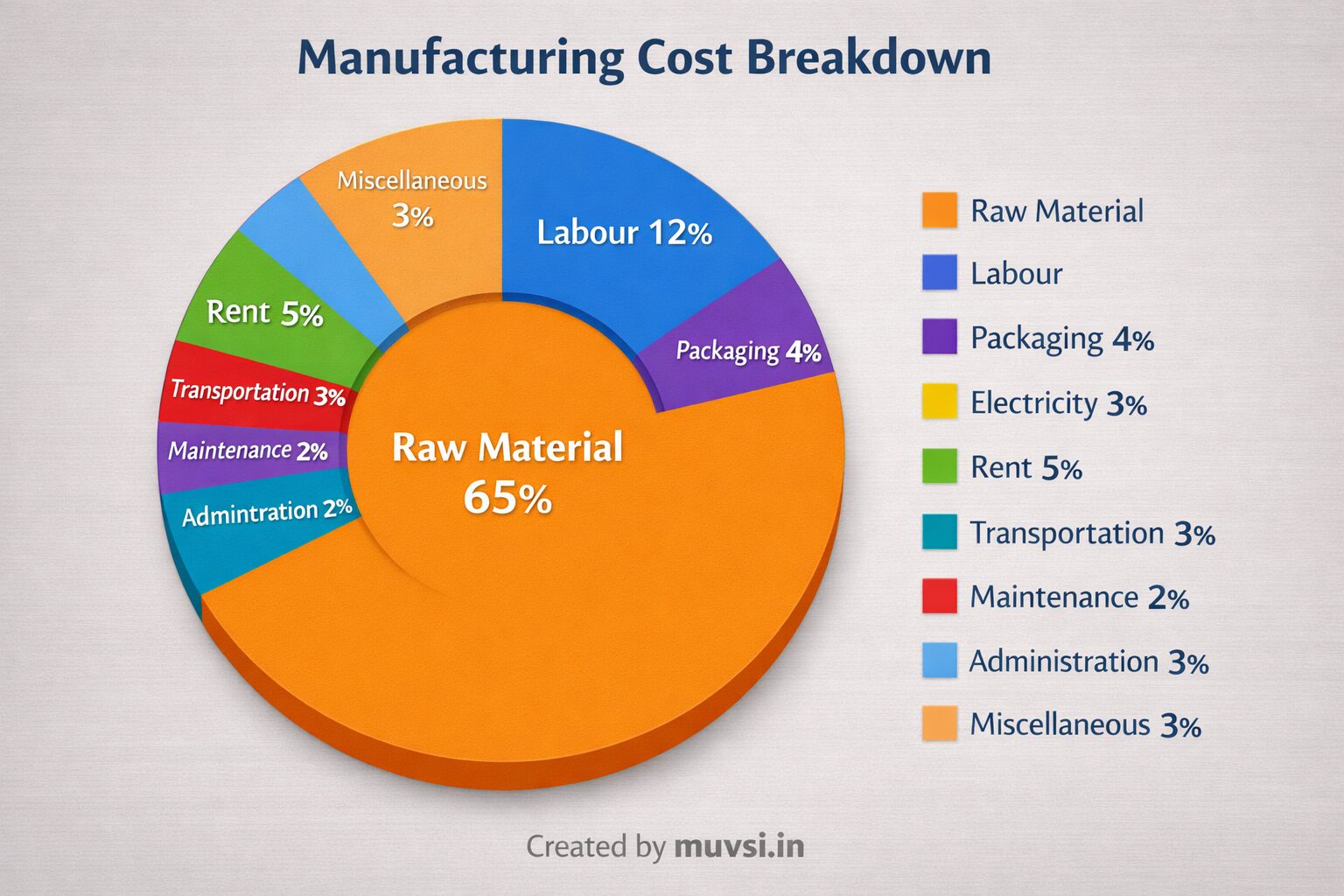
Estimating your manufacturing cost accurately is one of the most important steps before investing in a paper plate manufacturing business. Many entrepreneurs calculate only the raw material cost and ignore expenses such as electricity, labour, transportation, maintenance, packaging, and factory overheads. As a result, they overestimate their profits.
Your actual manufacturing cost per plate will depend on several factors, including the quality of paperboard, machine efficiency, production volume, labour productivity, and local operating expenses. The higher your production capacity utilisation, the lower your manufacturing cost per plate.
The following example illustrates the approximate monthly operating expenses for a small manufacturing unit producing around 1,00,000 paper plates per month.
Expense Head | Estimated Monthly Cost (₹) |
|---|---|
Raw Materials | 2,40,000 |
Labour | 45,000 |
Electricity | 12,000 |
Factory Rent | 18,000 |
Packaging | 15,000 |
Transportation | 12,000 |
Maintenance | 8,000 |
Administrative Expenses | 10,000 |
Miscellaneous | 10,000 |
Total Monthly Cost | ₹3,70,000 |
These figures are only indicative. Your actual costs may vary depending on your production capacity, business location, and raw material prices.
Use Our Manufacturing Profitability Calculator
Instead of relying on industry averages, calculate your own production cost using our free Manufacturing Profitability Calculator. It estimates manufacturing cost, cost per unit, monthly profit, annual profit, and break-even period based on your own business data.
Estimated Profit Margin in a Paper Plate Manufacturing Business
One of the most frequently asked questions is:
“How much profit can I earn from paper plate manufacturing?”
The honest answer is that there is no fixed number.
Your profitability depends on:
- Machine utilization
- Selling price
- Raw material cost
- Production efficiency
- Wastage percentage
- Customer mix
- Transportation expenses
Manufacturers selling directly to wholesalers generally work on thinner margins but achieve higher volumes. Businesses supplying premium printed or customised paper plates often earn better margins but may have lower production volumes.
Financial Indicator | Typical Range |
|---|---|
Gross Profit Margin | 25%–40% |
Net Profit Margin | 12%–20% |
Return on Investment | 20%–35% |
Break-even Period | 18–36 Months |
Rather than chasing unrealistic profit percentages, focus on increasing machine utilisation and building long-term wholesale customers. Consistent production usually generates better profits than occasional large orders.
Illustrative Monthly Profit Calculation
Particular | Amount (₹) |
|---|---|
Monthly Sales Revenue | 5,20,000 |
Total Manufacturing Cost | 3,70,000 |
Estimated Monthly Profit | 1,50,000 |
Estimated Annual Profit | 18,00,000 |
This example is only intended to illustrate the calculation method. Actual profits vary depending on production volume, selling price, and operating efficiency.
Reality Check
If someone promises that you’ll recover your entire investment in six months simply by purchasing a paper plate machine, be cautious. Sustainable manufacturing businesses are built through consistent sales, efficient production, and disciplined cost management—not unrealistic projections.
Break-even Analysis
The break-even point represents the period required to recover your initial investment through business profits.
For many small and medium paper plate manufacturing units, the break-even period generally falls between 18 and 36 months. Businesses with higher production efficiency, lower wastage, and strong sales networks often recover their investment more quickly.
Instead of focusing solely on increasing production, work towards improving machine utilisation and customer retention. Selling the same production capacity consistently is far more profitable than purchasing additional machinery prematurely.
My Advice on Profitability
If I were starting a paper plate manufacturing business today, my priority wouldn’t be buying the fastest machine available.
Instead, I would spend the first month identifying at least ten reliable wholesale customers who could place recurring orders. Once consistent demand is established, selecting the right machinery becomes much easier.
In manufacturing, sales determine production—not the other way around.
Many entrepreneurs believe production creates profits. In reality, production creates inventory. Customers create profits.
How to Market Your Paper Plate Manufacturing Business
Many entrepreneurs believe that manufacturing is the most difficult part of this business. In my experience, that’s only half the challenge. The real success of a paper plate manufacturing business depends on how effectively you build and maintain your customer network.
Paper plates are generally sold in bulk through wholesalers and distributors. This means your objective should be to secure repeat customers rather than one-time retail buyers.
Instead of waiting for customers to discover your business, actively approach local businesses that use disposable products every day.
Potential Customer | Buying Frequency |
|---|---|
Wholesalers | Very High |
Paper Product Distributors | Very High |
Restaurants | High |
Catering Companies | High |
Street Food Vendors | High |
Sweet Shops | Medium |
Retail Stores | Medium |
Hotels & Resorts | Medium |
Online Sellers | Growing |
Once you establish a few regular wholesale customers, your production planning becomes much easier, and your cash flow becomes more predictable.
My Advice:
Don’t try to sell everywhere. Become the preferred supplier for a few reliable distributors first. Long-term business relationships are more valuable than occasional large orders.
Marketing Strategies That Actually Work
Rather than spending heavily on advertising, focus on practical marketing methods that generate repeat business.
- Visit local wholesalers personally.
- Meet catering companies before the wedding season.
- Supply free product samples.
- Offer consistent product quality.
- Maintain timely deliveries.
- Provide competitive wholesale pricing.
- Create a Google Business Profile.
- List your products on IndiaMART and TradeIndia.
- Build relationships with food packaging distributors.
- Use WhatsApp Business to manage customer enquiries.
Most successful manufacturers grow through referrals rather than expensive advertising campaigns.
Common Mistakes to Avoid
Almost every manufacturing business faces challenges during its early stages. Avoiding the following mistakes can significantly improve your chances of success.
- Purchasing oversized machinery before confirming market demand.
- Ignoring working capital requirements.
- Buying low-quality raw materials to reduce costs.
- Depending on a single customer.
- Ignoring quality inspection.
- Keeping excessive finished stock.
- Competing only on price.
- Failing to maintain supplier relationships.
- Ignoring machine maintenance.
- Expanding production too quickly.
Reality Check:
Most manufacturing businesses fail because of poor cash flow—not because of poor machinery. Managing inventory, receivables, and operating expenses is just as important as production.
Is the Paper Plate Manufacturing Business Right for You?
Every business opportunity is not suitable for every entrepreneur. Before investing, honestly evaluate your strengths, financial capacity, and long-term goals.
This Business May Suit You If… | You May Want to Reconsider If… |
|---|---|
You enjoy manufacturing operations. | You expect passive income. |
You can build relationships with wholesalers. | You dislike sales and customer interaction. |
You have adequate working capital. | You are investing your entire savings without a backup plan. |
You are willing to learn production management. | You expect instant profits. |
You are planning for long-term growth. | You are looking for a short-term investment. |
Frequently Asked Questions
Is paper plate manufacturing profitable?
Yes. With efficient production, proper cost control, and a reliable customer base, the business can generate attractive long-term profits.
How much investment is required?
A small manufacturing unit generally requires an investment between ₹5 lakh and ₹18 lakh, depending on the machinery and production capacity.
Can I start this business from home?
Small manual operations may be possible from home, but commercial production is better suited to an industrial or commercial workspace.
What is the average profit margin?
Net profit margins typically range between 12% and 20%, although actual profitability depends on production efficiency and sales volume.
Which customers should I target first?
Wholesalers, distributors, caterers, restaurants, and food packaging suppliers generally provide the most consistent business opportunities.
Final Thoughts
The paper plate manufacturing business continues to offer opportunities for entrepreneurs who combine efficient production with disciplined business management. While the industry benefits from growing demand for disposable paper products, long-term success depends far more on customer acquisition, cost control, and operational efficiency than on machine capacity alone.
If I had to summarise this business in one sentence, it would be this:
Don’t buy a paper plate machine because demand exists somewhere in India. Buy one because you’ve identified customers in your market who are ready to purchase your products consistently.
Manufacturing creates products. Marketing creates customers. Sustainable businesses require both.
Useful Resources
- Manufacturing Profitability Calculator
- Paper Plate Making Machine Price Guide
- Paper Plate Machine Manufacturers & Suppliers
- Paper Plate Manufacturing Project Report
- Book a Business Consultation

Rupak Chakrabarty is the Founder and Lead Business Coach at MUVSI. With over two decades of experience in entrepreneurship, marketing, and business consulting, he helps aspiring entrepreneurs and MSMEs build profitable, market-driven businesses. His expertise includes business planning, B2B marketing, customer acquisition, and digital growth strategies.