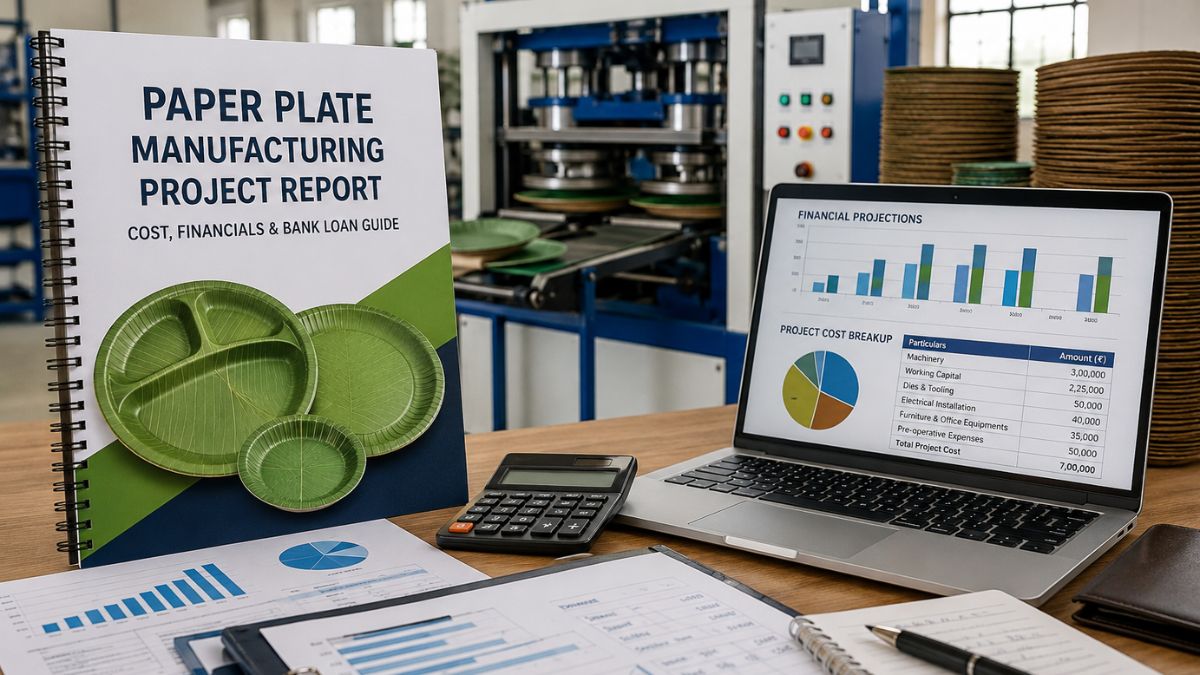
If you’re planning to start a paper plate manufacturing business, preparing a detailed project report should be one of your first priorities. A well-prepared project report helps you estimate the investment required, understand the financial viability of the business, plan production capacity, and evaluate expected profitability before committing your capital.
Many entrepreneurs assume that a project report is required only when applying for a bank loan. While lenders often ask for one, the real value of a project report lies in helping you make informed business decisions. It forces you to evaluate machinery costs, working capital requirements, operating expenses, sales projections, and potential risks before your business begins.
I’ve often seen first-time manufacturers focus almost entirely on the cost of the machine while overlooking the importance of cash flow. In reality, many manufacturing businesses struggle not because they purchased the wrong equipment, but because they underestimated the funds required to purchase raw materials, pay employees, and manage day-to-day operations during the first few months.
This guide explains what a paper plate manufacturing project report should include, the financial information generally expected by banks and financial institutions, estimated investment requirements, profitability assumptions, and the key factors you should analyse before investing in this business.
Whether you’re preparing a project report for your own planning or for a loan application, this article will help you understand the structure and purpose of a professionally prepared manufacturing project report.
What Is a Paper Plate Manufacturing Project Report?
A project report is a structured business document that evaluates the technical, operational, and financial feasibility of establishing a paper plate manufacturing unit. It combines market research, investment estimates, production planning, cost analysis, and financial projections into a single document that helps entrepreneurs and lenders assess whether the proposed business is commercially viable.
A professionally prepared project report is commonly used for:
- Applying for bank loans
- MSME financing
- Government subsidy schemes
- Investor presentations
- Business planning
- Estimating profitability
- Evaluating project feasibility
Even if you are self-financing your business, preparing a project report can significantly reduce investment mistakes by providing a realistic picture of the business before production begins.
Expert Insight
A project report should never be viewed as a document prepared solely for a bank manager. It should become the financial blueprint of your manufacturing business, helping you make informed decisions throughout the life of the project.
Contents of a Paper Plate Manufacturing Project Report
Although the exact format may vary depending on the bank, financial institution, or consultant preparing the report, a comprehensive paper plate manufacturing project report generally includes the following sections.
Section | Purpose |
|---|---|
Executive Summary | Overview of the proposed business |
Promoter Profile | Background of the entrepreneur |
Market Analysis | Industry demand and competition |
Product Details | Types and sizes of paper plates |
Manufacturing Process | Production workflow |
Machinery & Equipment | Machine specifications and cost |
Raw Materials | Paper rolls, laminated sheets, packaging |
Project Cost | Capital investment requirement |
Working Capital | Monthly operating expenses |
Financial Projections | Sales, profit and cash flow |
Break-even Analysis | Profitability assessment |
Risk Analysis | Business risks and mitigation |
Each section helps investors and lenders understand the technical and financial viability of the proposed manufacturing unit.
Estimated Paper Plate Manufacturing Project Cost
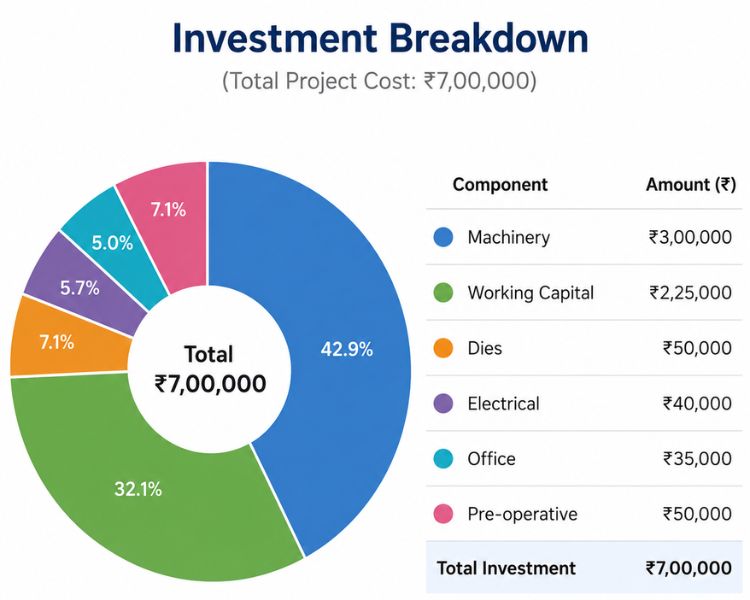
The investment required to establish a paper plate manufacturing unit depends on the production capacity, level of automation, factory location, and working capital requirements. The following table illustrates a sample investment for a small commercial manufacturing unit.
Particulars | Estimated Cost (₹) |
|---|---|
Paper Plate Making Machine | 3,00,000 |
Dies & Tooling | 50,000 |
Electrical Installation | 40,000 |
Furniture & Office Equipment | 35,000 |
Pre-operative Expenses | 50,000 |
Working Capital | 2,25,000 |
Total Project Cost | ₹7,00,000 |
Note: These figures are illustrative only. Actual investment varies depending on the machinery selected, production capacity, and local operating costs.
Working Capital Requirement
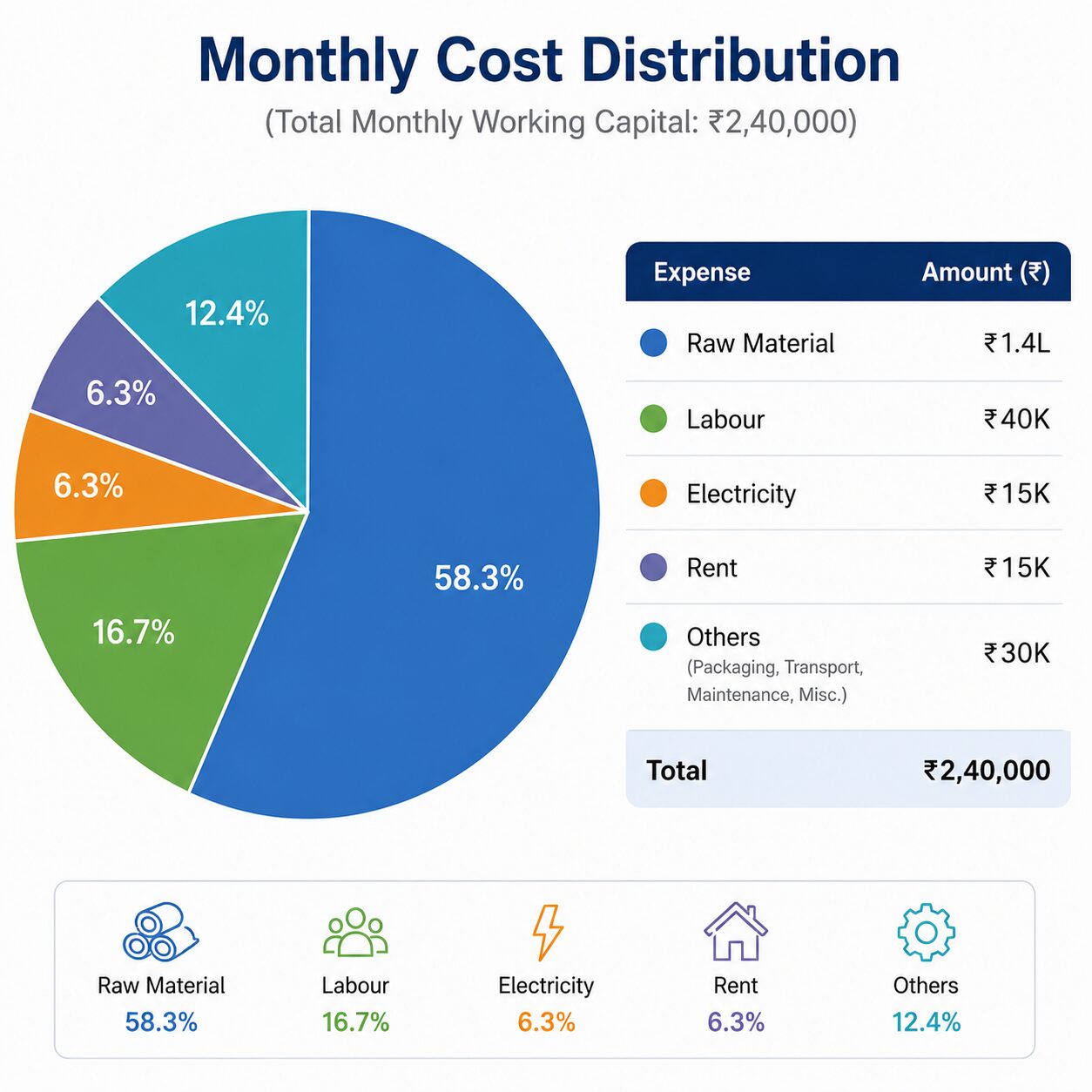
Working capital is one of the most underestimated components of a manufacturing project. While machinery is a one-time investment, working capital is required every month to keep production running smoothly.
Expense | Monthly Estimate (₹) |
|---|---|
Raw Materials | 1,40,000 |
Salaries & Wages | 40,000 |
Electricity | 15,000 |
Factory Rent | 15,000 |
Packaging | 8,000 |
Transportation | 10,000 |
Miscellaneous Expenses | 12,000 |
Total Working Capital | ₹2,40,000 |
Practical Tip
Many entrepreneurs arrange funds only for purchasing machinery. However, the business cannot operate without sufficient working capital to purchase raw materials and meet regular operating expenses. Always maintain enough liquidity to comfortably operate the business during the initial months.
Sample Financial Projections
A project report should include realistic financial assumptions rather than optimistic sales projections. Conservative estimates generally produce a more reliable assessment of the business.
Particulars | Estimated Value |
|---|---|
Monthly Production | 1,00,000 Plates |
Selling Price per Plate | ₹4.50 |
Monthly Revenue | ₹4,50,000 |
Monthly Operating Cost | ₹2,90,000 |
Monthly Profit | ₹1,60,000 |
Annual Profit | ₹19,20,000 |
Estimated Break-even | 4–5 Months |
These figures are intended only as an example. Actual profitability depends on production efficiency, selling price, raw material costs, and market demand.
Calculate Your Own Figures
Rather than relying on generic estimates, use our Manufacturing Profitability Calculator to prepare customised revenue, cost, profit, and break-even projections based on your own business assumptions.
Can This Project Report Be Used for a Bank Loan?
One of the most common questions entrepreneurs ask is whether a paper plate manufacturing project report can be submitted directly to a bank when applying for a business loan.
The answer depends on the lender and the size of the proposed project. Most banks expect a project report that contains realistic financial assumptions, detailed cost estimates, working capital calculations, projected financial statements, and information about the promoter. Some banks may also request supporting quotations for machinery and proof of your contribution towards the project cost.
This article is intended as an educational guide to help entrepreneurs understand what a project report typically contains. It is not a substitute for a customised project report prepared specifically for your proposed business.
Important
If you’re applying for an MSME loan or term loan, always confirm the documentation requirements with your bank before preparing or purchasing a project report. Requirements may vary between financial institutions.
Key Financial Ratios Included in a Project Report
A professionally prepared manufacturing project report generally includes several financial ratios that help evaluate the commercial viability of the business.
Financial Ratio | Purpose |
|---|---|
Break-even Point (BEP) | Determines when the business starts generating profit |
Return on Investment (ROI) | Measures profitability relative to investment |
Debt Service Coverage Ratio (DSCR) | Shows the ability to repay loan obligations |
Gross Profit Margin | Measures operational profitability |
Net Profit Margin | Indicates overall business performance |
Current Ratio | Evaluates short-term liquidity |
These ratios help lenders assess the financial strength of the proposed project and assist entrepreneurs in understanding the long-term sustainability of the business.
Common Reasons Project Reports Get Rejected
Even businesses with good market potential can face delays if the project report contains unrealistic assumptions or incomplete information. Some of the most common issues include:
- Overestimating monthly sales without supporting market research.
- Underestimating working capital requirements.
- Using outdated machinery prices or quotations.
- Ignoring electricity, labour, and transportation costs.
- Preparing unrealistic profit projections.
- Missing financial statements or cash flow projections.
- Incomplete promoter information.
- Lack of supporting quotations from machinery suppliers.
A realistic project report is generally more valuable than one that simply shows very high profits.
Expert Advice
Prepare your financial assumptions conservatively. It is better to exceed realistic projections after starting the business than to build a project report on overly optimistic estimates that may not be achievable.
Related Articles:
Frequently Asked Questions
What is a paper plate manufacturing project report?
It is a detailed business document that evaluates the technical, operational, and financial feasibility of establishing a paper plate manufacturing unit.
Is a project report mandatory for a bank loan?
Many banks require a project report when evaluating MSME and manufacturing loan applications, although the exact documentation requirements may vary.
What information should a project report include?
A comprehensive report generally includes project cost, machinery details, raw materials, market analysis, manufacturing process, working capital, projected financial statements, profitability analysis, and risk assessment.
Can I prepare my own project report?
Yes. Many entrepreneurs prepare their own reports for business planning. However, for loan applications, you should ensure the report meets your lender’s requirements and contains realistic financial projections.
How much investment is required for a paper plate manufacturing unit?
Investment varies depending on production capacity and automation level. Small commercial units may require between ₹5 lakh and ₹10 lakh, while larger automated plants require substantially higher capital.
How can I estimate profitability?
You can prepare realistic profitability estimates by calculating expected production, selling price, operating expenses, working capital, and break-even period. Our Manufacturing Profitability Calculator can help you perform these calculations.
Final Thoughts
A well-prepared paper plate manufacturing project report is much more than a document for obtaining finance. It serves as a roadmap that helps entrepreneurs understand investment requirements, evaluate risks, estimate profitability, and make informed business decisions before investing.
Whether you’re planning a small manufacturing unit or a larger commercial operation, take the time to prepare realistic financial assumptions and carefully evaluate every aspect of the business. A thoughtful project report can help prevent costly mistakes and improve the likelihood of building a sustainable manufacturing enterprise.
The quality of your planning often determines the quality of your business outcomes.
Need a detailed editable project report? We’re developing professionally structured project reports with financial projections, working capital estimates, profitability analysis, and editable spreadsheets for manufacturing businesses. Join our mailing list to be notified when they’re available.

Rupak Chakrabarty is the Founder and Lead Business Coach at MUVSI. With over two decades of experience in entrepreneurship, marketing, and business consulting, he helps aspiring entrepreneurs and MSMEs build profitable, market-driven businesses. His expertise includes business planning, B2B marketing, customer acquisition, and digital growth strategies.