Starting a paper plate manufacturing business is only half the journey. The real challenge begins after your first batch of paper plates comes off the production line. Without a steady flow of customers, even a well-equipped factory with efficient machines can struggle to generate consistent profits.
Many first-time entrepreneurs spend weeks comparing machines, negotiating prices, and arranging finance, but very little time planning how they will sell their products. As a result, they often discover that finding buyers is more difficult than manufacturing the plates themselves.
The good news is that disposable paper plates are used across a wide range of industries, from restaurants and catering companies to supermarkets, religious institutions, food vendors, and event organisers. The key is to identify the right customer segments and build long-term relationships rather than relying on occasional orders.
In this guide, I’ll share the most profitable places to sell paper plates in India, explain which buyers offer the best repeat business, and provide practical marketing strategies that can help you build a sustainable customer base.
Who Buys Paper Plates?
Paper plates are consumed by thousands of businesses every day. Unlike many manufactured products, demand comes from a wide variety of industries, making customer diversification easier if you develop an effective sales strategy.
The biggest advantage of the paper plate business is that many customers place repeat orders. Restaurants, caterers, wholesalers, and retailers require regular supplies, creating opportunities for recurring revenue rather than one-time sales.
Buyer Category | Purchase Frequency | Average Order Size | Repeat Business |
|---|---|---|---|
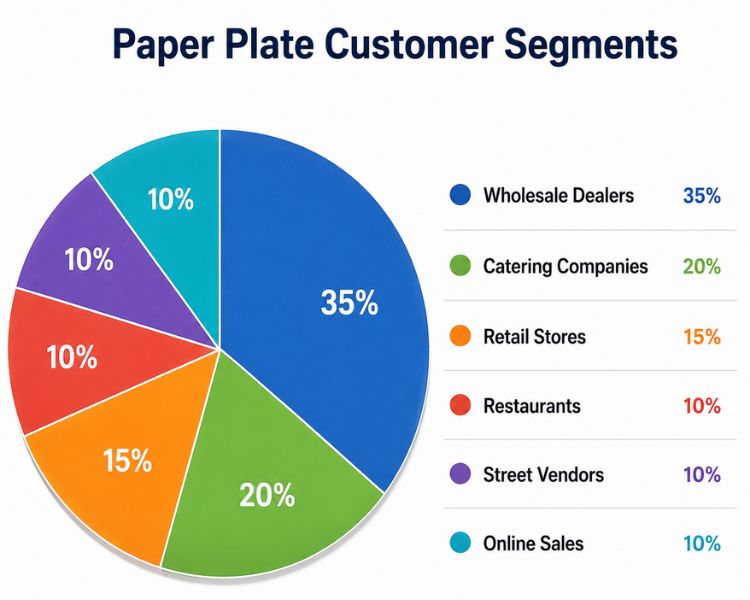
Wholesale Dealers | Very High | Large | ★★★★★ |
Caterers | High | Medium to Large | ★★★★★ |
Retail Stores | Regular | Medium | ★★★★☆ |
Restaurants | Regular | Medium | ★★★★☆ |
Street Food Vendors | Daily | Small | ★★★★★ |
Online Customers | Occasional | Small | ★★★☆☆ |
Rather than trying to serve every customer segment immediately, focus on building relationships with buyers who place repeat orders. A smaller number of loyal customers is generally more valuable than many one-time buyers.
1. Wholesale Disposable Products Dealers
Wholesale dealers are among the largest buyers of paper plates in India. They purchase products in bulk and supply them to retailers, supermarkets, catering suppliers, and small distributors across their region.
For new manufacturers, wholesalers can provide consistent monthly orders, reducing the need to manage hundreds of small customers.
Parameter | Details |
|---|---|
Order Size | Very Large |
Repeat Orders | Excellent |
Profit Margin | Medium |
Payment Cycle | 15–45 Days |
Difficulty Level | Medium |
How to Approach
- Visit wholesale markets personally.
- Carry product samples.
- Offer introductory pricing.
- Provide attractive bulk discounts.
- Ensure reliable delivery schedules.
My Advice
Don’t try to maximise profit on your first order. Focus on securing repeat monthly business. A dealer ordering every month is far more valuable than a customer who purchases once.
2. Catering Companies
Catering businesses consume thousands of disposable plates during weddings, corporate events, festivals, and social gatherings. They represent one of the most attractive customer segments because demand is recurring throughout the year.
Parameter | Details |
|---|---|
Order Size | Large |
Repeat Orders | ★★★★★ |
Seasonality | High during wedding seasons |
Profit Potential | High |
Build relationships with local caterers by offering consistent quality, competitive pricing, and reliable delivery. Once they trust your products, they often continue ordering for years.
3. Restaurants and Fast Food Outlets
Quick-service restaurants, cafés, snack bars, and takeaway outlets increasingly use disposable paper plates for serving customers. These businesses generally purchase smaller quantities than wholesalers but place regular repeat orders.
- Target local restaurants first.
- Offer customised plate sizes.
- Supply mixed carton quantities.
- Provide doorstep delivery.
Restaurants appreciate dependable suppliers who can replenish stock quickly whenever demand increases.
4. Street Food Vendors
Street food vendors represent one of the largest user groups for disposable paper plates. Chaat stalls, momo shops, pani puri vendors, dosa stalls, and Chinese food carts consume paper plates daily.
Advantages | Challenges |
|---|---|
Daily demand | Smaller order sizes |
Cash payments | Price sensitive |
Regular repeat business | Need frequent deliveries |
If you can efficiently serve multiple vendors within the same locality, this segment can generate dependable cash flow throughout the year.
5. Supermarkets and Grocery Stores
Retail stores sell disposable paper plates directly to households, especially during festivals, family gatherings, birthdays, and picnics. Although individual stores order smaller quantities, building a network of retailers can create stable monthly sales.
Ensure your products are attractively packaged and clearly labelled. Consumers often choose products that appear clean, food-safe, and professionally packed.
Selling Tip
Retailers are more willing to stock new brands when attractive packaging is combined with competitive dealer margins and dependable supply.
6. Marriage Halls and Banquet Venues
Marriage halls, banquet venues, and convention centres regularly host weddings, receptions, birthday parties, and corporate events. Many of these venues either purchase disposable paper plates directly or recommend suppliers to catering companies.
Parameter | Details |
|---|---|
Order Size | Large |
Repeat Business | ★★★★☆ |
Payment Method | Monthly / Event Based |
Best Selling Products | Large Dinner Plates |
Building relationships with venue managers can generate regular referrals to caterers and event organisers.
7. Sweet Shops and Bakeries
Sweet shops and bakeries frequently use paper plates for serving snacks, sweets, cakes, and fast-moving takeaway items. Demand remains steady throughout the year and usually increases during festive seasons.
- Offer multiple plate sizes.
- Supply small quantities frequently.
- Provide attractive dealer pricing.
- Ensure consistent product quality.
8. Tea Stalls and Juice Shops
Small food businesses often purchase disposable paper plates every week. While individual order values are relatively low, they usually pay in cash and become long-term repeat customers.
If your factory serves a city or district, creating delivery routes that cover dozens of small outlets can become a profitable sales channel.
9. Cloud Kitchens and Food Delivery Businesses
The rapid growth of online food delivery has increased demand for disposable serving products. Many cloud kitchens use paper plates for specific food items, promotional events, or catering orders.
Advantages | Challenges |
|---|---|
Growing market | High quality expectations |
Repeat orders | Competitive pricing |
Bulk purchases | Fast delivery required |
10. Hotels and Resorts
Hotels occasionally purchase paper plates for outdoor events, room service, staff cafeterias, and special functions. Larger hotels usually purchase through procurement departments or authorised distributors.
Approach hotels with professionally printed brochures, product samples, and clearly defined pricing.
11. Schools and Colleges
Educational institutions require disposable paper plates during annual functions, sports events, cultural programmes, seminars, and student celebrations.
Although purchases may be seasonal, institutions often place large bulk orders when organising events.
12. Religious Institutions
Temples, mosques, churches, gurudwaras, and charitable organisations frequently organise community meals and religious gatherings where disposable paper plates are widely used.
These institutions usually value dependable supply, hygienic products, and reasonable pricing over premium branding.
13. NGOs and Community Organisations
Non-government organisations conducting relief programmes, awareness campaigns, health camps, and community events often require disposable serving products.
Networking with local NGOs can generate periodic bulk orders while also increasing your business visibility within the community.
14. Corporate Offices
Many offices purchase disposable paper plates for meetings, employee celebrations, training programmes, and office cafeterias. Corporate buyers generally prefer professional suppliers capable of issuing GST invoices and maintaining consistent quality.
15. Government Departments and Tenders
Government departments, municipal bodies, educational institutions, and public sector organisations periodically procure disposable products through quotations or tender processes.
If your business has adequate production capacity and complies with applicable registration requirements, participating in government procurement can provide substantial business opportunities.
Expert Advice
Don’t depend on a single customer segment. A healthy paper plate business typically serves a mix of wholesalers, retailers, caterers, institutional buyers, and small businesses. Diversifying your customer base reduces risk if demand slows in one sector.
Customer Priority Matrix
If you’re just starting your paper plate business, focus on customer segments that combine repeat orders with manageable competition.
Customer | Profit Potential | Repeat Orders | Difficulty | Recommended |
|---|---|---|---|---|
Catering Companies | ★★★★★ | ★★★★★ | Medium | ⭐⭐⭐⭐⭐ |
Wholesale Dealers | ★★★★☆ | ★★★★★ | Medium | ⭐⭐⭐⭐⭐ |
Restaurants | ★★★★☆ | ★★★★☆ | Easy | ⭐⭐⭐⭐☆ |
Retail Stores | ★★★☆☆ | ★★★★☆ | Easy | ⭐⭐⭐⭐☆ |
Street Food Vendors | ★★★☆☆ | ★★★★★ | Easy | ⭐⭐⭐⭐☆ |
Online Sales | ★★★☆☆ | ★★★☆☆ | High | ⭐⭐⭐☆☆ |
For most new entrepreneurs, catering companies and wholesale dealers offer the fastest path to consistent monthly revenue. Once you’ve established a reliable production and delivery system, you can gradually expand into retail and institutional markets.
Sell Paper Plates Online
While offline sales remain the primary revenue source for most paper plate manufacturers, online marketplaces can help you reach customers outside your local area. Selling online also allows you to test new products, attract retail buyers, and build your own brand.
Amazon
Amazon is suitable for selling small retail packs directly to consumers. Attractive packaging, competitive pricing, and positive customer reviews can help generate consistent sales.
Flipkart
Flipkart offers another opportunity to reach household buyers looking for disposable tableware. Festival seasons often bring increased demand for paper plates.
IndiaMART
IndiaMART is one of the most effective platforms for B2B manufacturers. It connects suppliers with wholesalers, retailers, caterers, hotels, and institutional buyers looking to purchase in bulk.
Your Own Website
A business website helps establish credibility and allows potential buyers to learn about your products, manufacturing capacity, certifications, and contact information. Even if most of your sales happen offline, a professional website makes your business easier to discover through Google.
My Advice
Don’t depend entirely on online marketplaces. The most successful paper plate manufacturers usually combine local dealer networks with digital marketing to create multiple sources of revenue.
10 Proven Marketing Strategies to Increase Paper Plate Sales
Finding buyers requires more than simply offering competitive prices. These practical strategies can help you build a stronger customer base and generate repeat business.
- Distribute free product samples to wholesalers, caterers, restaurants, and retailers.
- Create a WhatsApp product catalogue with prices, sizes, and packaging options.
- Register your business on Google Business Profile to attract local buyers.
- Visit wholesale markets regularly instead of waiting for enquiries.
- Offer attractive introductory discounts for first-time buyers.
- Provide consistent product quality to encourage repeat orders.
- Develop relationships with distributors rather than relying only on direct retail sales.
- Participate in local trade fairs and exhibitions to showcase your products.
- Use social media to share factory photos, customer testimonials, and new product launches.
- Reward loyal customers with volume discounts or priority delivery.
Offline vs Online Selling
Factor | Offline Sales | Online Sales |
|---|---|---|
Order Size | Large | Small to Medium |
Repeat Business | Excellent | Moderate |
Profit Margin | Higher | Lower after platform fees |
Customer Reach | Local & Regional | Nationwide |
Marketing Cost | Lower | Higher |
For most small manufacturers, offline sales through wholesalers, distributors, and catering companies remain the most profitable channel. Online marketplaces should be viewed as an additional source of revenue rather than the primary sales strategy.
Common Mistakes When Selling Paper Plates
Many new manufacturers struggle to grow because they repeat the same avoidable mistakes.
- Depending on a single customer.
- Competing only on price.
- Ignoring product quality.
- Not following up with potential buyers.
- Providing inconsistent delivery schedules.
- Poor packaging and branding.
- Ignoring digital marketing opportunities.
- Failing to build long-term customer relationships.
- Offering excessive credit without proper evaluation.
- Ignoring customer feedback.
Business Coaching Tip
The strongest paper plate businesses are built on repeat customers—not one-time sales. Focus on reliability, consistent quality, and timely delivery, and your existing customers will become your best source of future business.
Frequently Asked Questions
Who are the biggest buyers of paper plates?
Wholesale dealers, catering companies, restaurants, retailers, event organisers, and institutional buyers are among the largest consumers of disposable paper plates.
Is selling paper plates profitable?
Yes, provided you maintain consistent quality, control production costs, and build a reliable network of repeat buyers.
Can I sell paper plates online?
Yes. Platforms such as Amazon, Flipkart, and IndiaMART allow manufacturers to reach retail and wholesale customers across India.
Should I sell directly to retailers or wholesalers?
New manufacturers generally find wholesalers easier to manage because they purchase larger quantities and place repeat orders. As your business grows, you can gradually expand into direct retail and institutional sales.
How do I get my first customers?
Start by visiting local wholesale markets, distributing product samples, approaching catering companies, registering your business online, and networking with retailers and food businesses in your area.
Final Thoughts
Manufacturing paper plates is only one part of building a successful business. Your long-term success depends on creating a reliable sales network that generates repeat orders month after month. Instead of chasing hundreds of one-time customers, focus on developing strong relationships with wholesalers, caterers, retailers, and institutional buyers who value consistent quality and dependable service.
As your customer base expands, continue investing in product quality, efficient production, and professional marketing. A steady stream of repeat buyers will make your business far more resilient than relying solely on price competition.
In the paper plate business, the best manufacturer isn’t always the one with the biggest factory—it’s the one with the strongest customer network.
Continue Your Business Planning
If you’re still planning your paper plate manufacturing business, don’t miss these helpful resources:
- How to Start a Paper Plate Manufacturing Business
- Paper Plate Machine Price Guide
- Paper Plate Manufacturing Project Report
- Manufacturing Profitability Calculator
Need Help Starting Your Paper Plate Business?
Planning a manufacturing business involves much more than purchasing a machine. Choosing the right production capacity, estimating costs, preparing a realistic project report, and finding reliable buyers can significantly influence your success.
At MUVSI, we help aspiring entrepreneurs with practical manufacturing guidance, profitability calculators, machine directories, and business planning resources to make informed investment decisions.

Rupak Chakrabarty is the Founder and Lead Business Coach at MUVSI. With over two decades of experience in entrepreneurship, marketing, and business consulting, he helps aspiring entrepreneurs and MSMEs build profitable, market-driven businesses. His expertise includes business planning, B2B marketing, customer acquisition, and digital growth strategies.